

Your Success, Our Mission!
6000+ Careers Transformed.
We’ve all experienced the magic of opening an app and finding exactly what we wanted — sometimes even before we searched for it. Behind this magic, a Recommendation System processes millions of data points and predicts what you might like next, based on what it has learned about you and other users.
At its heart, a recommender system is a mapping function:

It estimates how much a user will like a particular item.
Higher scores indicate a stronger likelihood of recommendation.
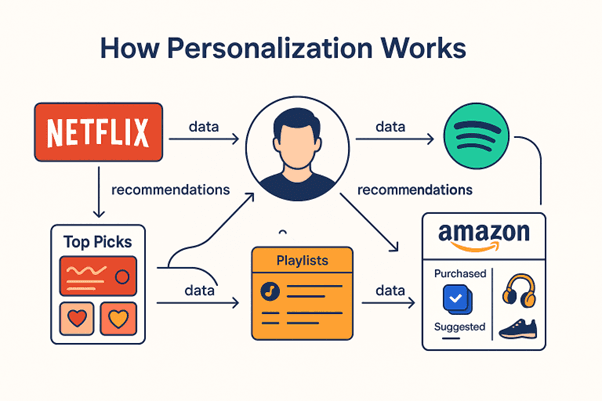
All recommendation systems begin with a User–Item Matrix:
| User | Movie A | Movie B | Movie C | Movie D |
|---|---|---|---|---|
| U1 | 5 | 4 | ? | ? |
| U2 | 3 | ? | 4 | 2 |
| U3 | ? | 5 | 5 | ? |
Rows = users
Columns = items
Values = explicit ratings or implicit behaviors
“?” = unknown ratings that the system needs to predict
The goal is to fill in these missing values to make personalized recommendations.
Recommendation systems follow a machine learning pipeline:
Data Collection → Gather historical interactions (clicks, purchases, likes).
Preprocessing → Handle missing values, encode users/items numerically.
Pattern Extraction → Find similarities or learn embeddings.
Prediction → Estimate unseen ratings or generate rankings.
Evaluation → Compare recommendations against actual user behavior to refine the model.
import pandas as pd
import numpy as np
ratings = pd.DataFrame({
   'User': ['U1', 'U1', 'U2', 'U2', 'U3', 'U3'],
   'Movie': ['A', 'B', 'A', 'C', 'B', 'C'],
   'Rating': [5, 4, 3, 4, 5, 5]
})
# Pivot the data to create a user-item matrix
matrix = ratings.pivot_table(index='User', columns='Movie', values='Rating')
print("User-Item Rating Matrix:\n", matrix.fillna(0))
Output:
Movie    A    B    C
User
U1      5.0  4.0  0.0
U2      3.0  0.0  4.0
U3      0.0  5.0  5.0
Each row captures a user’s behavior pattern.
Missing entries (0.0) are where the system predicts new preferences.
The recommender’s main goal is to predict missing ratings as accurately as possible. Methods include:
Collaborative Filtering → based on similar users
Content-Based Filtering → based on item features
Matrix Factorization → discovers latent factors
Neural Networks / Deep Learning → learns complex patterns
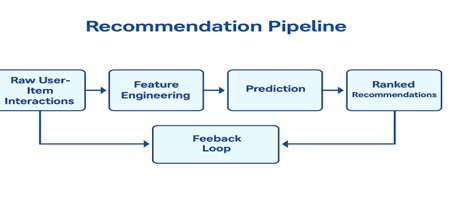
Captures the end-to-end workflow from raw data to personalized output.
Tracks listening history, skips, playlist additions, and even the time of day a user listens.
Builds embeddings representing your musical fingerprint.
Recommends songs whose embeddings are closest to yours in vector space.
Recommenders predict missing user-item interactions.
Data is represented as a matrix of ratings or behaviors.
The system learns patterns, predicts scores, and continuously refines results.
Collaborative, content-based, or hybrid models can be applied depending on the use case.
Top Tutorials

Python
Python is a popular and versatile programming language used for a wide variety of tasks, including web development, data analysis, artificial intelligence, and more.

SQL
The SQL for Beginners Tutorial is a concise and easy-to-follow guide designed for individuals new to Structured Query Language (SQL). It covers the fundamentals of SQL, a powerful programming language used for managing relational databases. The tutorial introduces key concepts such as creating, retrieving, updating, and deleting data in a database using SQL queries.

Data Science
Learn Data Science for free with our data science tutorial. Explore essential skills, tools, and techniques to master Data Science and kickstart your career

 in Bengaluru, India



All Courses (6)
Master's Degree (2)
Professional Certifications (4)
Ideal for working professionals and graduates
Outcomes: 5-40 LPA Job + Masters Degree

 What is a Recommendation System?

 in Bengaluru, India