
Your Success, Our Mission!
6000+ Careers Transformed.
Recommendation systems are not one-size-fits-all. Based on the approach used to generate recommendations, they are broadly classified into:
Content-Based Filtering (CBF)
Collaborative Filtering (CF)
Hybrid Approaches
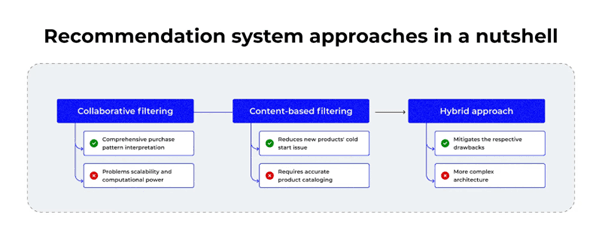
Each type has unique logic, strengths, weaknesses, and application scenarios.
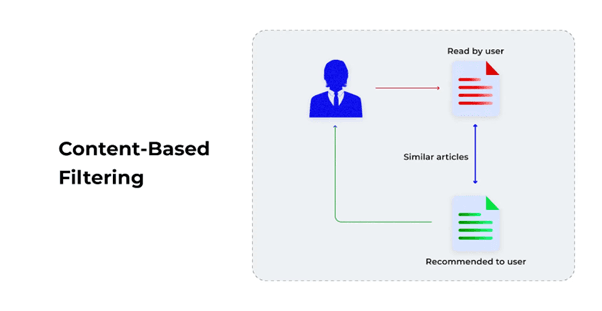
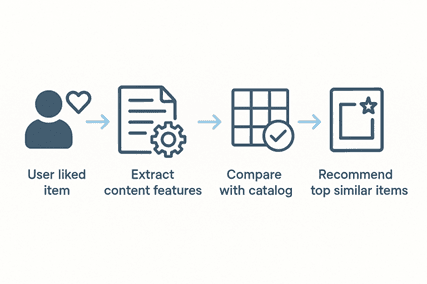
Content-Based Filtering focuses on analyzing the properties of items that a user has previously interacted with and recommending items that are similar in features.
Key Idea:
A system builds a profile for each user based on the attributes of items they like.
Recommends items with matching attributes.
Example: If a user likes “Inception” (a sci-fi, dream, action film), the system identifies other movies with similar textual or categorical features and recommends them.
Step-by-Step Process:
1. Feature Extraction → Convert item attributes (genre, tags, keywords) into numeric vectors.
2. User Profile Creation → Aggregate features from items the user interacted with.
3. Similarity Calculation → Compare other items with user profile using similarity metrics (cosine similarity, Euclidean distance).
4. Recommendation Generation → Rank items based on similarity and recommend the top-N items.
Python Example:
from sklearn.feature_extraction.text import TfidfVectorizer
from sklearn.metrics.pairwise import cosine_similarity
import pandas as pd
# Sample movie dataset
movies = pd.DataFrame({
   'Movie': ['Inception', 'Interstellar', 'Avatar', 'The Dark Knight'],
   'Description': [
       'dream mind-bending sci-fi',
       'space travel time black hole',
       'alien world humans sci-fi',
       'superhero vigilante dark city'
   ]
})
# Convert textual features to vectors
tfidf = TfidfVectorizer()
tfidf_matrix = tfidf.fit_transform(movies['Description'])
# Compute similarity between movies
cos_sim = cosine_similarity(tfidf_matrix)
# Recommend movies similar to Inception (index 0)
idx = 0
similar_movies = list(enumerate(cos_sim[idx]))
similar_movies = sorted(similar_movies, key=lambda x: x[1], reverse=True)[1:3]
print("Movies similar to Inception:")
for i, score in similar_movies:
   print(f"- {movies['Movie'][i]} (Similarity: {score:.2f})")
Output:
Movies similar to Inception:
- Avatar (Similarity: 0.34)
- Interstellar (Similarity: 0.29)
Advantages of Content-Based Filtering:
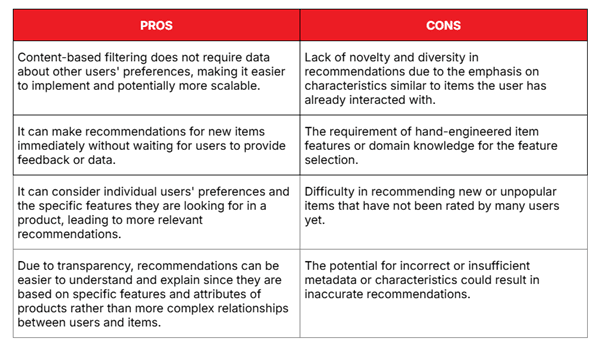
- Works for new users if item features are known.
- Recommendations are explainable, which improves user trust.
- Captures fine-grained preferences for specific item types.
Limitations:
- Limited novelty: tends to recommend very similar items repeatedly.
- Requires descriptive metadata for every item.
- Does not leverage knowledge from other users’ behaviors.
Real-World Applications:
Spotify → recommends songs based on genre, tempo, mood of previously liked songs.
Amazon → recommends products similar to what you bought before.
Netflix → suggests movies with similar genres, casts, or storylines.
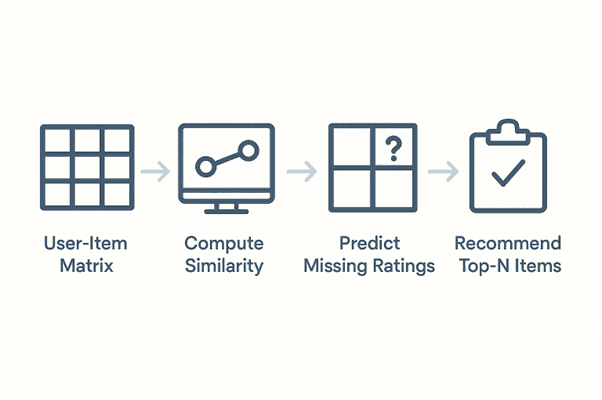
Graphical Representation (Conceptual):
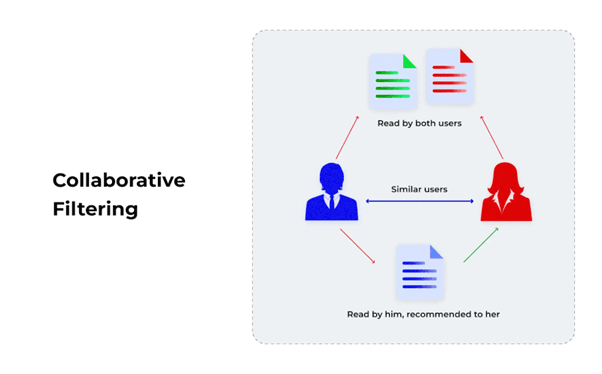
Collaborative Filtering leverages the wisdom of the crowd. It assumes that users with similar preferences in the past will like similar items in the future.
Key Idea:
CF does not require item content.
Recommendations are based on user behavior similarity or item similarity.
Types:
1. User-Based CF → find users similar to target user, recommend what they liked.
2. Item-Based CF → find items similar to those the user liked, recommend those.
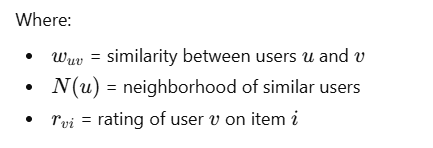
Mathematical Foundation (User-Based CF):

Python Example: User-Based Collaborative Filtering
import numpy as np
from sklearn.metrics.pairwise import cosine_similarity
# User-Item ratings matrix
ratings = np.array([
   [5, 4, 0],
   [3, 0, 4],
   [0, 5, 5]
])
# Compute user similarity
user_similarity = cosine_similarity(ratings)
print(np.round(user_similarity, 2))
Output:
[[1.   0.73 0.66]
[0.73 1.   0.72]
[0.66 0.72 1.  ]]
Users 1 and 2 have a similarity of 0.73, showing closely aligned preferences.
Advantages of Collaborative Filtering:
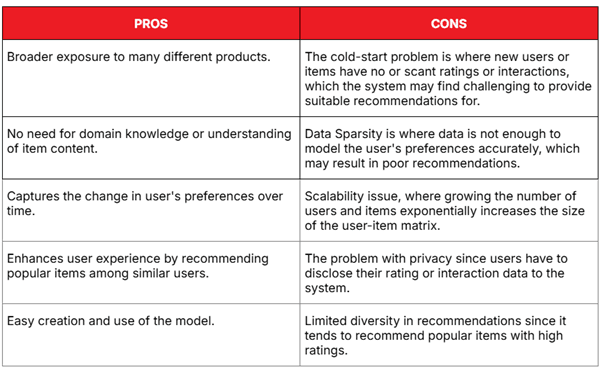
- Captures complex, hidden patterns in user behavior.
- Learn from real user interactions, independent of item features.
- Can recommend items that the user might not have discovered on their own.
Limitations:
- Cold Start Problem: new users or items have insufficient data.
- Requires a large user base and dense interactions for high accuracy.
- Sparse datasets can reduce prediction quality.
Real-World Applications:
Netflix → recommends movies liked by similar users.
YouTube → suggests videos watched by users with similar viewing patterns.
Amazon → “Customers who bought this also bought…”
Graphical Representation (Conceptual):
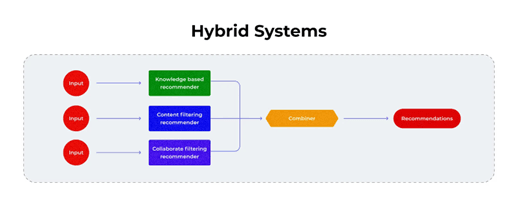
Hybrid systems combine Content-Based Filtering and Collaborative Filtering to overcome the weaknesses of each approach.
Key Idea:
Merge content features and user interaction data to generate recommendations.
Can be implemented using weighted methods, switching methods, or deep learning embeddings.
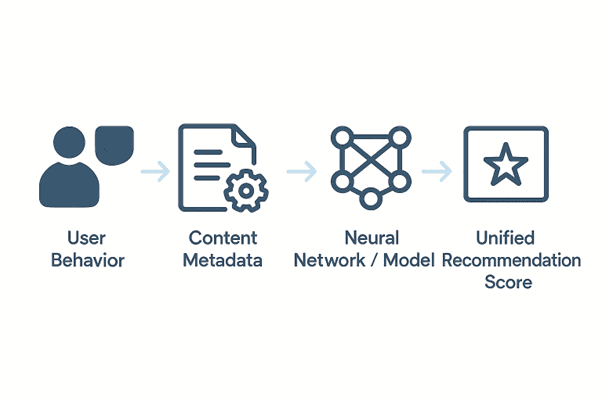
How It Works (Example – Netflix):
Content Features → genre, cast, duration, storyline keywords
Collaborative Data → user watch history, ratings, viewing habits
Model Integration → deep learning architecture merges embeddings from content and user latent vectors
Recommendation Score → unified score ranks items for recommendation
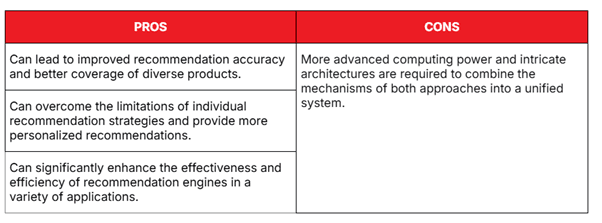
Advantages of Hybrid Systems:
- More accurate and robust recommendations.
- Mitigates cold-start problems.
- Captures both user preferences and item characteristics.
Limitations:
- Requires more computation and storage.
- Complex to design and maintain.
- Requires tuning multiple models to optimize performance.
Real-World Applications:
Netflix → blends content-based similarity with collaborative filtering from other users.
Amazon → merges product features with user purchase patterns.
Spotify → combines user listening behavior and song audio features.
Graphical Representation (Conceptual):
Top Tutorials

Python
Python is a popular and versatile programming language used for a wide variety of tasks, including web development, data analysis, artificial intelligence, and more.

SQL
The SQL for Beginners Tutorial is a concise and easy-to-follow guide designed for individuals new to Structured Query Language (SQL). It covers the fundamentals of SQL, a powerful programming language used for managing relational databases. The tutorial introduces key concepts such as creating, retrieving, updating, and deleting data in a database using SQL queries.

Data Science
Learn Data Science for free with our data science tutorial. Explore essential skills, tools, and techniques to master Data Science and kickstart your career

 in Bengaluru, India



All Courses (6)
Master's Degree (2)
Professional Certifications (4)
Ideal for working professionals and graduates
Outcomes: 5-40 LPA Job + Masters Degree

 What is a Recommendation System?
 in Bengaluru, India