

Your Success, Our Mission!
6000+ Careers Transformed.
Artificial Neural Networks (ANNs) are powerful tools for learning patterns in numerical and tabular data, but they are not designed to handle images effectively. The core reason lies in how ANNs process inputs. An image has spatial structure — neighboring pixels together form edges, shapes, textures, and meaningful visual patterns. However, a typical ANN does not understand this spatial relationship.
To feed an image into an ANN, we first flatten it into a long one-dimensional vector. For example, a 28 × 28 grayscale image becomes 784 individual numbers. The ANN then treats each of these 784 pixels as if they are unrelated. This completely breaks the natural structure of the image. Two pixels that are side by side in the original picture — forming a curve or an edge — become just two distant elements in a list.
This flattening leads to several problems:
This is why standard ANNs struggle with visual tasks such as classification, object detection, and recognition.
Here Comes the Magic of CNNs:
When your phone unlocks using Face ID or when Google Photos automatically groups pictures of the same person — the model behind the scenes is a Convolutional Neural Network (CNN).
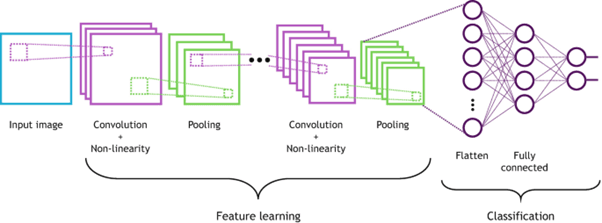
CNNs were created specifically to overcome the limitations of ANNs with visual data. Instead of flattening images, CNNs analyze them in small patches using convolution operations, allowing the network to learn spatial hierarchies:
Because CNNs preserve spatial relationships, they have become the backbone of modern computer vision — powering applications from medical imaging to autonomous vehicles.
Top Tutorials

Python
Python is a popular and versatile programming language used for a wide variety of tasks, including web development, data analysis, artificial intelligence, and more.

SQL
The SQL for Beginners Tutorial is a concise and easy-to-follow guide designed for individuals new to Structured Query Language (SQL). It covers the fundamentals of SQL, a powerful programming language used for managing relational databases. The tutorial introduces key concepts such as creating, retrieving, updating, and deleting data in a database using SQL queries.

Data Science
Learn Data Science for free with our data science tutorial. Explore essential skills, tools, and techniques to master Data Science and kickstart your career

 in Bengaluru, India



All Courses (6)
Master's Degree (2)
Professional Certifications (4)
Ideal for working professionals and graduates
Outcomes: 5-40 LPA Job + Masters Degree

 The Limitations of ANNs


 in Bengaluru, India