
Your Success, Our Mission!
6000+ Careers Transformed.
A coffee shop owner tracks daily earnings:
[100, -50, 200, -30, 150, -20, 300]
Some days are great, some are bad.
But the owner isn’t interested in just one day.
He wants to know:
“Which continuous stretch of days gave me the highest profit?”
Not random days.
Not scattered choices.
Only continuous days.
That’s exactly what a subarray is.
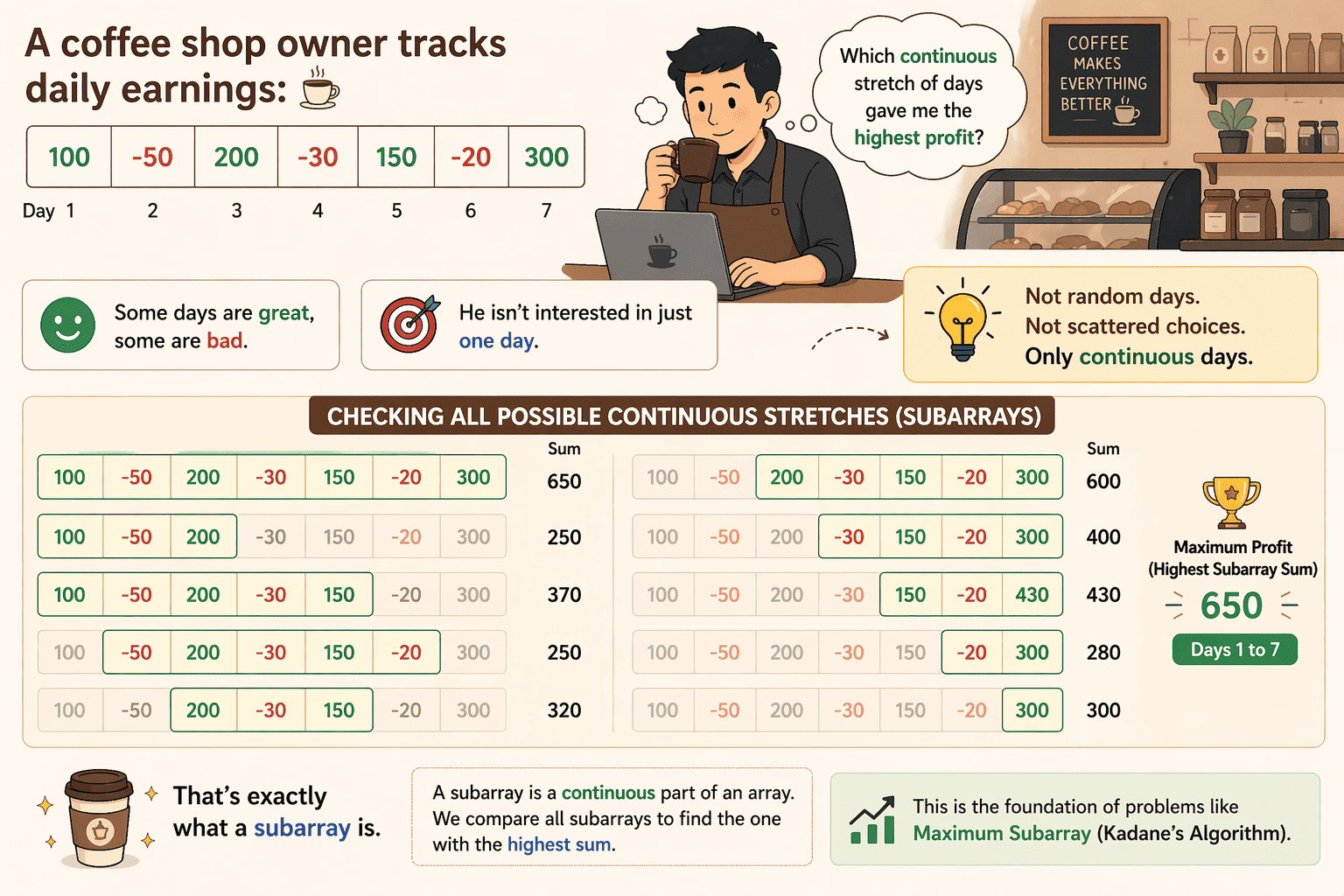
A subarray is a continuous part of an array.
| Array: [1, 2, 3, 4] Subarrays: [1], [2], [3], [4] [1,2], [2,3], [3,4] [1,2,3], [2,3,4] [1,2,3,4] |
Important:
You try every possible subarray and calculate the sum.
| def max_subarray_brute(arr): max_sum = float('-inf') for i in range(len(arr)): for j in range(i, len(arr)): current_sum = sum(arr[i:j+1]) max_sum = max(max_sum, current_sum) return max_sum |
Problem:
Kadane’s Algorithm (The Smart Insight)
Instead of checking everything, we think smart:
“If the current sum becomes negative, drop it!”
Because a negative sum will only reduce future profit.
Concept - Maximum Subarray Sum
| def kadane(arr): current_sum = arr[0] max_sum = arr[0] for num in arr[1:]: current_sum = max(num, current_sum + num) max_sum = max(max_sum, current_sum) return max_sum |
Technical Example:
Input:
[-2, 1, -3, 4, -1, 2, 1, -5, 4]
Output:
6 → subarray [4, -1, 2, 1]
Real-Life Insight:
This is optimization thinking
Sliding Window (Fixed Size Subarrays)
Sometimes interviewer asks:
“Find maximum sum of subarray of size k”
Example:
| [2, 1, 5, 1, 3, 2], k = 3 |
Concept - Window Moves Forward
| def max_sum_k(arr, k): window_sum = sum(arr[:k]) max_sum = window_sum for i in range(k, len(arr)): window_sum += arr[i] - arr[i-k] max_sum = max(max_sum, window_sum) return max_sum |
Time Complexity = O(n)
Real-Life Example:
Finding the best 3-day sales period without recalculating everything.
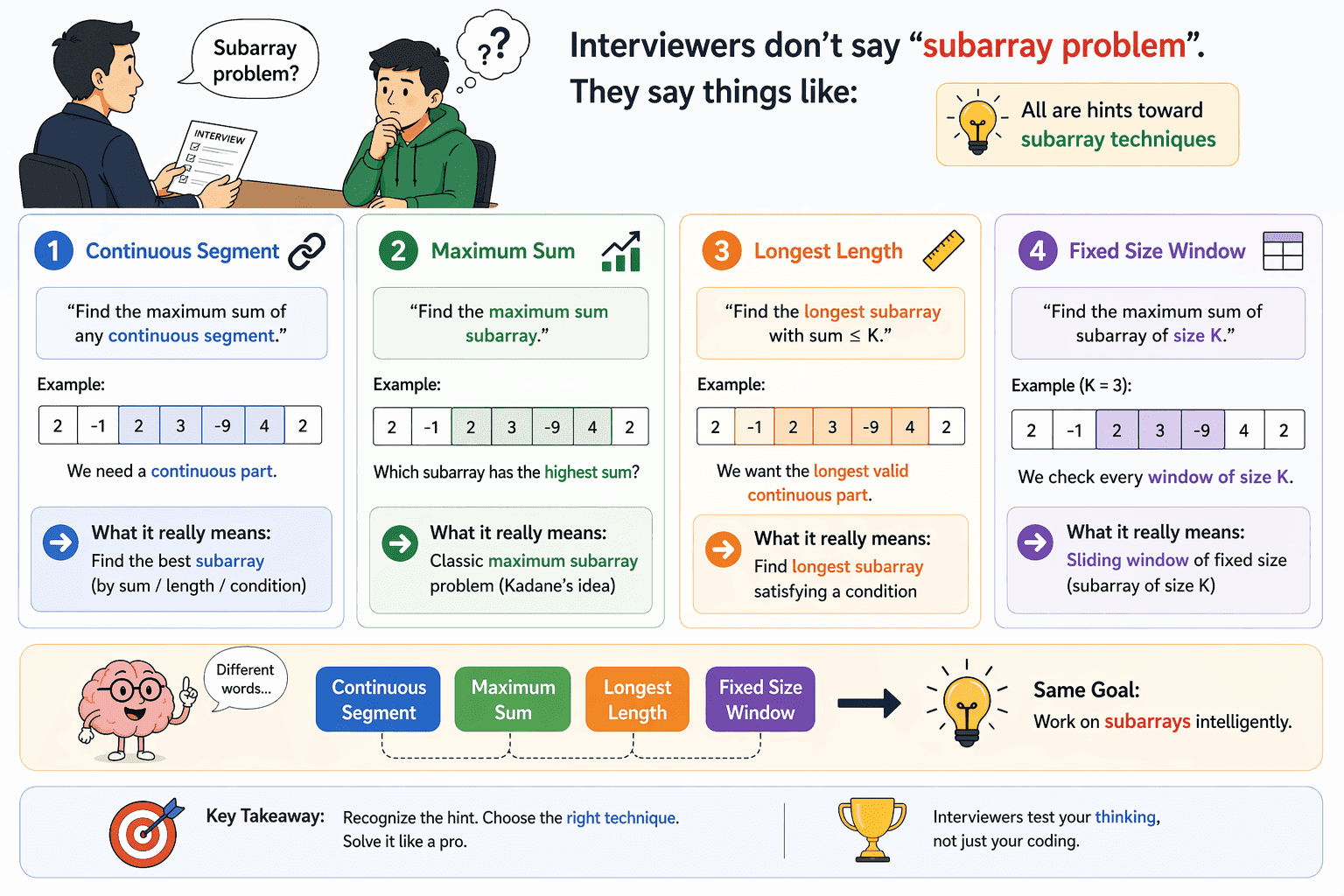
Interviewers don’t say “subarray problem”.
They say things like:
All are hints toward subarray techniques
Top Tutorials

Top 10 Machine Learning Projects with Source Code (Beginner to Advanced)
Explore the Top 10 Machine Learning projects with source code, from beginner to advanced. Learn real-world ML applications, build portfolio-ready projects, and master hands-on skills with step-by-step tutorials from AlmaBetter.

Technologies to Learn in 2026: Building the Future of Innovation
Explore the top technologies to learn in 2026 including Generative AI, Cloud, Cybersecurity, Web3, Data Science, AR/VR, Quantum, RPA, and Green Tech.

aws
This tutorial presents a structured, beginner-focused yet industry-aligned guide to Amazon Web Services, designed specifically for 2026 learning and career requirements

 in Bengaluru, India



All Courses (6)
Master's Degree (2)
Fellowship (2)
Certifications (2)

 Subarray Problems


 in Bengaluru, India