

Your Success, Our Mission!
6000+ Careers Transformed.
From each page, you keep reading forward
Count how many times you get distracted
If distractions exceed K → you stop and restart from the next page
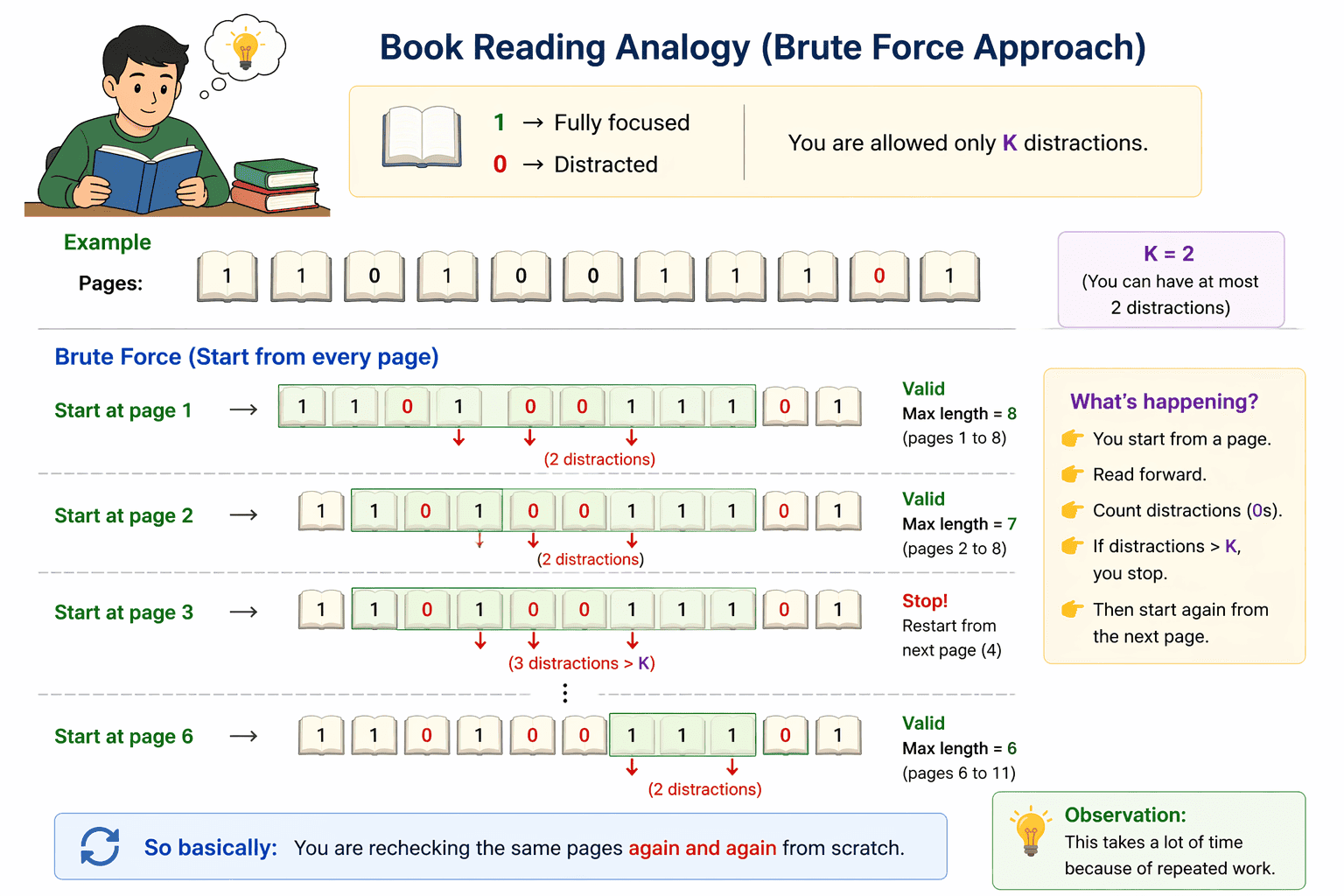
For every index i:
| nums = [1, 0, 1, 0, 1] k = 1 |
Check all subarrays:
...and so on.
Maximum length found = 3
| def longestOnes(nums, k): n = len(nums) max_length = 0 for i in range(n): zero_count = 0 for j in range(i, n): if nums[j] == 0: zero_count += 1 if zero_count > k: break max_length = max(max_length, j - i + 1) return max_length |
Here’s the problem:
It checks too many unnecessary subarrays
Recalculates zero count again and again
Becomes very slow for large inputs (like 10⁵ elements)
Notice this:
When we move from one subarray to the next, we are starting from scratch again, even though most elements are the same.
This is the inefficiency.
“Why not reuse previous work instead of recalculating everything?”
Instead of restarting every time:
This idea leads to the Sliding Window Approach (Optimal Solution)
Top Tutorials

Top 10 Machine Learning Projects with Source Code (Beginner to Advanced)
Explore the Top 10 Machine Learning projects with source code, from beginner to advanced. Learn real-world ML applications, build portfolio-ready projects, and master hands-on skills with step-by-step tutorials from AlmaBetter.

Technologies to Learn in 2026: Building the Future of Innovation
Explore the top technologies to learn in 2026 including Generative AI, Cloud, Cybersecurity, Web3, Data Science, AR/VR, Quantum, RPA, and Green Tech.

aws
This tutorial presents a structured, beginner-focused yet industry-aligned guide to Amazon Web Services, designed specifically for 2026 learning and career requirements

 in Bengaluru, India



All Courses (6)
Master's Degree (2)
Fellowship (2)
Certifications (2)

 Brute Force Approach


 in Bengaluru, India