

Your Success, Our Mission!
6000+ Careers Transformed.
At its core, the Flipping Bits with K-Window problem is about optimizing continuity in a binary sequence.
You are given:
Your task:
Find the maximum number of consecutive 1s you can obtain by flipping at most K zeros.
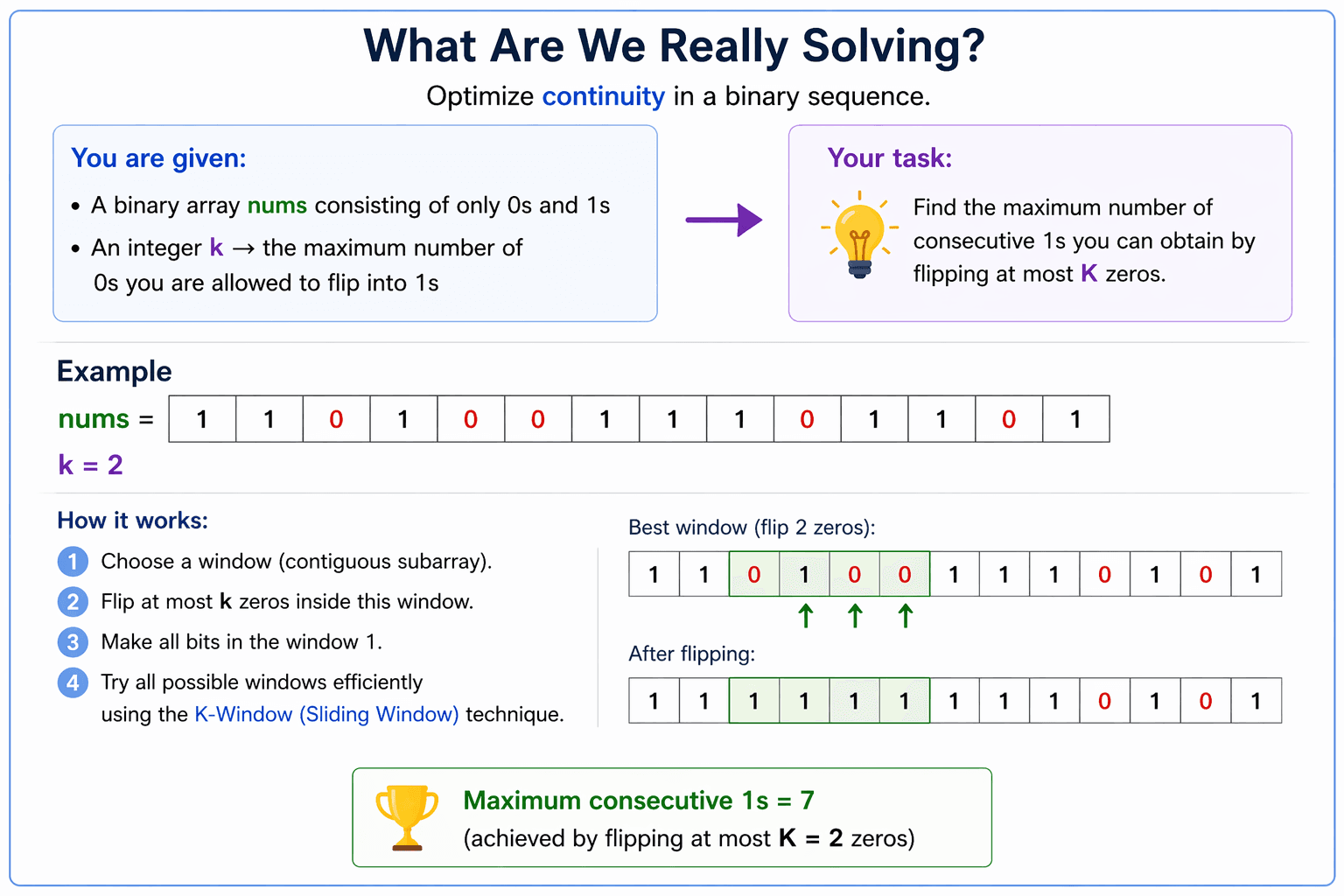
Let’s simplify what this means:
So instead of asking:
“Where are the longest 1s?”
We are actually asking:
“Which segment of the array becomes the longest stretch of 1s if we are allowed to fix at most K zeros?”
We are not required to flip exactly K zeros
→ flipping ≤ K zeros is allowed
The flips must help create a continuous block
→ scattered flips won’t help unless they form a long segment
We are essentially searching for:
A subarray that contains at most K zeros
Example
Consider:
| nums = [1, 0, 1, 1, 0, 0, 1] k = 2 |
Now think step-by-step:
| [1, 1, 1, 1, 1, 0, 1] |
Now the longest consecutive 1s = 5
Think of it like a window sliding over the array**:**
| [1, 0, 1, 1, 0, 0, 1] ↑-----------↑ window with ≤ 2 zeros |
Inside this window:
We are looking for:
Longest subarray such that:
| Number of zeros ≤ K |
And the answer is:
| max_length = right - left + 1 |
Top Tutorials

Top 10 Machine Learning Projects with Source Code (Beginner to Advanced)
Explore the Top 10 Machine Learning projects with source code, from beginner to advanced. Learn real-world ML applications, build portfolio-ready projects, and master hands-on skills with step-by-step tutorials from AlmaBetter.

Technologies to Learn in 2026: Building the Future of Innovation
Explore the top technologies to learn in 2026 including Generative AI, Cloud, Cybersecurity, Web3, Data Science, AR/VR, Quantum, RPA, and Green Tech.

aws
This tutorial presents a structured, beginner-focused yet industry-aligned guide to Amazon Web Services, designed specifically for 2026 learning and career requirements

 in Bengaluru, India



All Courses (6)
Master's Degree (2)
Fellowship (2)
Certifications (2)

 Problem Understanding


 in Bengaluru, India