
Your Success, Our Mission!
6000+ Careers Transformed.
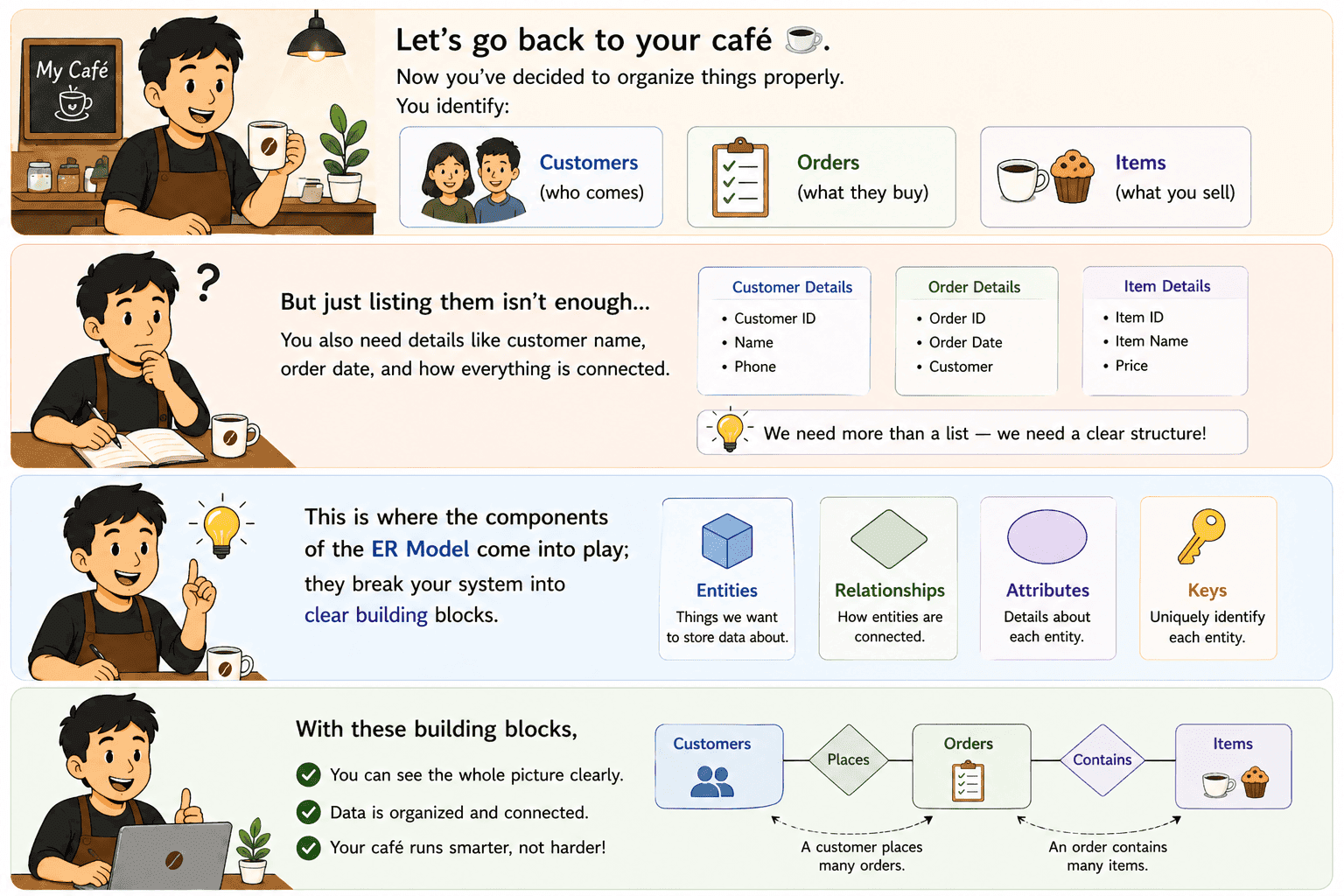
Let’s go back to your café.
Now you’ve decided to organize things properly. You identify:
But just listing them isn’t enough…
You also need details like customer name, order date, and how everything is connected.
This is where the components of the ER Model come into play; they break your system into clear building blocks.
The ER Model has three main components:
These three together form the complete structure of any database.
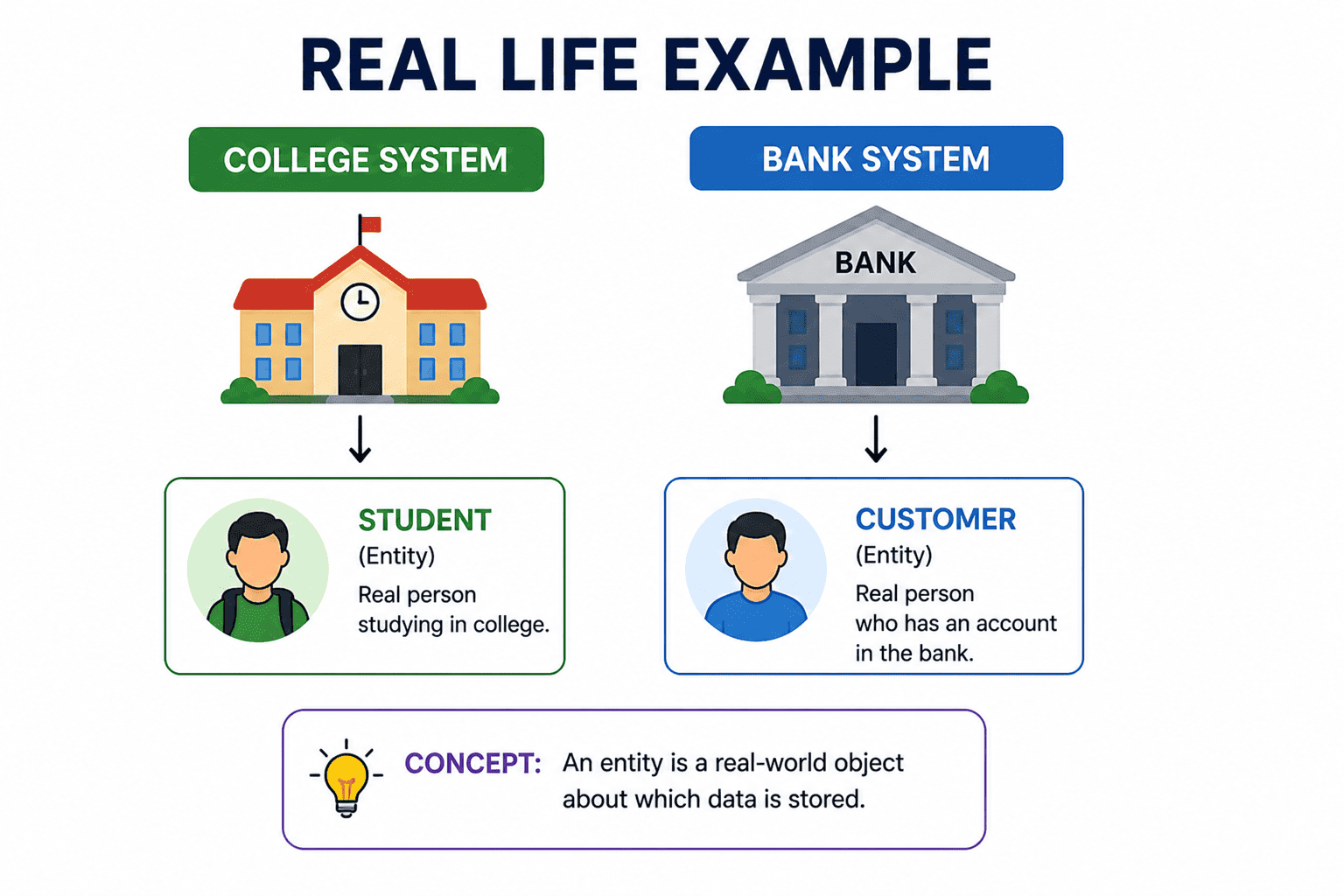
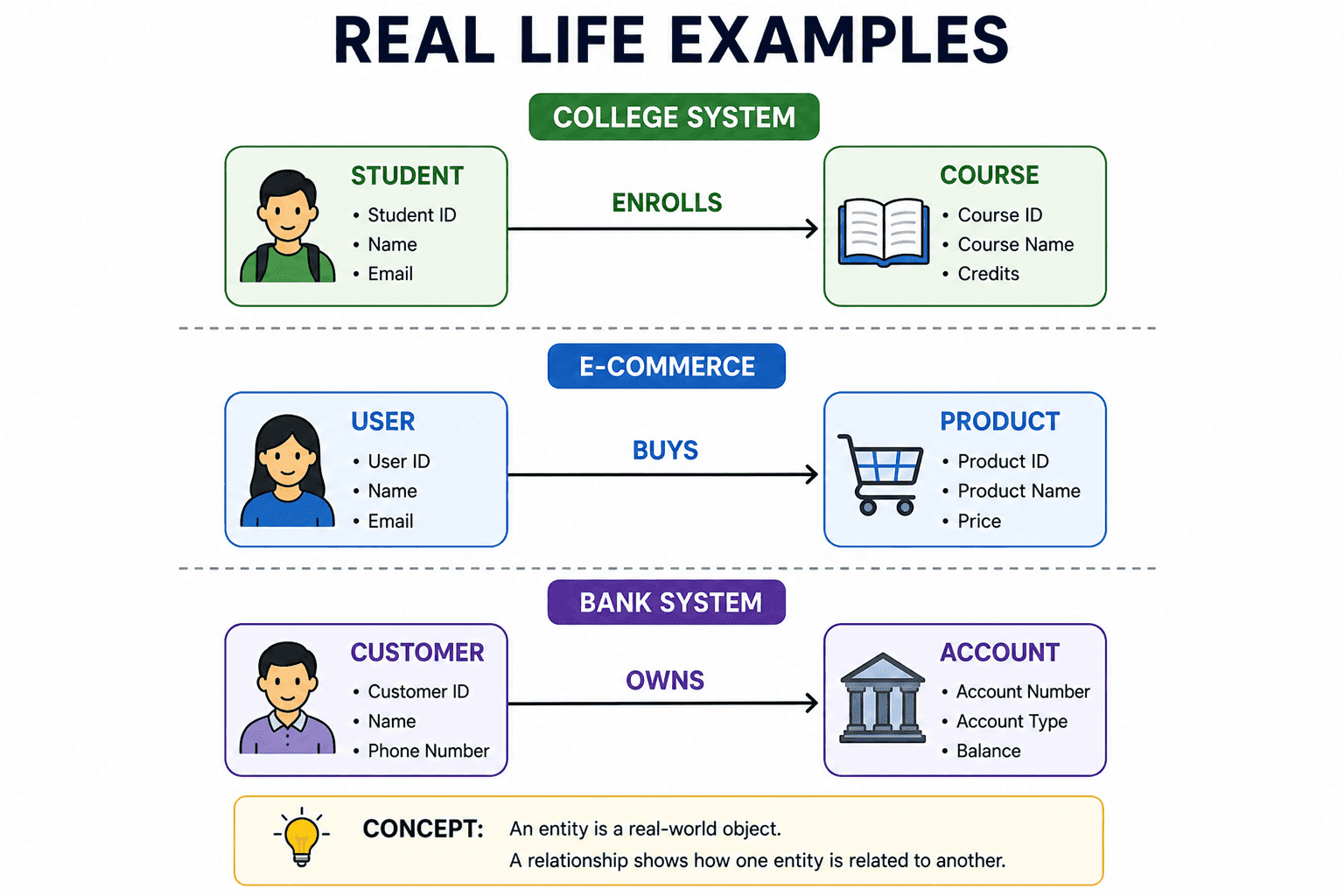
An Entity is a real-world object that we want to store data about.
Examples:
It is represented by a rectangle in ER diagrams.
Code Example
Entity | Example Data |
| Student | 101, Taniya, 19 |
| Product | P01, Laptop, 50000 |
An Attribute describes an entity (its properties).
Examples:
| Student → Name, Age, ID Product → Price, Name |
Represented by an oval
Code Example
Attribute Type | Example |
| Simple | Name |
| Composite | Full Name |
| Derived | Age (from DOB) |
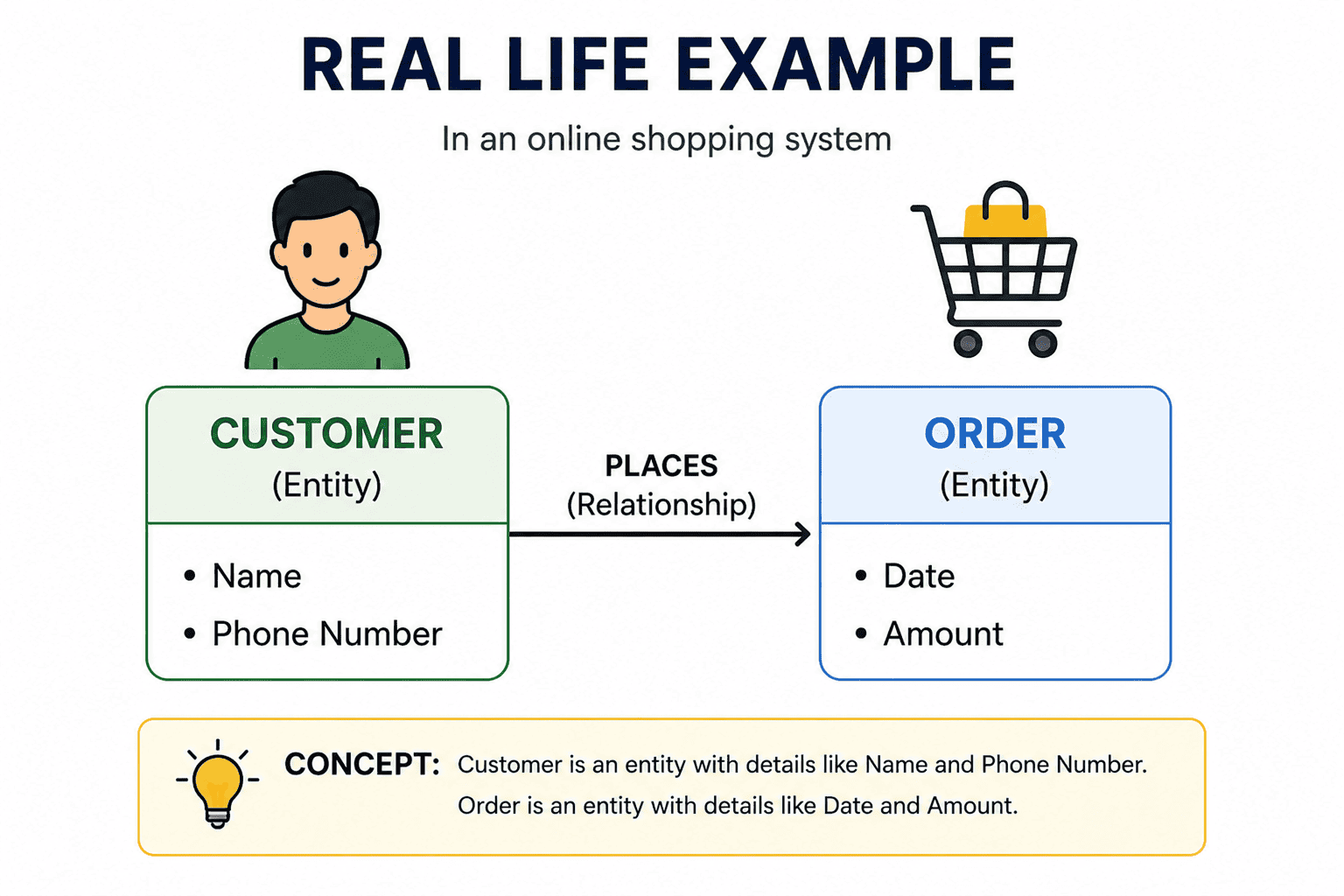
A Relationship shows how entities are connected.
Examples:
Represented by a diamond
Code Example
Entity 1 | Relationship | Entity 2 |
| Student | Enrolls | Course |
| Customer | Places | Order |
Top Tutorials

Python
Python is a popular and versatile programming language used for a wide variety of tasks, including web development, data analysis, artificial intelligence, and more.

SQL
The SQL for Beginners Tutorial is a concise and easy-to-follow guide designed for individuals new to Structured Query Language (SQL). It covers the fundamentals of SQL, a powerful programming language used for managing relational databases. The tutorial introduces key concepts such as creating, retrieving, updating, and deleting data in a database using SQL queries.

Data Science
Learn Data Science for free with our data science tutorial. Explore essential skills, tools, and techniques to master Data Science and kickstart your career

 in Bengaluru, India



All Courses (6)
Master's Degree (2)
Professional Certifications (4)
Ideal for working professionals and graduates
Outcomes: 5-40 LPA Job + Masters Degree

 Components of ER Model
 in Bengaluru, India