

Your Success, Our Mission!
6000+ Careers Transformed.
Conclusion
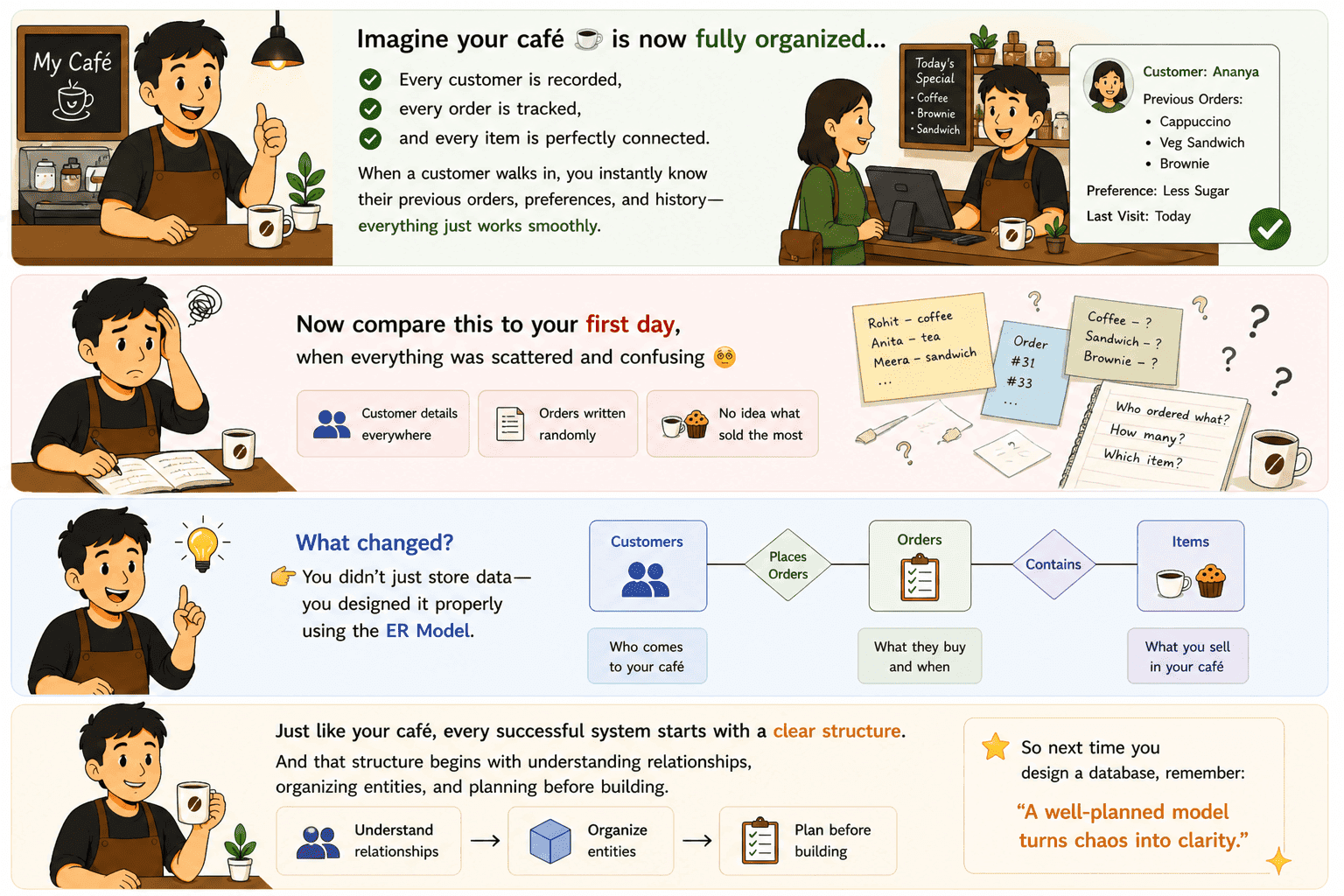
Imagine your café is now fully organized…
Every customer is recorded, every order is tracked, and every item is perfectly connected. When a customer walks in, you instantly know their previous orders, preferences, and history. Everything just works smoothly.
Now compare this to your first day, when everything was scattered and confusing
What changed?
You didn’t just store data, you designed it properly using the ER Model.
Just like your café, every successful system starts with a clear structure.
And that structure begins with understanding relationships, organizing entities, and planning before building.
So next time you design a database, remember:
“A well-planned model turns chaos into clarity.”
The Entity-Relationship (ER) Model is a fundamental concept in database design that helps transform complex real-world scenarios into a clear and structured format. By identifying entities, defining their attributes, and establishing meaningful relationships, the ER Model provides a strong foundation for building efficient databases. It acts as a blueprint that guides developers before implementation, reducing confusion and minimizing errors.
Throughout this article, we explored how ER modeling simplifies data organization and improves understanding of how different components interact within a system. From basic concepts to relationship types and diagram representation, each step plays a crucial role in designing a well-structured database. The use of ER diagrams further enhances clarity by offering a visual representation that is easy to interpret and communicate.
Without proper planning, databases can become disorganized and difficult to manage. However, with the ER Model, data becomes structured, scalable, and easier to maintain. It ensures consistency, avoids redundancy, and supports better decision-making during development.
In conclusion, the ER Model is not just a design tool but a thinking approach.
A well-designed ER model leads to a powerful and reliable database system.
Additional Readings
https://www.almabetter.com/bytes/articles/data-models-in-dbms
Why useful:
Explains that the ER model focuses on entities, attributes, and relationships, acting as a blueprint for database design.
This article explains the complete database design process, including ER diagrams as the first step.
https://www.almabetter.com/bytes/articles/database-design-in-dbms
Why useful:
Shows how ER diagrams are used in conceptual design to represent entities and relationships visually.
A structured tutorial that includes ER diagram concepts, symbols, and cardinality. https://www.almabetter.com/bytes/tutorials/gate-data-science-and-ai/database-fundamentals-for-gate
Why useful:
Covers ER diagram symbols, relationships, and cardinality (1:1, 1:N, M:N) in a simple way.
This article explains key features of DBMS and how models like ER contribute to system reliability.
https://www.almabetter.com/bytes/articles/features-of-dbms
Why useful:
Helps connect ER modeling with real database features like structure and recovery.
Main hub where you can explore more DBMS, SQL, and system design topics.
https://www.almabetter.com/bytes
Why useful:
Provides all tutorials, articles, and learning paths in one place.
Top Tutorials

Python
Python is a popular and versatile programming language used for a wide variety of tasks, including web development, data analysis, artificial intelligence, and more.

SQL
The SQL for Beginners Tutorial is a concise and easy-to-follow guide designed for individuals new to Structured Query Language (SQL). It covers the fundamentals of SQL, a powerful programming language used for managing relational databases. The tutorial introduces key concepts such as creating, retrieving, updating, and deleting data in a database using SQL queries.

Data Science
Learn Data Science for free with our data science tutorial. Explore essential skills, tools, and techniques to master Data Science and kickstart your career

 in Bengaluru, India



All Courses (6)
Master's Degree (2)
Professional Certifications (4)
Ideal for working professionals and graduates
Outcomes: 5-40 LPA Job + Masters Degree

 Conclusion

 in Bengaluru, India