
Your Success, Our Mission!
6000+ Careers Transformed.
Back to your café again…
You notice something interesting:
So not all connections are the same
Some are one-to-one, some one-to-many, and some many-to-many.
That’s exactly what Types of Relationships in the ER Model explain.
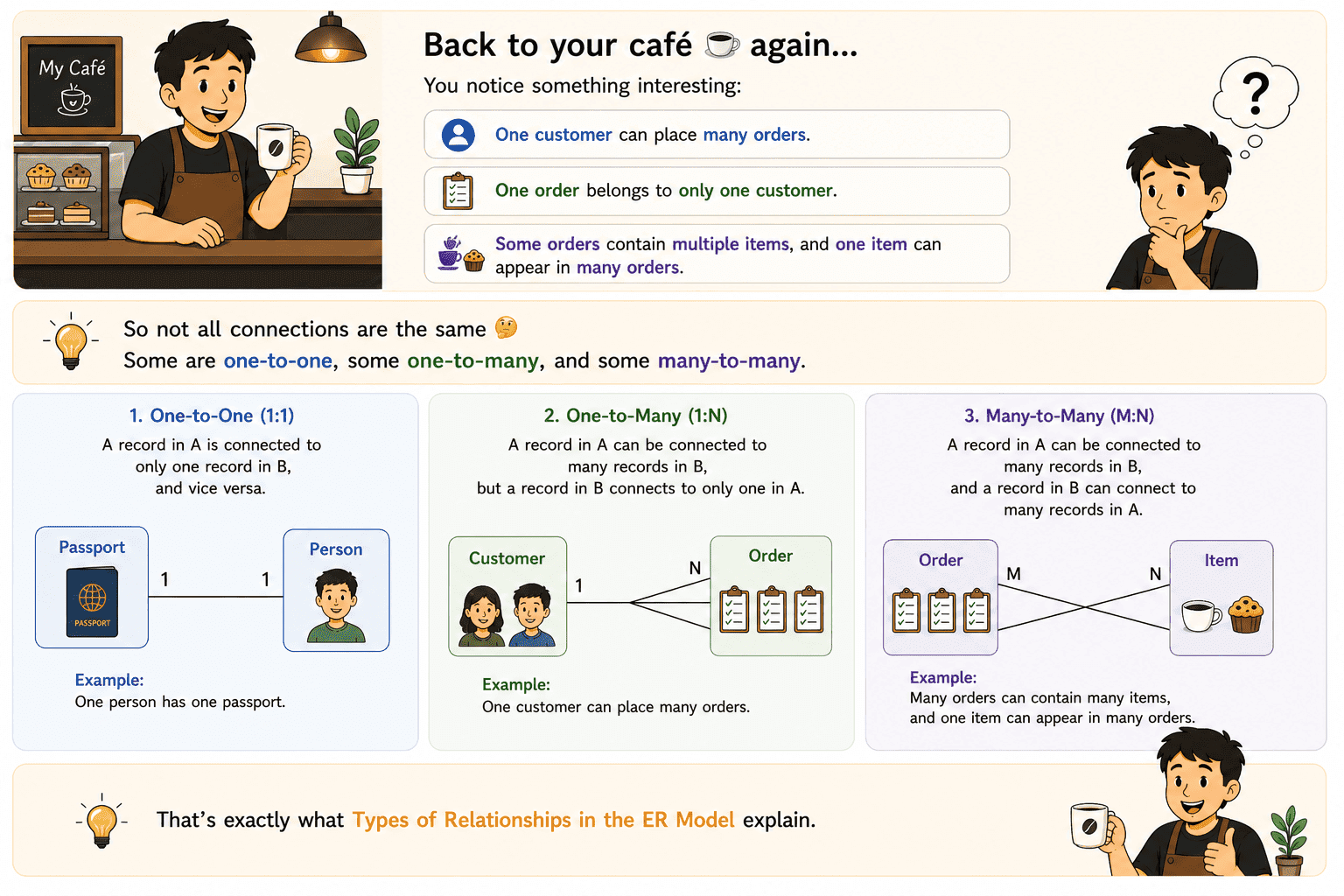
Relationships in ER models are classified based on how many entities are connected.
There are three main types:
These define how data interacts inside a system.
In this type, one entity is related to only one other entity.
Example:
Person_ID | Name | Passport_ID |
| 1 | Taniya | P101 |
Technical Example
| Person(Person_ID, Name) Passport(Passport_ID, Person_ID) |
Real Life Example
In this type, one entity can be related to many entities,
but each of those belongs to only one.
Example:
| Customer(Customer_ID, Name) Orders(Order_ID, Customer_ID) |
In this type, many entities are related to many others.
Example:
| Student(Student_ID, Name) Course(Course_ID, Name) Enrollment(Student_ID, Course_ID) |
Here, Enrollment is a bridge (junction table)
Real Life Example
Understanding relationships is the heart of ER modeling:
1:1 → One to one
1:N → One to many (most common)
M:N → Many to many (requires bridge table)
If you get relationships right, your database will behave correctly.
Top Tutorials

Python
Python is a popular and versatile programming language used for a wide variety of tasks, including web development, data analysis, artificial intelligence, and more.

SQL
The SQL for Beginners Tutorial is a concise and easy-to-follow guide designed for individuals new to Structured Query Language (SQL). It covers the fundamentals of SQL, a powerful programming language used for managing relational databases. The tutorial introduces key concepts such as creating, retrieving, updating, and deleting data in a database using SQL queries.

Data Science
Learn Data Science for free with our data science tutorial. Explore essential skills, tools, and techniques to master Data Science and kickstart your career

 in Bengaluru, India



All Courses (6)
Master's Degree (2)
Professional Certifications (4)
Ideal for working professionals and graduates
Outcomes: 5-40 LPA Job + Masters Degree

 Types of Relationships
 in Bengaluru, India