

Your Success, Our Mission!
6000+ Careers Transformed.
Imagine you want to launch your own website
You need a computer that:
Your personal laptop can’t do that
So you create a Virtual Machine (VM) in the cloud…
Your website is now live
Users can access it anytime
You can control everything remotely
That’s the power of VM Instances in GCP
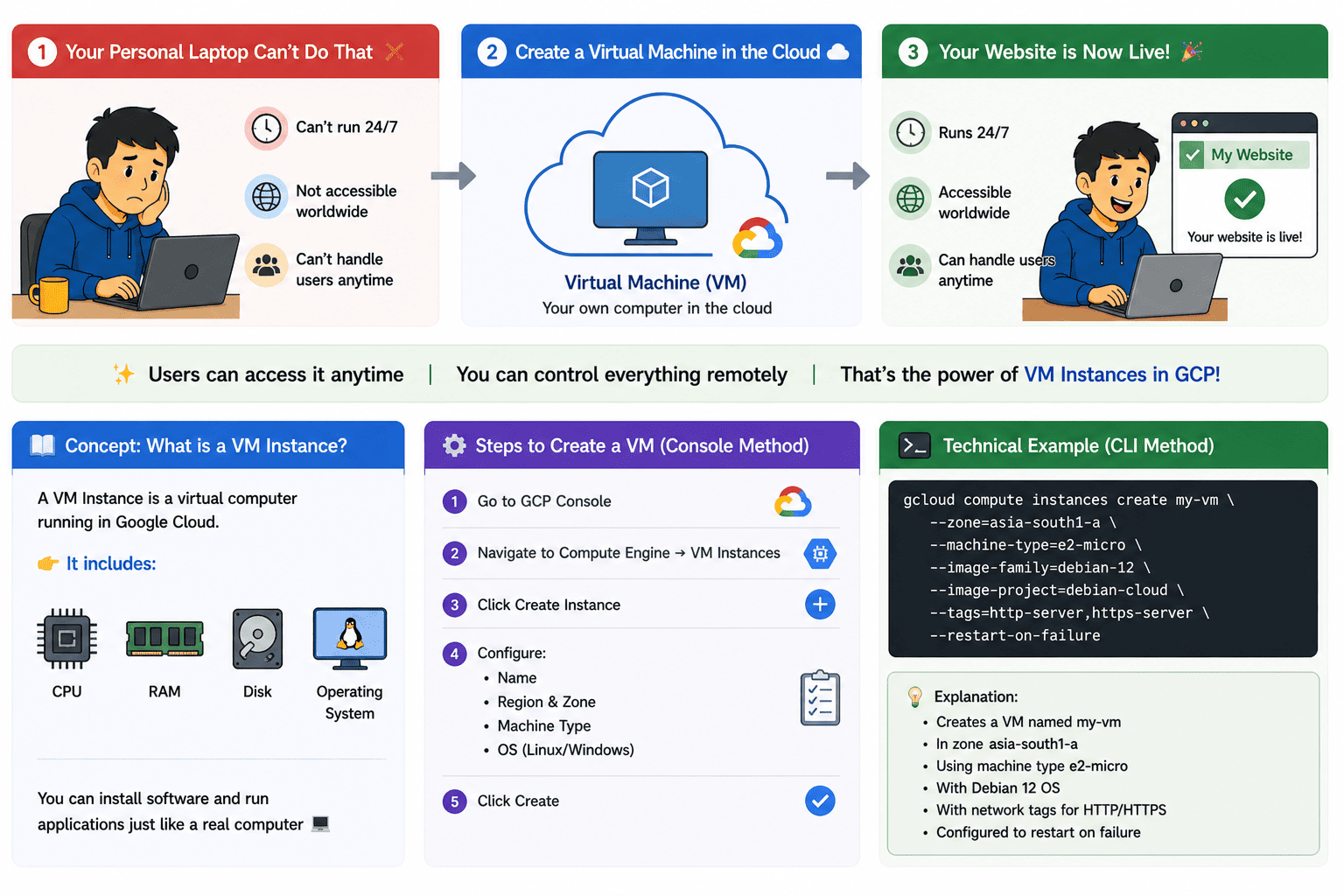
A VM Instance is a virtual computer running in Google Cloud.
It includes:
You can install software and run applications just like a real computer
Steps to Create a VM (Console Method)
Technical Example (CLI Method)
| gcloud compute instances create my-vm \ --zone=asia-south1-a \ --machine-type=e2-medium \ --image-family=debian-11 \ --image-project=debian-cloud |
This creates a VM in seconds
Managing VM Instances
| gcloud compute instances stop my-vm gcloud compute instances start my-vm |
Accessing Your VM
gcloud compute ssh my-vm
Real-Life Examples
1. Website Hosting
Top Tutorials

Python
Python is a popular and versatile programming language used for a wide variety of tasks, including web development, data analysis, artificial intelligence, and more.
SQL
The SQL for Beginners Tutorial is a concise and easy-to-follow guide designed for individuals new to Structured Query Language (SQL). It covers the fundamentals of SQL, a powerful programming language used for managing relational databases. The tutorial introduces key concepts such as creating, retrieving, updating, and deleting data in a database using SQL queries.

Data Science
Learn Data Science for free with our data science tutorial. Explore essential skills, tools, and techniques to master Data Science and kickstart your career

 in Bengaluru, India



All Courses (6)
Master's Degree (2)
Professional Certifications (4)
Ideal for working professionals and graduates
Outcomes: 5-40 LPA Job + Masters Degree

 Creating & Managing VM Instances

 in Bengaluru, India