
Your Success, Our Mission!
6000+ Careers Transformed.
You’ve built an amazing app
It works perfectly on your laptop… but now you want the world to use it
The challenge:
Instead of worrying about infrastructure, you deploy using:
Your app goes live in minutes
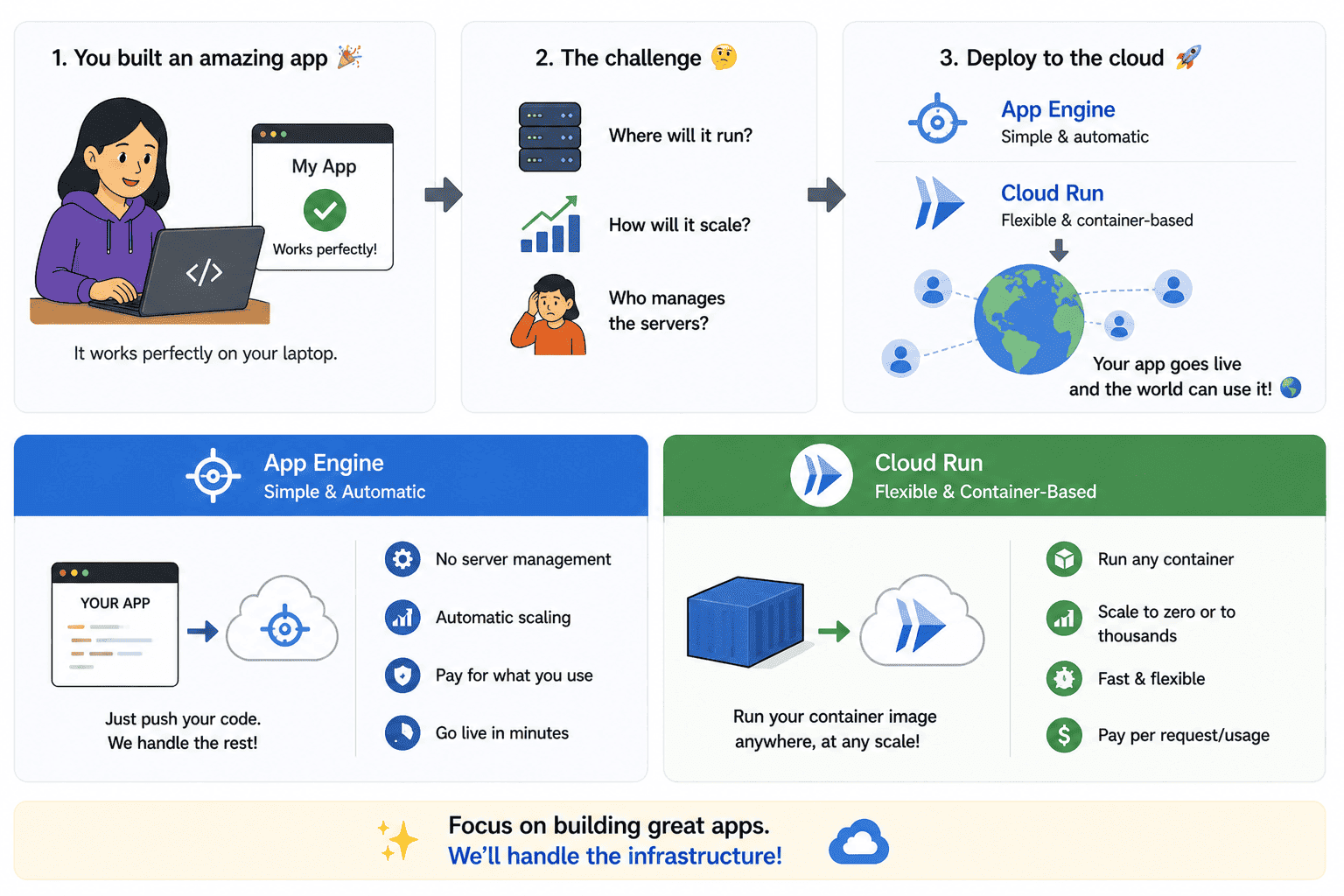
Deployment means:
Making your application available to users over the internet
App Engine (Easy Deployment)
| runtime: nodejs18 |
| gcloud app deploy |
| gcloud app browse |
Your app is now live
Cloud Run (Container-Based)
| gcloud builds submit --tag gcr.io/my-project/my-app |
| gcloud run deploy my-service \ --image gcr.io/my-project/my-app \ --platform managed \ --allow-unauthenticated |
App runs in scalable containers
Feature | App Engine | Cloud Run |
| Type | PaaS | Container-based |
| Setup | Very simple | Moderate |
| Flexibility | Limited | High |
| Scaling | Automatic | Automatic |
| Use Case | Basic apps | Microservices |
Top Tutorials

Python
Python is a popular and versatile programming language used for a wide variety of tasks, including web development, data analysis, artificial intelligence, and more.
SQL
The SQL for Beginners Tutorial is a concise and easy-to-follow guide designed for individuals new to Structured Query Language (SQL). It covers the fundamentals of SQL, a powerful programming language used for managing relational databases. The tutorial introduces key concepts such as creating, retrieving, updating, and deleting data in a database using SQL queries.
Data Science
Learn Data Science for free with our data science tutorial. Explore essential skills, tools, and techniques to master Data Science and kickstart your career

 in Bengaluru, India



All Courses (6)
Master's Degree (2)
Professional Certifications (4)
Ideal for working professionals and graduates
Outcomes: 5-40 LPA Job + Masters Degree

 Creating & Managing VM Instances

 in Bengaluru, India