
Your Success, Our Mission!
6000+ Careers Transformed.
Imagine you rent a computer in the cloud
At first, you choose a small machine perfect for testing
But suddenly your app grows
Now your system becomes slow
What do you do?
That’s where Machine Types & Scaling come into play
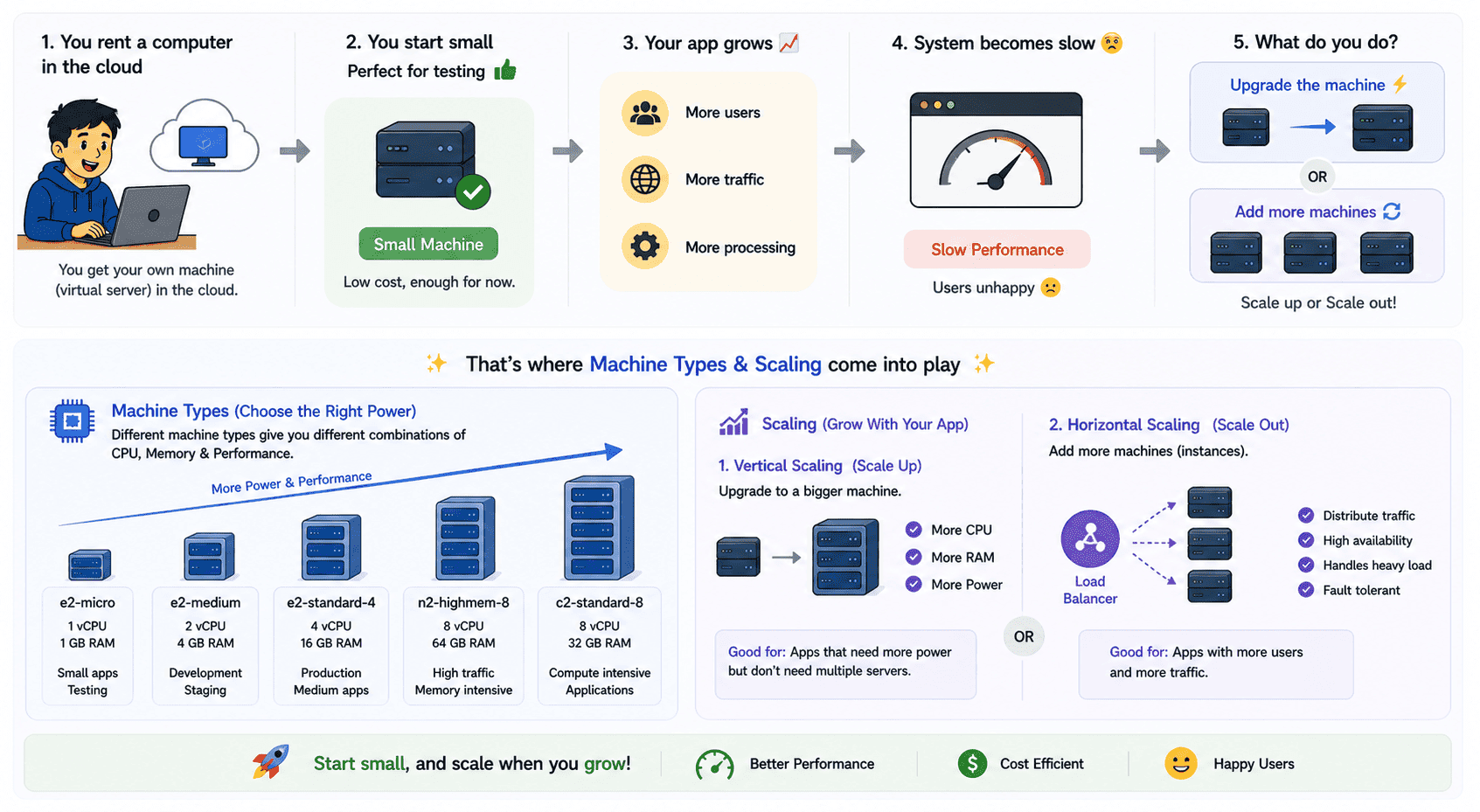
Machine Types define the CPU, memory (RAM), and performance of your VM.
Choosing the right machine type ensures:
Types of Machine Families
Type | Use Case |
| General Purpose | Balanced workloads |
| Compute Optimized | High CPU tasks |
| Memory Optimized | Large databases |
| GPU Machines | AI/ML, graphics |
Example Machine Type
| --machine-type=e2-medium |
Includes predefined CPU & RAM
What is Scaling?
Scaling means adjusting resources based on demand
Two types of scaling:
Type | Description |
| Vertical Scaling | Increase power of one VM |
| Horizontal Scaling | Add more VMs |
Feature | Vertical Scaling | Horizontal Scaling |
| Method | Upgrade machine | Add more machines |
| Limit | Has limits | Highly scalable |
| Complexity | Simple | Requires load balancing |
Technical Example (Scaling VM)
| gcloud compute instances set-machine-type my-vm \ --machine-type=e2-standard-4 |
| gcloud compute instance-groups managed set-autoscaling my-group \ --max-num-replicas=5 \ --target-cpu-utilization=0.6 |
Automatically adds/removes VMs
Real-Life Examples / Use Cases
Top Tutorials

Python
Python is a popular and versatile programming language used for a wide variety of tasks, including web development, data analysis, artificial intelligence, and more.
SQL
The SQL for Beginners Tutorial is a concise and easy-to-follow guide designed for individuals new to Structured Query Language (SQL). It covers the fundamentals of SQL, a powerful programming language used for managing relational databases. The tutorial introduces key concepts such as creating, retrieving, updating, and deleting data in a database using SQL queries.

Data Science
Learn Data Science for free with our data science tutorial. Explore essential skills, tools, and techniques to master Data Science and kickstart your career

 in Bengaluru, India



All Courses (6)
Master's Degree (2)
Professional Certifications (4)
Ideal for working professionals and graduates
Outcomes: 5-40 LPA Job + Masters Degree

 Creating & Managing VM Instances

 in Bengaluru, India