

Your Success, Our Mission!
6000+ Careers Transformed.
Once text has been converted into numerical features—using Bag of Words, n-grams, or TF-IDF—the next step is choosing a model that can learn from those features. Before deep learning became popular, classical machine learning algorithms formed the backbone of most NLP systems. Even today, they remain widely used because they are fast, interpretable, and often surprisingly effective.
One of the most commonly used algorithms is Naive Bayes. It works on probabilities and makes a simplifying assumption that features are independent of each other. While this assumption isn’t strictly true for language, Naive Bayes performs very well in tasks like spam detection and sentiment classification, especially when paired with TF-IDF features.
Another popular choice is Logistic Regression. Despite its name, it’s a classification algorithm, not a regression one. In NLP, it works well for binary and multi-class text classification problems. Logistic regression is easy to train, scales well to large datasets, and provides clear insights into which words influence predictions.
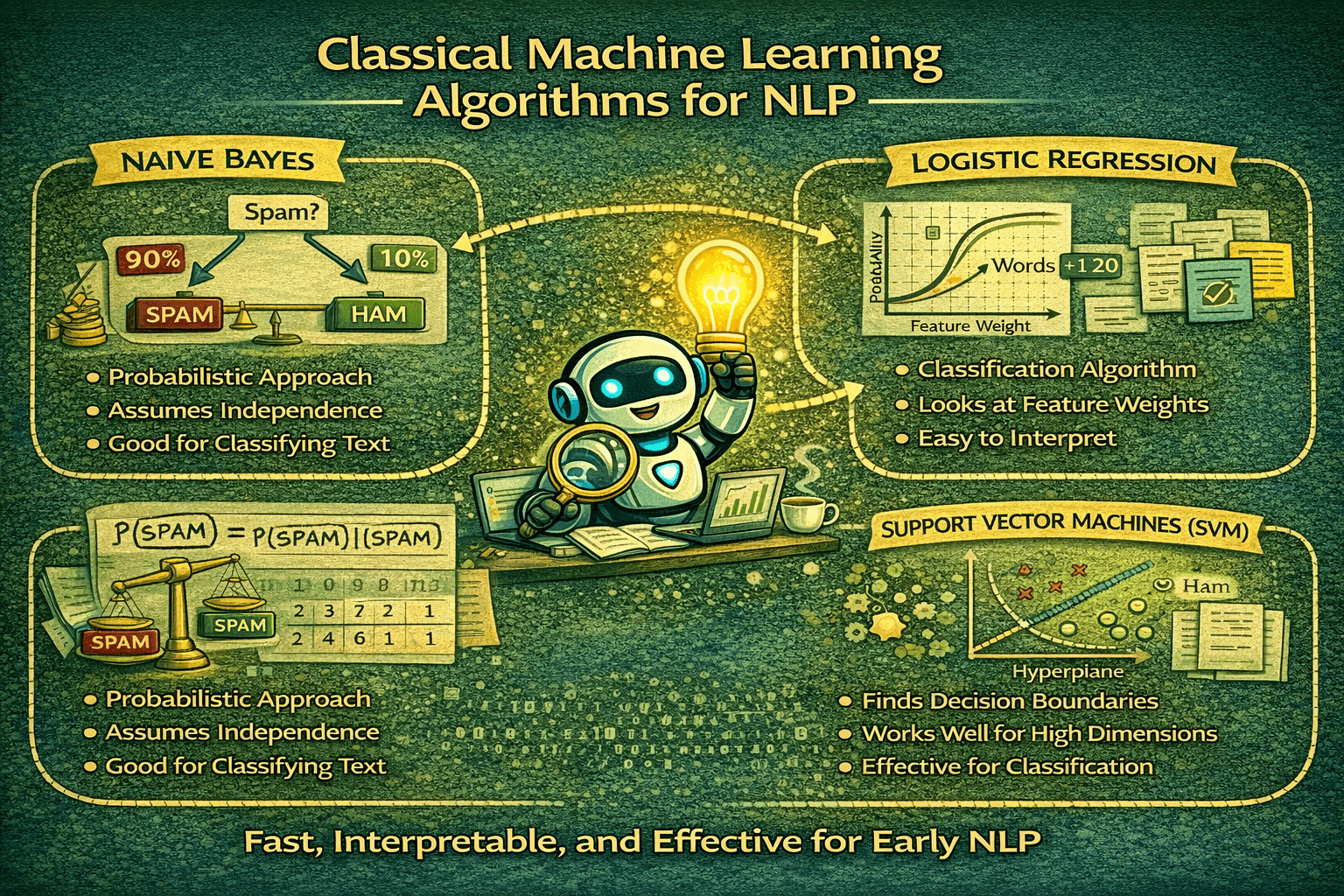
Support Vector Machines (SVMs) are also widely used in classical NLP. SVMs try to find a decision boundary that best separates different classes in high-dimensional feature space. Because text data often has thousands of features, SVMs can be very effective, especially when the dataset is not extremely large.
What makes these models valuable is not just performance, but interpretability. You can inspect feature weights and understand why a model made a certain decision. This is especially important in domains like healthcare, finance, or legal applications.
While modern NLP often relies on deep learning, classical machine learning models are still excellent baselines—and in many real-world systems, they are the final solution rather than a stepping stone.
Top Tutorials

Python
Python is a popular and versatile programming language used for a wide variety of tasks, including web development, data analysis, artificial intelligence, and more.
SQL
The SQL for Beginners Tutorial is a concise and easy-to-follow guide designed for individuals new to Structured Query Language (SQL). It covers the fundamentals of SQL, a powerful programming language used for managing relational databases. The tutorial introduces key concepts such as creating, retrieving, updating, and deleting data in a database using SQL queries.
Data Science
Learn Data Science for free with our data science tutorial. Explore essential skills, tools, and techniques to master Data Science and kickstart your career

 in Bengaluru, India



All Courses (6)
Master's Degree (2)
Fellowship (2)
Certifications (2)

 Bag of Words and N-gram Models

 in Bengaluru, India