

Your Success, Our Mission!
6000+ Careers Transformed.
An end-to-end NLP pipeline defines how raw text data flows through multiple stages to become actionable insights or predictions. Designing a robust pipeline is critical for building scalable and maintainable NLP systems in production.
The pipeline typically begins with data ingestion, where text is collected from sources such as APIs, databases, web scraping, logs, or user inputs. This is followed by data preprocessing, which includes cleaning text, removing noise, handling missing values, tokenization, normalization, stop-word removal, and sometimes lemmatization or stemming.
Next comes feature representation, where text is converted into numerical form using techniques like Bag-of-Words, TF-IDF, word embeddings, or contextual embeddings from transformer models. After this, the modeling stage applies machine learning or deep learning models to perform tasks such as classification, named entity recognition, sentiment analysis, or text generation.
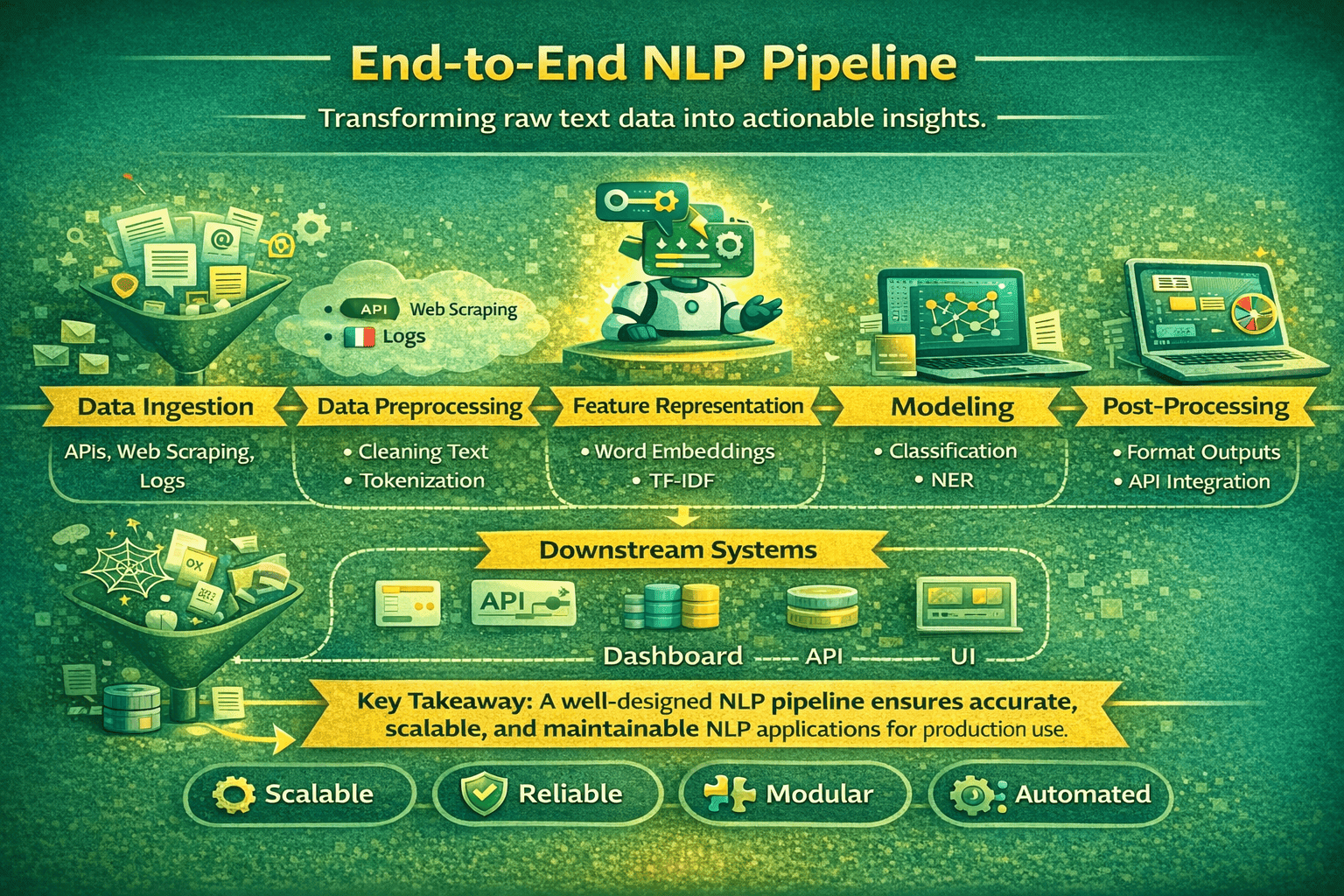
Once predictions are generated, post-processing is applied to format outputs, apply business rules, or aggregate results. Finally, the pipeline integrates with downstream systems, such as dashboards, APIs, databases, or user interfaces.
In production environments, pipelines must also handle error handling, logging, versioning, and scalability. Modular design is crucial — each component should be independently testable and replaceable. Automation tools and workflow orchestrators are often used to ensure reproducibility and consistency.
A well-designed NLP pipeline ensures faster experimentation, easier debugging, and smoother deployment. It also allows teams to update individual components (such as models or preprocessing logic) without breaking the entire system, making it essential for real-world NLP applications.
Top Tutorials

Python
Python is a popular and versatile programming language used for a wide variety of tasks, including web development, data analysis, artificial intelligence, and more.
SQL
The SQL for Beginners Tutorial is a concise and easy-to-follow guide designed for individuals new to Structured Query Language (SQL). It covers the fundamentals of SQL, a powerful programming language used for managing relational databases. The tutorial introduces key concepts such as creating, retrieving, updating, and deleting data in a database using SQL queries.

Data Science
Learn Data Science for free with our data science tutorial. Explore essential skills, tools, and techniques to master Data Science and kickstart your career

 in Bengaluru, India



All Courses (6)
Master's Degree (2)
Fellowship (2)
Certifications (2)

 Designing End-to-End NLP Pipelines

 in Bengaluru, India