

Your Success, Our Mission!
6000+ Careers Transformed.
Building an NLP model is only half the job. The other half—and often the more important part—is figuring out how well it actually works. This is where evaluation metrics come in. Without the right metrics, it’s easy to think a model is performing well when it’s actually missing the point.
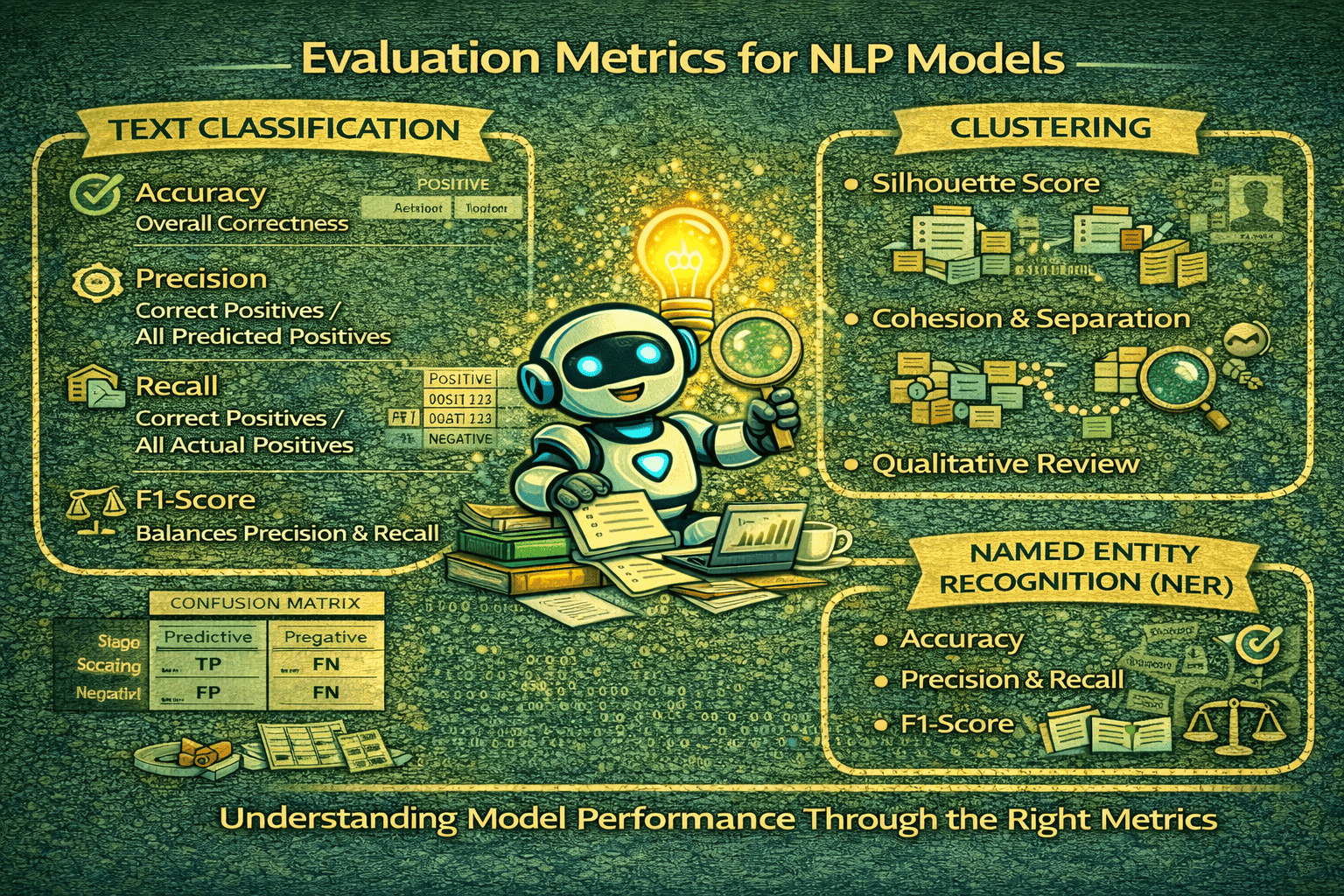
For text classification, the most common metrics are accuracy, precision, recall, and F1-score. Accuracy tells you how often the model is correct overall, but it can be misleading when classes are imbalanced. For example, if 95% of emails are non-spam, a model that always predicts “not spam” will look great on accuracy but be completely useless. Precision and recall help here—precision measures how reliable positive predictions are, while recall measures how many actual positives the model manages to catch. The F1-score balances both and is often a safer metric to rely on.
In tasks like clustering, evaluation is trickier because there are no labels. Metrics such as silhouette score or cohesion and separation are used to judge how well texts are grouped. In practice, clustering is often evaluated qualitatively—by manually inspecting clusters and checking whether they make sense for the business or research goal.
For Named Entity Recognition, evaluation usually happens at the token or entity level using precision, recall, and F1-score again. Here, even small mistakes matter. Missing a single entity in a legal or medical document can be more serious than misclassifying a sentence.
One important habit to develop is error analysis. Instead of relying only on numbers, look at where your model fails. Patterns in mistakes often reveal preprocessing issues, labeling problems, or limitations in your feature representation.
Good evaluation is about context. The “best” metric depends on the task, the data, and the real-world cost of errors. Strong NLP practitioners don’t chase high scores blindly—they choose metrics that reflect what actually matters.
Top Tutorials

Python
Python is a popular and versatile programming language used for a wide variety of tasks, including web development, data analysis, artificial intelligence, and more.
SQL
The SQL for Beginners Tutorial is a concise and easy-to-follow guide designed for individuals new to Structured Query Language (SQL). It covers the fundamentals of SQL, a powerful programming language used for managing relational databases. The tutorial introduces key concepts such as creating, retrieving, updating, and deleting data in a database using SQL queries.

Data Science
Learn Data Science for free with our data science tutorial. Explore essential skills, tools, and techniques to master Data Science and kickstart your career

 in Bengaluru, India



All Courses (6)
Master's Degree (2)
Fellowship (2)
Certifications (2)

 Bag of Words and N-gram Models

 in Bengaluru, India