

Your Success, Our Mission!
6000+ Careers Transformed.
Natural Language Processing did not suddenly appear in its current, powerful form. It evolved gradually, shaped by both technological limits and changing ideas about how language should be handled by machines. Understanding this evolution helps you appreciate why modern NLP looks the way it does today.
In the early days, NLP systems were almost entirely rule-based. Engineers and linguists manually wrote grammar rules, dictionaries, and patterns that the computer had to follow. If a sentence matched a rule, the system responded; if not, it failed. These systems worked reasonably well in narrow, controlled environments, but they were brittle. Language is too flexible and creative for fixed rules, and even small variations in phrasing could break the system.
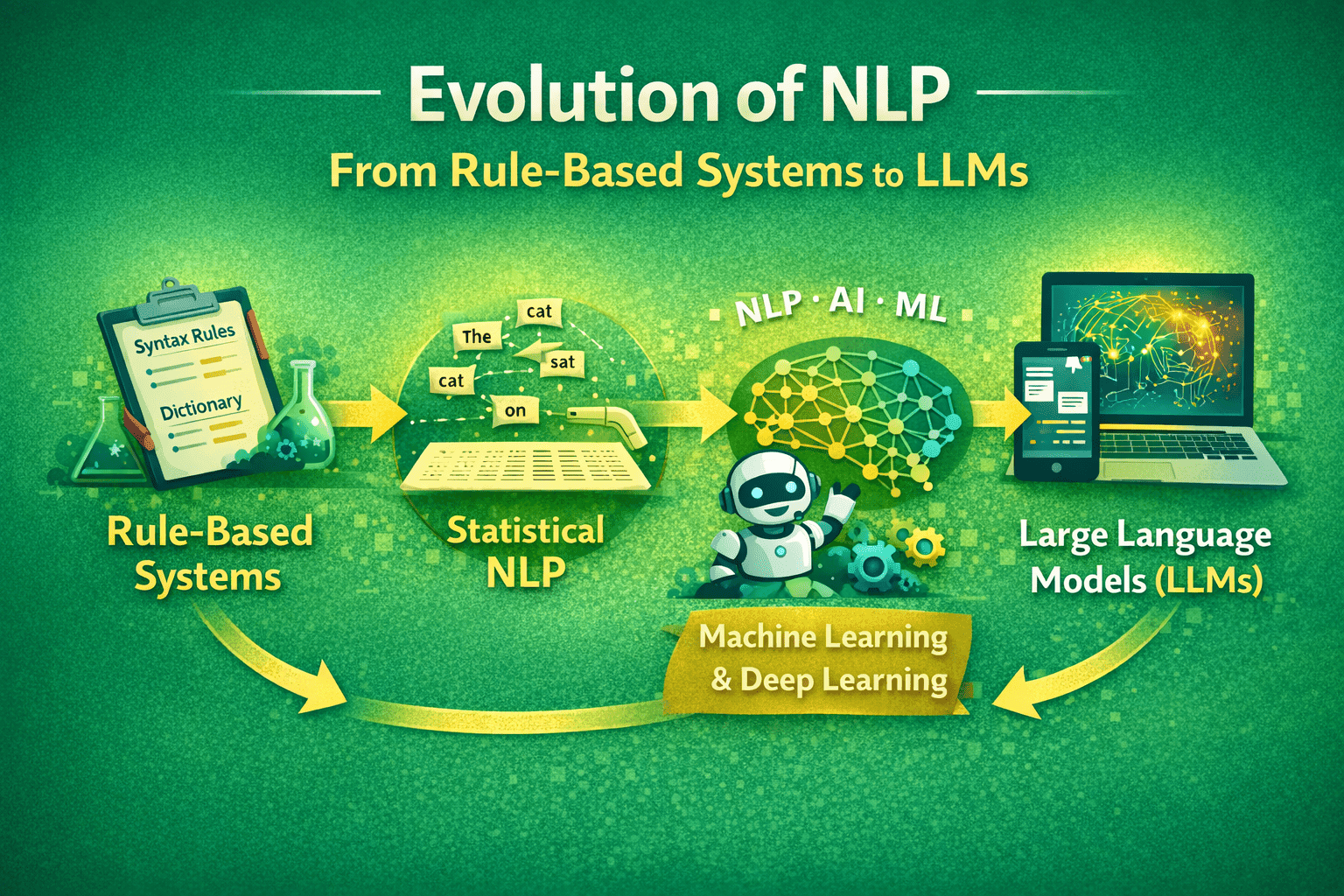
The next major shift came with statistical NLP. Instead of hard-coded rules, models started learning from large amounts of text data. Techniques like n-grams and probabilistic models allowed systems to make educated guesses based on patterns they had seen before. This approach handled variability better, but it still struggled with long-range context and deeper meaning.
As computing power and data grew, machine learning and deep learning took center stage. Neural networks, followed by RNNs and LSTMs, improved the ability to model sequences and context. The real turning point, however, was the introduction of transformers, which could process language in parallel and capture relationships across entire sentences and documents.
Today, this evolution has led to Large Language Models (LLMs)—systems trained on massive datasets that can understand, generate, and reason with text at an unprecedented level. While impressive, they are not magic. They are the result of decades of incremental progress, each phase building on the lessons and limitations of the one before it.
Top Tutorials

Python
Python is a popular and versatile programming language used for a wide variety of tasks, including web development, data analysis, artificial intelligence, and more.
SQL
The SQL for Beginners Tutorial is a concise and easy-to-follow guide designed for individuals new to Structured Query Language (SQL). It covers the fundamentals of SQL, a powerful programming language used for managing relational databases. The tutorial introduces key concepts such as creating, retrieving, updating, and deleting data in a database using SQL queries.

Data Science
Learn Data Science for free with our data science tutorial. Explore essential skills, tools, and techniques to master Data Science and kickstart your career

 in Bengaluru, India



All Courses (6)
Master's Degree (2)
Fellowship (2)
Certifications (2)

 What is Natural Language Processing?

 in Bengaluru, India