

Your Success, Our Mission!
6000+ Careers Transformed.
To really understand how NLP works, it helps to borrow a few ideas from linguistics, the study of language itself. You don’t need to become a linguist, but knowing the basics of syntax, semantics, and pragmatics gives you a clearer picture of what NLP models are trying to capture—and where they often struggle.
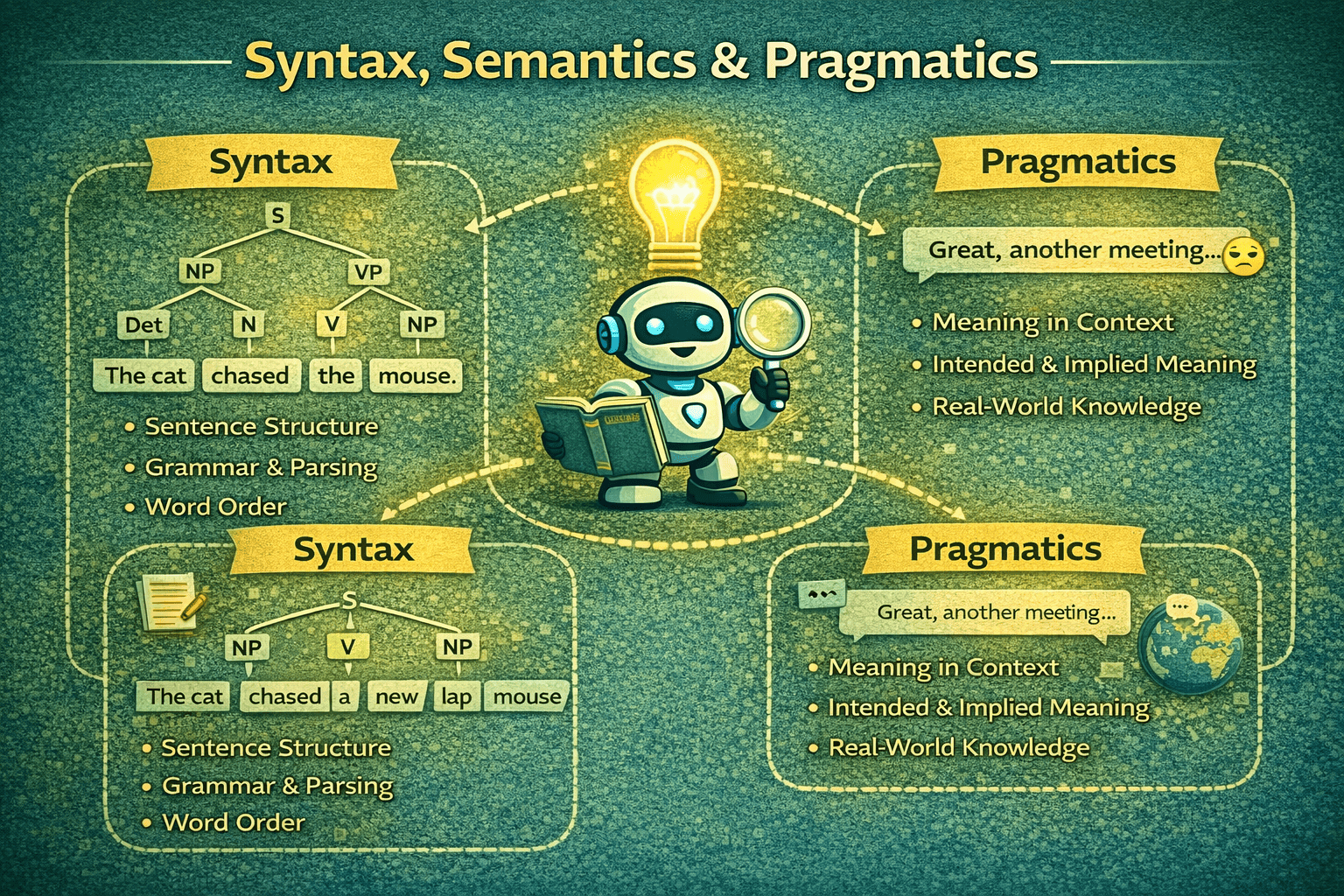
Syntax is about structure. It deals with how words are arranged to form sentences. For example, “The cat chased the mouse” and “The mouse chased the cat” use the same words but have completely different meanings because their structure is different. Early NLP systems focused heavily on syntax through grammar rules and sentence parsing. Even today, understanding sentence structure helps with tasks like parsing, information extraction, and question answering.
Semantics focuses on meaning. It’s concerned with what words and sentences actually mean, independent of context. For instance, words like “bank” can have multiple meanings—a financial institution or the side of a river. Semantic understanding helps NLP systems choose the correct meaning based on surrounding words. Techniques like word embeddings and contextual models are largely designed to capture semantic relationships.
Pragmatics goes one step further and looks at meaning in context. This includes implied meaning, intent, tone, and real-world knowledge. When someone says, “Great, another meeting,” the literal words are positive, but the intended meaning may be frustration. Pragmatics is one of the hardest areas for NLP, because it requires understanding beyond the text itself.
Modern NLP models attempt to learn aspects of all three, but none handle them perfectly. Knowing these concepts helps you design better pipelines, interpret model errors, and set realistic expectations for what NLP systems can—and cannot—do.
Top Tutorials

Python
Python is a popular and versatile programming language used for a wide variety of tasks, including web development, data analysis, artificial intelligence, and more.
SQL
The SQL for Beginners Tutorial is a concise and easy-to-follow guide designed for individuals new to Structured Query Language (SQL). It covers the fundamentals of SQL, a powerful programming language used for managing relational databases. The tutorial introduces key concepts such as creating, retrieving, updating, and deleting data in a database using SQL queries.

Data Science
Learn Data Science for free with our data science tutorial. Explore essential skills, tools, and techniques to master Data Science and kickstart your career

 in Bengaluru, India



All Courses (6)
Master's Degree (2)
Fellowship (2)
Certifications (2)

 Types of Text Data and Data Sources

 in Bengaluru, India