

Your Success, Our Mission!
6000+ Careers Transformed.
Model optimization focuses on improving the efficiency, speed, and cost-effectiveness of NLP models during inference, especially when deploying them in real-time or large-scale systems. While large language models deliver high accuracy, they can be computationally expensive and slow if not optimized.
One common optimization technique is model compression, which includes methods like pruning, quantization, and knowledge distillation. Pruning removes redundant parameters, quantization reduces numerical precision, and distillation trains smaller models to mimic larger ones — all helping reduce memory usage and inference time.
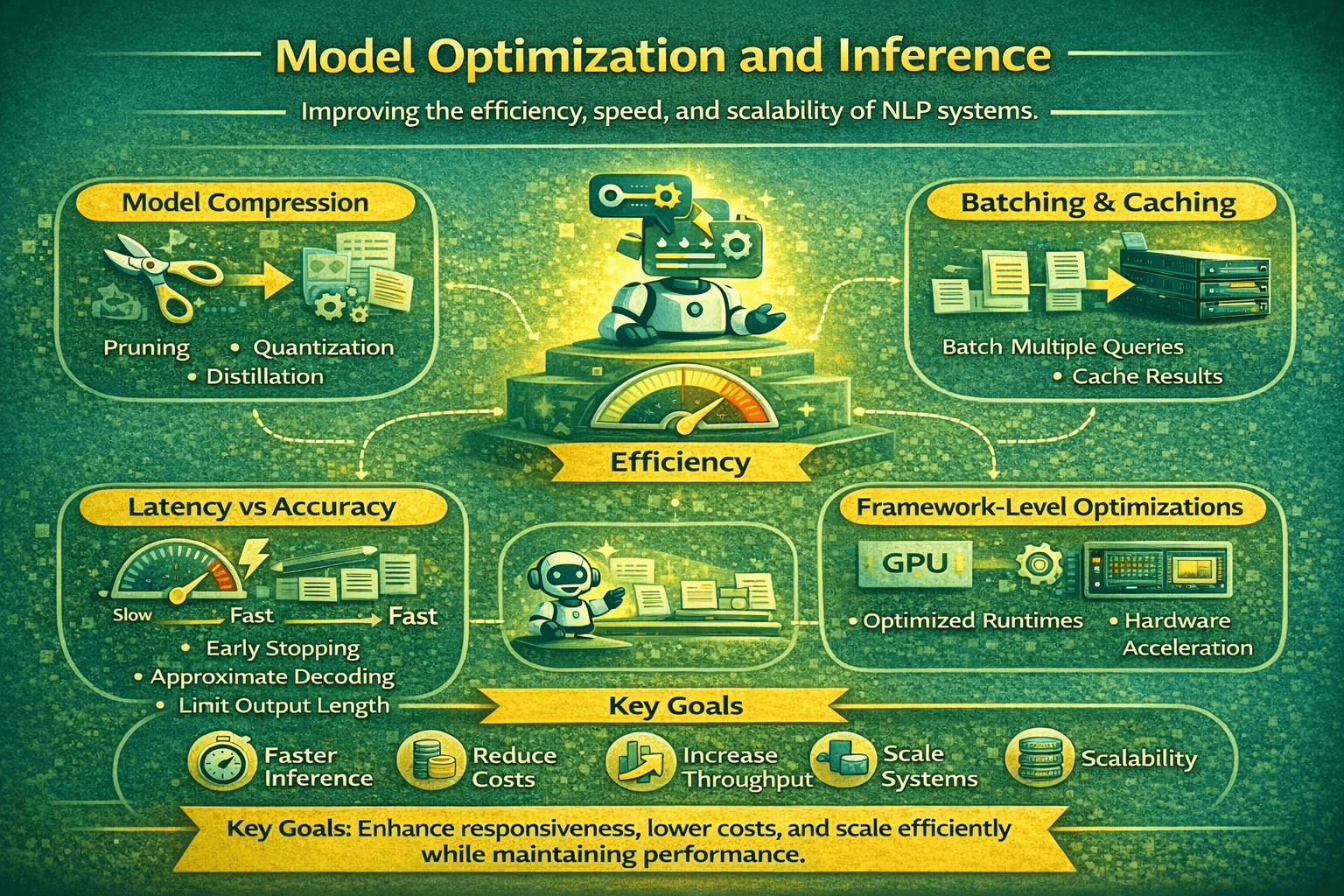
Another important aspect is batching and caching. Processing multiple requests together improves hardware utilization, while caching frequent queries reduces redundant computation. Selecting the right hardware — CPUs, GPUs, or specialized accelerators — also plays a key role in inference efficiency.
Inference optimization also involves latency vs accuracy trade-offs. In some applications, a slightly less accurate model with faster response time may be preferable. Techniques such as early stopping, approximate decoding, and limiting output length help reduce response times.
Framework-level optimizations, such as using optimized runtimes and inference engines, further improve performance. Monitoring inference metrics like latency, throughput, memory usage, and error rates is essential to detect bottlenecks.
Effective model optimization ensures that NLP systems remain responsive, scalable, and cost-efficient while maintaining acceptable performance levels. This is especially critical for real-time applications like chatbots, voice assistants, and search engines.
Top Tutorials

Python
Python is a popular and versatile programming language used for a wide variety of tasks, including web development, data analysis, artificial intelligence, and more.

SQL
The SQL for Beginners Tutorial is a concise and easy-to-follow guide designed for individuals new to Structured Query Language (SQL). It covers the fundamentals of SQL, a powerful programming language used for managing relational databases. The tutorial introduces key concepts such as creating, retrieving, updating, and deleting data in a database using SQL queries.

Data Science
Learn Data Science for free with our data science tutorial. Explore essential skills, tools, and techniques to master Data Science and kickstart your career

 in Bengaluru, India



All Courses (6)
Master's Degree (2)
Fellowship (2)
Certifications (2)

 Designing End-to-End NLP Pipelines

 in Bengaluru, India