
Your Success, Our Mission!
6000+ Careers Transformed.
Multilingual and low-resource NLP focuses on building language technologies for languages with limited labeled data or computational resources. While major languages dominate NLP research, thousands of languages remain underrepresented.
Multilingual models aim to support multiple languages using shared representations. Techniques like cross-lingual embeddings and multilingual transformers allow knowledge transfer across languages, reducing the need for large datasets per language.
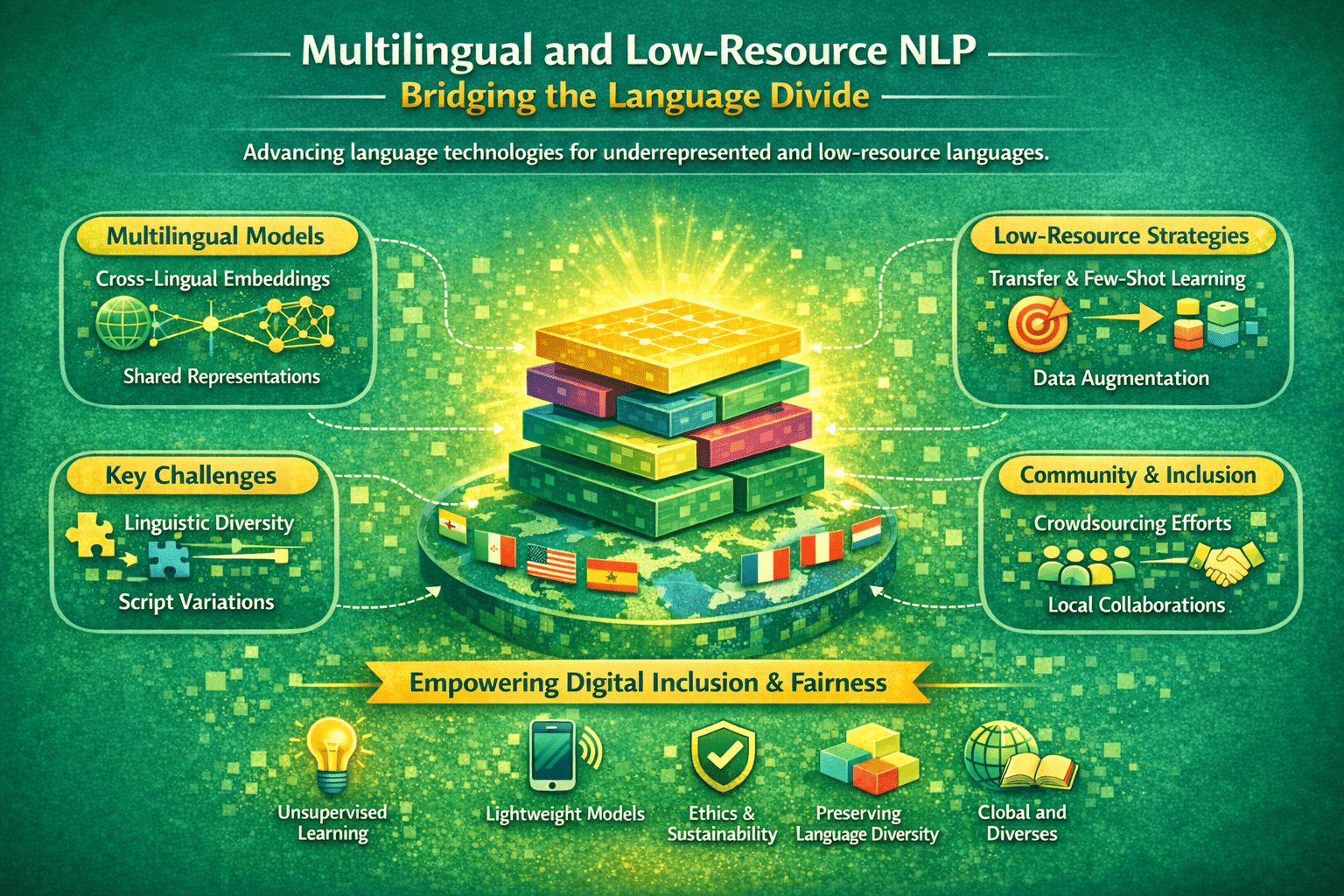
Low-resource NLP often relies on transfer learning, zero-shot learning, and few-shot learning, where models trained on high-resource languages are adapted to low-resource ones. Data augmentation techniques such as translation, paraphrasing, and synthetic data generation are also commonly used.
Challenges in multilingual NLP include linguistic diversity, script variations, and cultural context differences. Evaluation is particularly difficult due to the lack of standardized benchmarks and labeled datasets.
Supporting low-resource languages is important for digital inclusion, accessibility, and fairness. It enables broader participation in technology and reduces language-based inequalities.
As NLP continues to evolve, multilingual and low-resource research will play a key role in making language technologies more inclusive and globally relevant.
Beyond model architectures and learning strategies, community involvement and data collection play a crucial role in advancing multilingual and low-resource NLP. Collaborations with native speakers, linguists, and local organizations help create high-quality datasets that reflect real language use rather than artificial or biased samples. Crowdsourcing, participatory data creation, and open-source initiatives have become valuable approaches for gathering annotations, dictionaries, and parallel corpora for underrepresented languages. These efforts not only improve model performance but also ensure cultural sensitivity and ethical data usage.
Another important direction is the development of language-agnostic and resource-efficient methods. Instead of relying heavily on large annotated datasets, researchers are exploring unsupervised and self-supervised learning techniques that learn from raw text or speech. Lightweight models optimized for low computational power are also gaining attention, especially for deployment on mobile devices in regions with limited internet access or hardware constraints. Such approaches make it feasible to bring NLP capabilities—like speech recognition, translation, and information access—to communities with minimal infrastructure.
Finally, the future of multilingual and low-resource NLP is closely tied to policy, ethics, and sustainability. Decisions about which languages to support, how data is collected, and who benefits from these technologies have long-term social implications. Responsible research must address bias, consent, and representation to avoid reinforcing existing inequalities. By prioritizing inclusive benchmarks, open research, and equitable deployment, multilingual and low-resource NLP can move beyond technical innovation to become a powerful tool for preserving linguistic diversity and enabling more equitable global access to AI-driven technologies.
Top Tutorials

Python
Python is a popular and versatile programming language used for a wide variety of tasks, including web development, data analysis, artificial intelligence, and more.
SQL
The SQL for Beginners Tutorial is a concise and easy-to-follow guide designed for individuals new to Structured Query Language (SQL). It covers the fundamentals of SQL, a powerful programming language used for managing relational databases. The tutorial introduces key concepts such as creating, retrieving, updating, and deleting data in a database using SQL queries.

Data Science
Learn Data Science for free with our data science tutorial. Explore essential skills, tools, and techniques to master Data Science and kickstart your career

 in Bengaluru, India



All Courses (6)
Master's Degree (2)
Fellowship (2)
Certifications (2)

 Designing End-to-End NLP Pipelines

 in Bengaluru, India