

Your Success, Our Mission!
6000+ Careers Transformed.
At its core, Natural Language Processing (NLP) is about enabling machines to work with human language in a way that is useful and meaningful. Humans communicate through text and speech all the time—emails, messages, reviews, voice commands—but for a computer, this language is anything but simple. Unlike numbers or structured data, language is messy, ambiguous, and heavily dependent on context. NLP exists to handle this complexity.
In practical terms, NLP sits at the intersection of language, data, and algorithms. It allows machines to read text, analyze it, extract information, and sometimes generate new text that sounds natural to humans. Common examples include spam detection in emails, sentiment analysis of product reviews, chatbots answering customer queries, language translation tools, and voice assistants responding to spoken commands. These systems may look intelligent on the surface, but behind the scenes they rely on carefully designed NLP techniques.
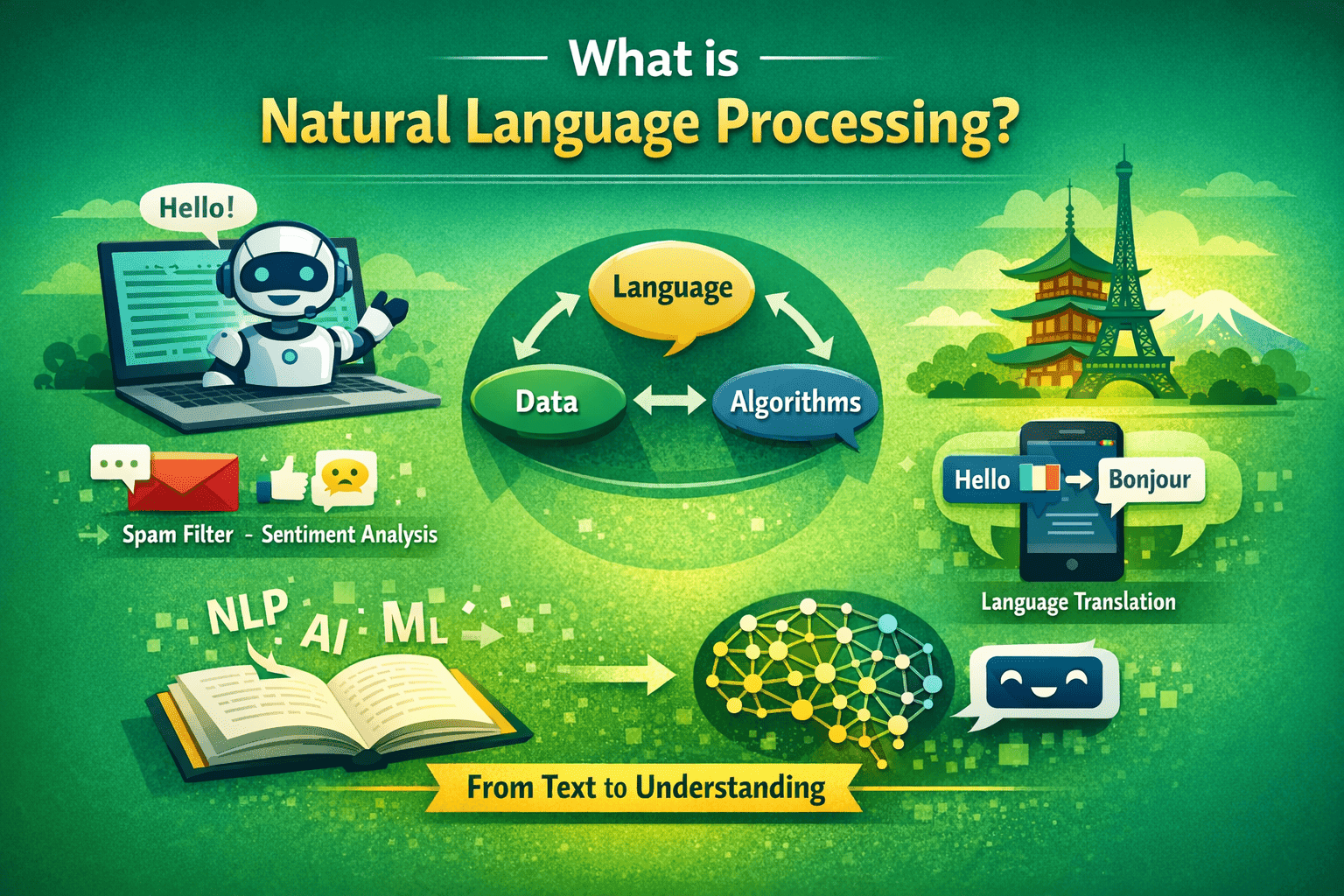
What makes NLP particularly challenging is the nature of human language itself. The same word can have different meanings depending on context, sentence structure can vary widely, and people often imply meaning rather than state it directly. Sarcasm, slang, abbreviations, and grammatical mistakes make the problem even harder. NLP systems try to deal with this uncertainty by combining linguistic rules with statistical methods and machine learning models.
As you progress through this roadmap, you’ll see how NLP evolves from simple approaches—like counting words or matching patterns—to advanced models that can understand context, capture meaning, and generate fluent text. This lesson lays the foundation for that journey by answering a simple but important question: what does it really mean for a machine to understand language?
Top Tutorials

Python
Python is a popular and versatile programming language used for a wide variety of tasks, including web development, data analysis, artificial intelligence, and more.
SQL
The SQL for Beginners Tutorial is a concise and easy-to-follow guide designed for individuals new to Structured Query Language (SQL). It covers the fundamentals of SQL, a powerful programming language used for managing relational databases. The tutorial introduces key concepts such as creating, retrieving, updating, and deleting data in a database using SQL queries.

Data Science
Learn Data Science for free with our data science tutorial. Explore essential skills, tools, and techniques to master Data Science and kickstart your career

 in Bengaluru, India



All Courses (6)
Master's Degree (2)
Fellowship (2)
Certifications (2)

 What is Natural Language Processing?

 in Bengaluru, India