

Your Success, Our Mission!
6000+ Careers Transformed.
Before diving into transformers and large language models, it’s useful to revisit neural networks and understand why they changed the way NLP systems are built. At a high level, a neural network is a collection of connected layers that learn patterns by adjusting weights based on data. In NLP, those patterns are hidden inside sequences of words rather than fixed-length numeric features.
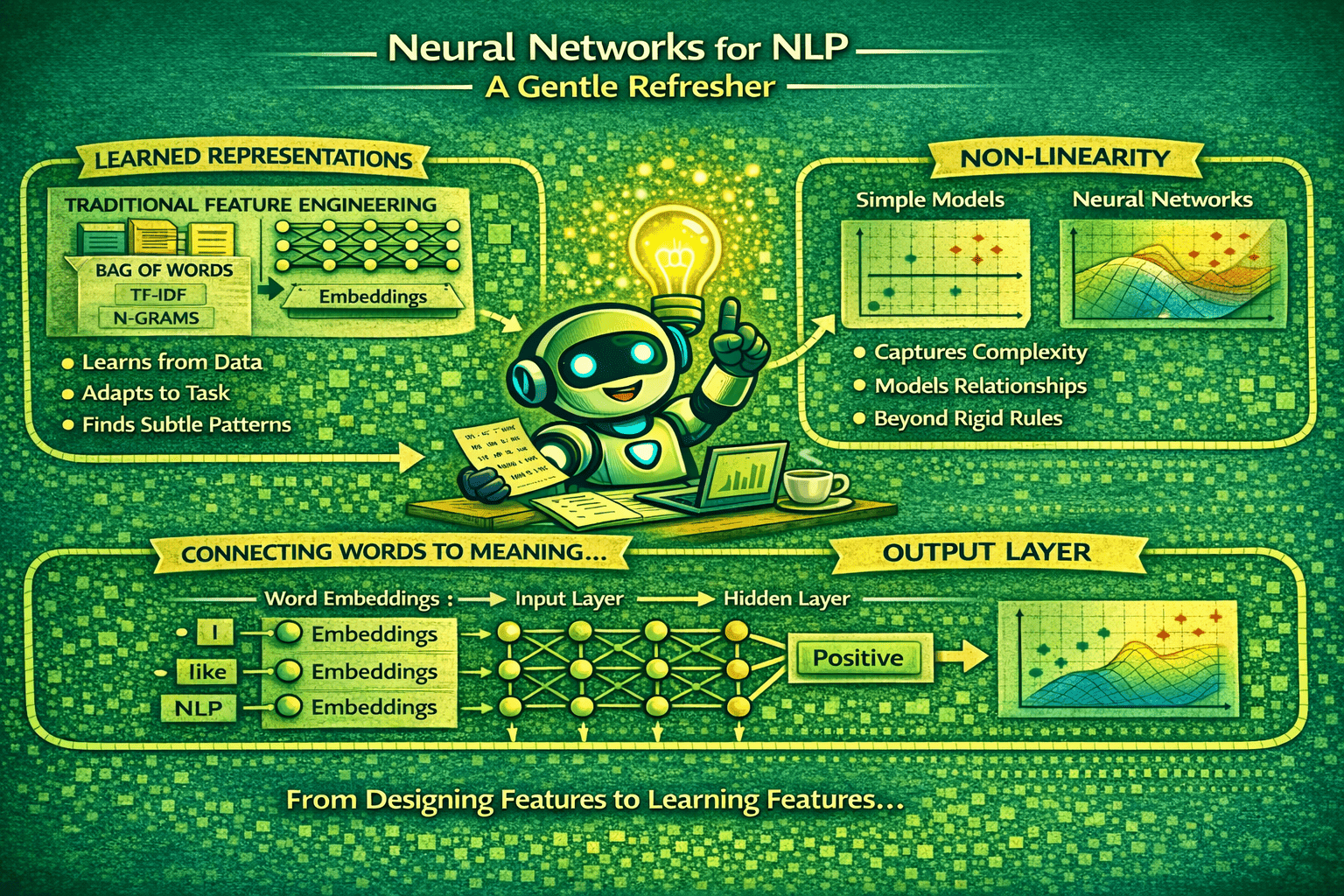
Traditional machine learning models rely heavily on manually designed features. Neural networks, on the other hand, learn representations automatically. When fed text that has been converted into vectors, a neural network gradually learns which combinations of words, phrases, or positions matter most for a task. This makes them especially powerful for language, where rigid rules rarely hold.
In early NLP systems, feedforward neural networks were used on top of features like TF-IDF or word embeddings. While effective, these models treated text as fixed-size input and struggled to capture word order and sequence information. Still, they laid important groundwork by showing that learned representations often outperform hand-crafted ones.
Another key idea introduced by neural networks is non-linearity. Language patterns are rarely linear, and neural networks can model complex relationships that simpler algorithms miss. This is why even relatively shallow networks often outperform classical models on the same data.
The most important takeaway from this lesson is not architectural detail, but mindset. Neural networks shift NLP from “designing features” to “learning features.” As you move forward, you’ll see how this idea evolves into sequence models, attention mechanisms, and eventually transformers that can model language at scale.
Top Tutorials

Python
Python is a popular and versatile programming language used for a wide variety of tasks, including web development, data analysis, artificial intelligence, and more.

SQL
The SQL for Beginners Tutorial is a concise and easy-to-follow guide designed for individuals new to Structured Query Language (SQL). It covers the fundamentals of SQL, a powerful programming language used for managing relational databases. The tutorial introduces key concepts such as creating, retrieving, updating, and deleting data in a database using SQL queries.

Data Science
Learn Data Science for free with our data science tutorial. Explore essential skills, tools, and techniques to master Data Science and kickstart your career

 in Bengaluru, India



All Courses (6)
Master's Degree (2)
Fellowship (2)
Certifications (2)

 Neural Networks for NLP – A Gentle Refresher

 in Bengaluru, India