

Your Success, Our Mission!
6000+ Careers Transformed.
Once you understand what NLP is and where it’s used, the next natural question is: what kind of roles actually work with NLP? The answer is—quite a few, and not all of them require you to build complex models from scratch.
One common role is the Data Analyst or NLP Analyst. In this position, NLP is often used to analyze large volumes of text such as customer feedback, reviews, support tickets, or survey responses. The focus here is less on deep model design and more on extracting insights, building dashboards, and helping businesses make decisions based on text data.
The Machine Learning Engineer or NLP Engineer role goes deeper into model building. These professionals work on designing, training, and optimizing NLP models for tasks like classification, search, recommendation, or information extraction. They also handle data pipelines, evaluation, and deployment, ensuring models perform reliably in production.
Then there are Applied AI and LLM-focused roles, which have become more prominent recently. These roles involve working with large language models, fine-tuning them for specific use cases, designing prompts, and integrating them into real products. Here, understanding both NLP fundamentals and system design is crucial.
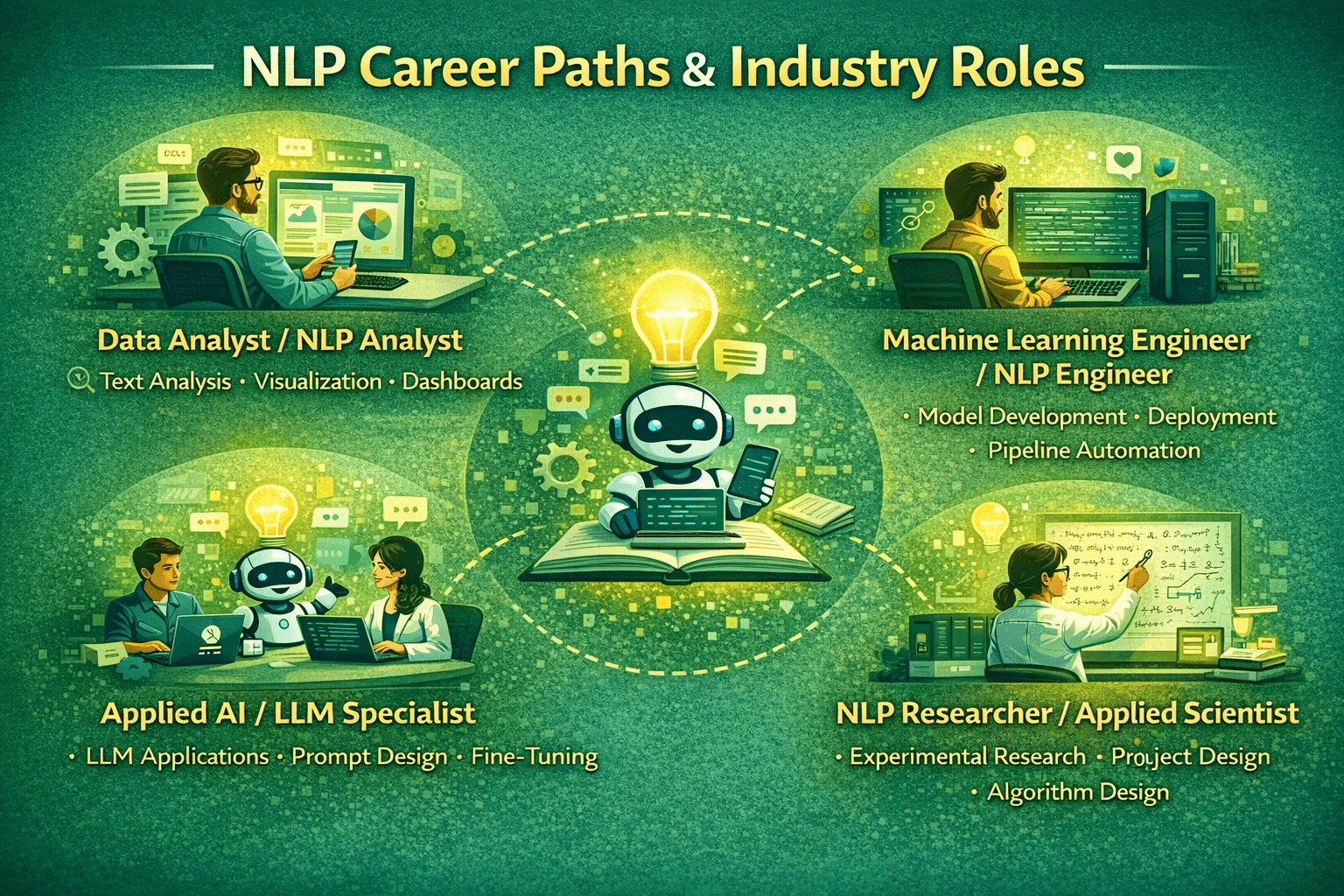
In research-oriented roles, such as NLP Researcher or Applied Scientist, the focus shifts toward experimenting with new architectures, improving performance, or addressing challenges like bias and efficiency. These roles often require a stronger background in mathematics and deep learning.
What’s important to understand is that NLP careers are not one-size-fits-all. Some roles are closer to analysis, others to engineering, and some to research. This roadmap is designed to give you a broad foundation first, so you can later specialize based on your interests and career goals.
Top Tutorials

Python
Python is a popular and versatile programming language used for a wide variety of tasks, including web development, data analysis, artificial intelligence, and more.
SQL
The SQL for Beginners Tutorial is a concise and easy-to-follow guide designed for individuals new to Structured Query Language (SQL). It covers the fundamentals of SQL, a powerful programming language used for managing relational databases. The tutorial introduces key concepts such as creating, retrieving, updating, and deleting data in a database using SQL queries.

Data Science
Learn Data Science for free with our data science tutorial. Explore essential skills, tools, and techniques to master Data Science and kickstart your career

 in Bengaluru, India



All Courses (6)
Master's Degree (2)
Fellowship (2)
Certifications (2)

 What is Natural Language Processing?

 in Bengaluru, India