

Your Success, Our Mission!
6000+ Careers Transformed.
Before moving deeper into NLP models and techniques, it’s worth pausing to understand what background knowledge actually helps—and what doesn’t need to be perfect from day one. One of the biggest myths around NLP is that you must be an expert in everything before you start. In reality, you can grow your skills in parallel as long as you know the basics.
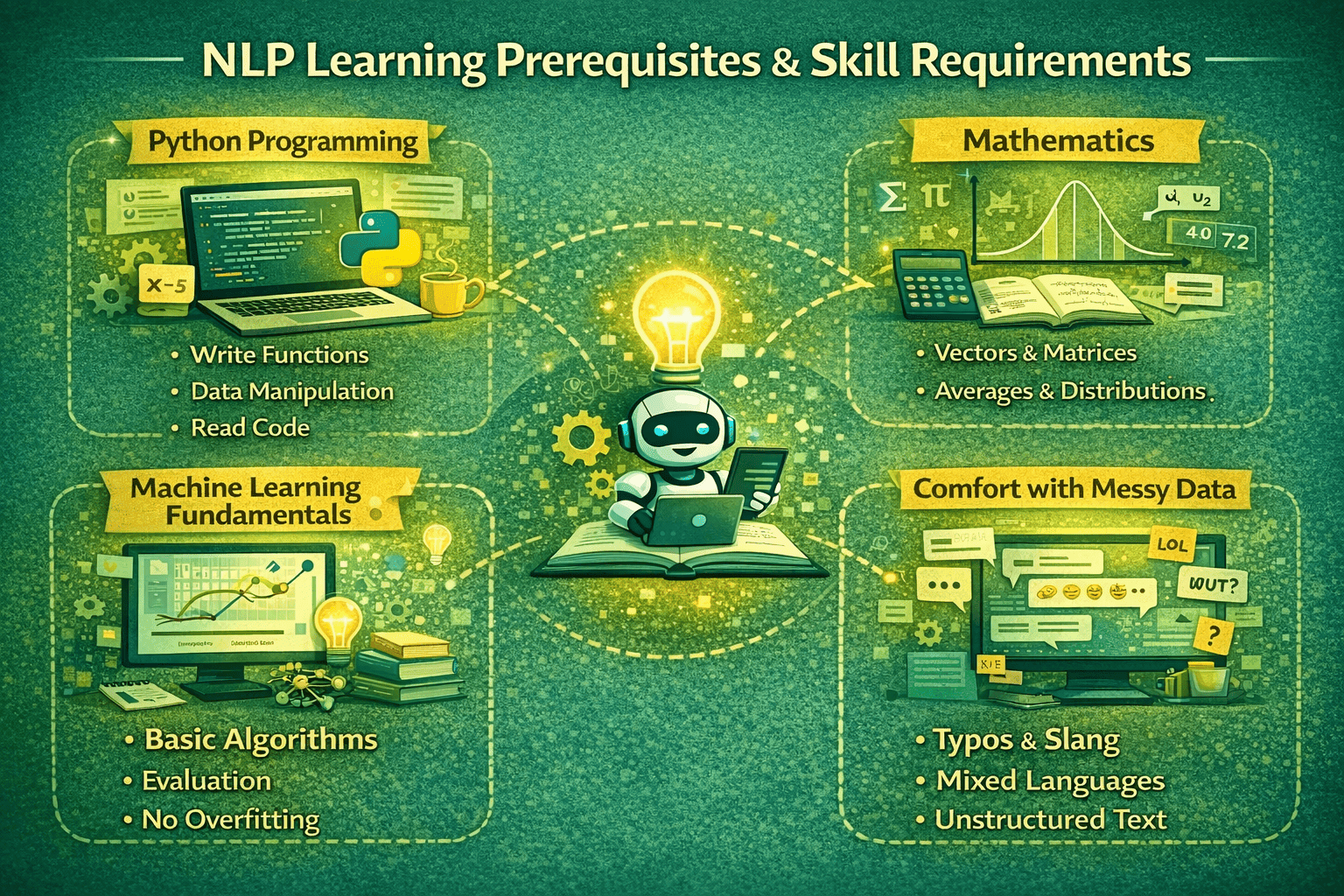
At a minimum, Python is essential. Most NLP libraries and tools are Python-based, and you should be comfortable with writing functions, working with lists and dictionaries, and handling basic data manipulation. You don’t need advanced software engineering skills early on, but you should be able to read and understand existing code.
Some mathematics is important, but again, depth matters more than breadth. A basic understanding of probability, averages, distributions, and vectors will take you far. Linear algebra concepts like vectors and matrices show up often, especially once you move into embeddings and neural networks. You don’t need to derive formulas, but you should understand what these concepts represent.
A working knowledge of machine learning fundamentals is also helpful. Concepts like training vs testing data, overfitting, evaluation metrics, and model generalization appear constantly in NLP workflows. Even simple models like logistic regression or Naive Bayes provide valuable intuition for how text models behave.
Finally, one underrated prerequisite is comfort with messy data. Text data is rarely clean. Spelling mistakes, slang, emojis, mixed languages, and incomplete sentences are common. Being patient and curious when working with imperfect data is a real skill in NLP.
The good news is that this roadmap is designed assuming you’ll learn many of these skills along the way. You don’t need to master everything upfront—just enough to start moving forward confidently.
Top Tutorials

Python
Python is a popular and versatile programming language used for a wide variety of tasks, including web development, data analysis, artificial intelligence, and more.
SQL
The SQL for Beginners Tutorial is a concise and easy-to-follow guide designed for individuals new to Structured Query Language (SQL). It covers the fundamentals of SQL, a powerful programming language used for managing relational databases. The tutorial introduces key concepts such as creating, retrieving, updating, and deleting data in a database using SQL queries.

Data Science
Learn Data Science for free with our data science tutorial. Explore essential skills, tools, and techniques to master Data Science and kickstart your career

 in Bengaluru, India



All Courses (6)
Master's Degree (2)
Fellowship (2)
Certifications (2)

 What is Natural Language Processing?

 in Bengaluru, India