

Your Success, Our Mission!
6000+ Careers Transformed.
Once you have text represented in a numerical form—using TF-IDF or word embeddings—the next step is understanding what kind of NLP problem you are actually solving. Not all NLP tasks are the same, and choosing the wrong framing can lead to poor results even with a good model.
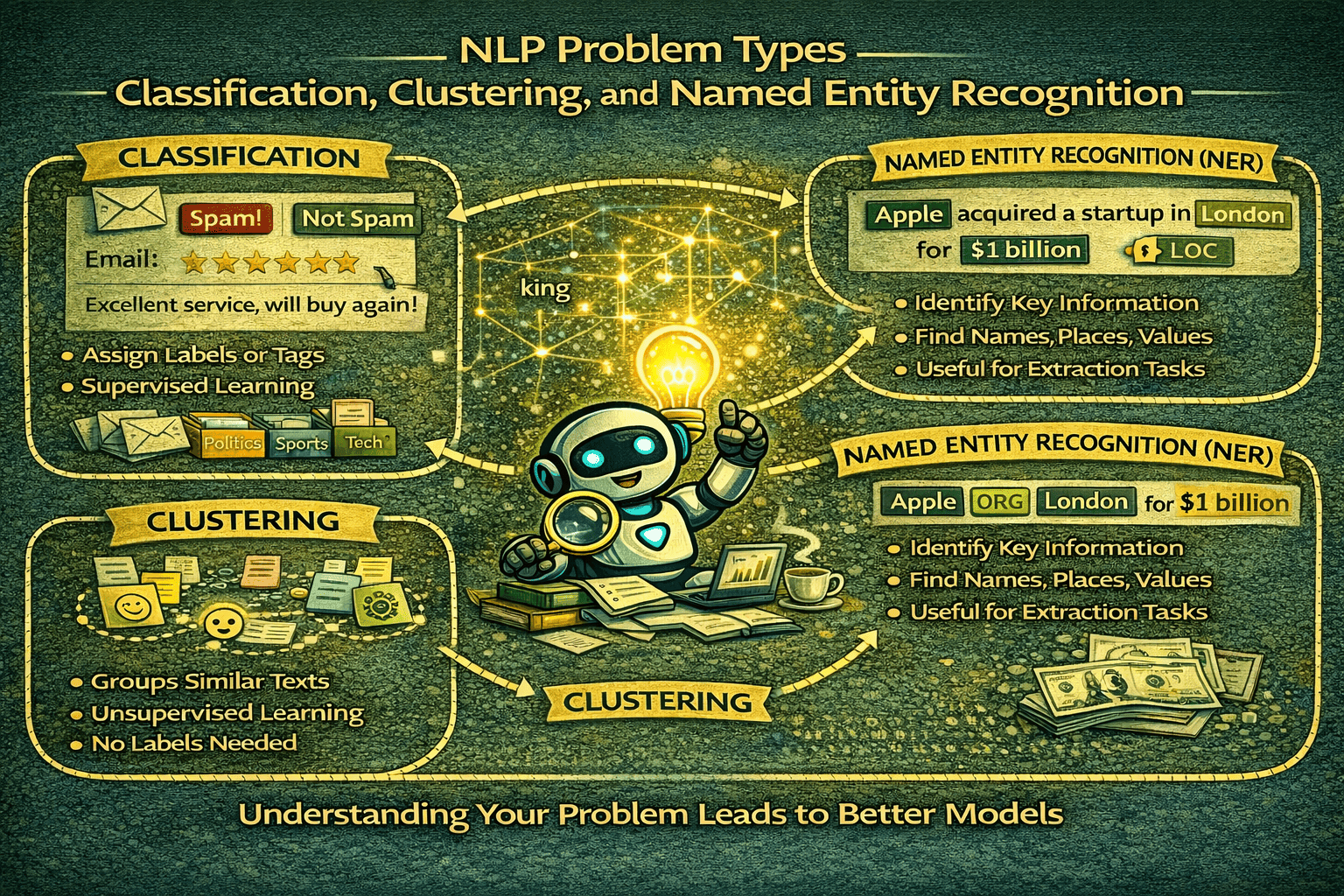
Text classification is one of the most common NLP problem types. Here, the goal is to assign one or more predefined labels to a piece of text. Examples include spam vs non-spam emails, positive vs negative sentiment, or categorizing news articles into topics like politics, sports, or technology. Classification is a supervised task, meaning you need labeled data. Many real-world NLP applications start here because classification is intuitive, measurable, and works well with both classical models and modern deep learning approaches.
Clustering is different. Instead of assigning known labels, clustering groups similar texts together based on their content. This is an unsupervised task, useful when labels are unavailable or expensive to create. For example, clustering customer feedback can reveal recurring themes or hidden patterns without explicitly defining categories upfront. The challenge with clustering is evaluation—it’s often harder to judge “correctness” because there’s no ground truth.
Named Entity Recognition (NER) focuses on identifying and classifying specific entities within text, such as names of people, organizations, locations, dates, or monetary values. In a sentence like “Apple acquired a startup in London for $1 billion,” NER systems label “Apple,” “London,” and “$1 billion” as meaningful entities. NER is crucial in applications like resume parsing, legal document analysis, and information extraction.
Understanding these problem types helps you design the right pipeline, choose suitable features, and evaluate models correctly. A clear problem definition often matters more than model complexity—and getting this right early saves a lot of rework later.
Top Tutorials

Python
Python is a popular and versatile programming language used for a wide variety of tasks, including web development, data analysis, artificial intelligence, and more.
SQL
The SQL for Beginners Tutorial is a concise and easy-to-follow guide designed for individuals new to Structured Query Language (SQL). It covers the fundamentals of SQL, a powerful programming language used for managing relational databases. The tutorial introduces key concepts such as creating, retrieving, updating, and deleting data in a database using SQL queries.

Data Science
Learn Data Science for free with our data science tutorial. Explore essential skills, tools, and techniques to master Data Science and kickstart your career

 in Bengaluru, India



All Courses (6)
Master's Degree (2)
Fellowship (2)
Certifications (2)

 Bag of Words and N-gram Models

 in Bengaluru, India