
Your Success, Our Mission!
6000+ Careers Transformed.
As NLP continues accelerating, 2026 and beyond will be defined by more human-centric, inclusive, efficient, and responsible language technologies. Traditional rule-based systems are being replaced by models that can understand, generate, and interact using natural language in dynamic environments. The field is moving toward multi-modal understanding, where language interacts with vision, speech, and structured data in unified models. Similarly, real-time, on-edge NLP, privacy-preserving inference, and energy-efficient architectures are becoming essential for scalability and sustainability.
One of the biggest ongoing shifts is the rise of Large Language Models (LLMs) and foundation models—general models pretrained on massive corpora and adapted to many tasks via prompt engineering or fine-tuning. Researchers are also focusing on explainability, fairness, and data supply chains to ensure models behave ethically and safely. Open-source NLP continues to grow rapidly, democratizing access to state-of-the-art models.
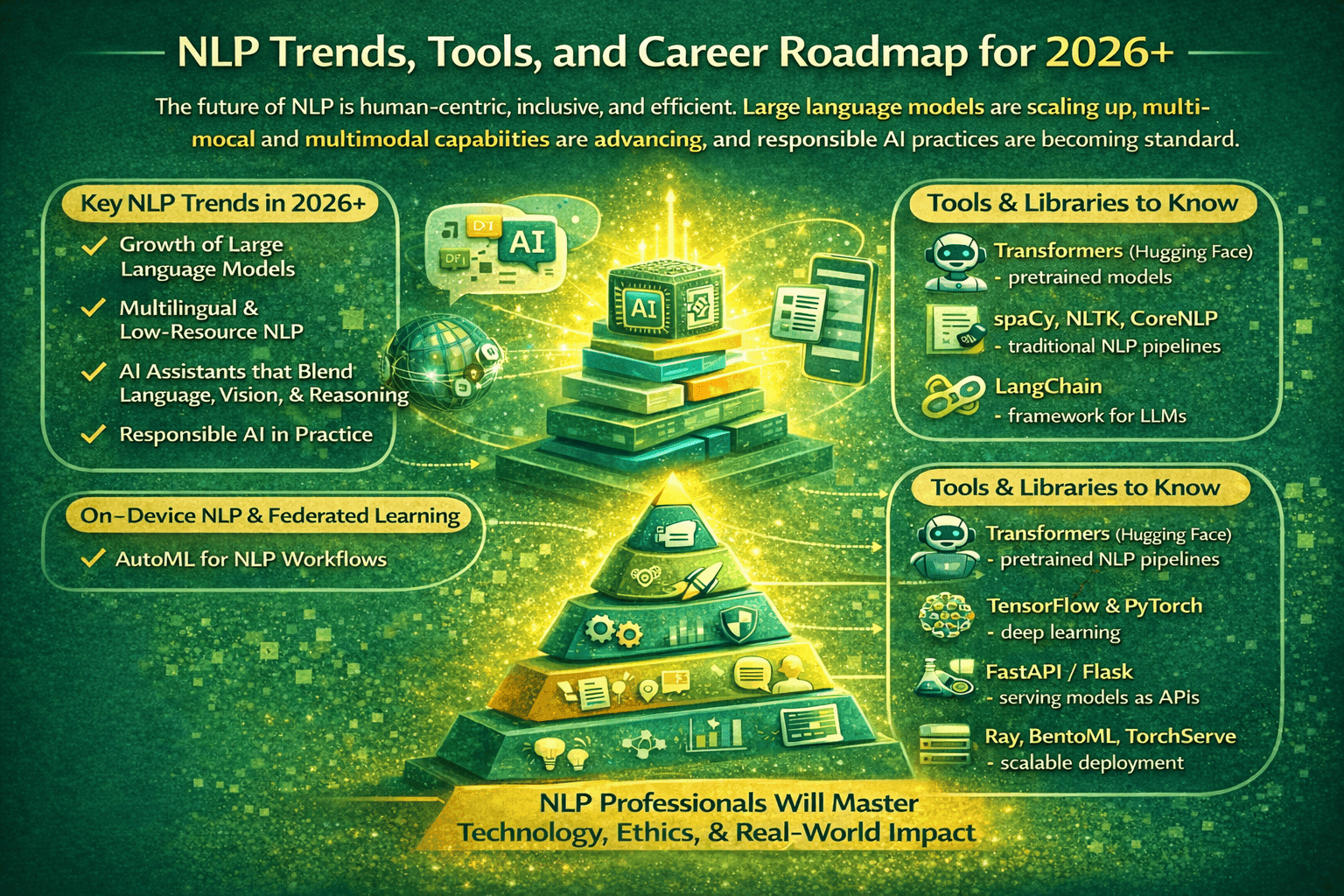
Key NLP trends in 2026+:
Continued growth of LLMs and instruction-tuned models
Multilingual NLP with low-resource language support
AI assistants that blend language, vision, and reasoning
Responsible AI: bias auditing, transparency, and ethical evaluation
On-device NLP and federated learning for privacy
AutoML for NLP workflows and automated model lifecycle
Tools and Libraries to Know
Enterprise and research NLP depends on powerful ecosystems. Leading tools include:
Transformers (Hugging Face) — dominant library for pretrained models
spaCy, NLTK, and CoreNLP — robust for traditional NLP pipelines
LangChain — bridges LLMs with applications, databases, and reasoning
TensorFlow & PyTorch — deep learning backbones
FastAPI / Flask — for serving models as APIs
Ray, BentoML, TorchServe — scalable model deployment
Career Roadmap for NLP (2026+)
Whether you are a beginner or upskilling, pathways remain flexible:
Foundations: Python, statistics, linear algebra, NLP basics
Intermediate Skills: embeddings, transformers, sequence modeling
Advanced Expertise: LLM training, mult-modal systems, prompt strategy
Production Skills: MLOps/ModelOps, deployment, monitoring
Ethics & Safety: Bias mitigation, privacy, fairness assurance
Specialized Tracks: speech NLP, BioNLP, legal/health document AI
Hands-on projects are crucial: build chatbots, NER systems, search engines, summarizers, and domain-specific assistants. Contribute to open-source, publish notebooks, and stay current with conferences like ACL, NeurIPS, and industry forums.
In 2026 and beyond, NLP professionals will combine deep technical expertise with a strong understanding of real-world impact, ethics, and scalability.
Top Tutorials

Python
Python is a popular and versatile programming language used for a wide variety of tasks, including web development, data analysis, artificial intelligence, and more.
SQL
The SQL for Beginners Tutorial is a concise and easy-to-follow guide designed for individuals new to Structured Query Language (SQL). It covers the fundamentals of SQL, a powerful programming language used for managing relational databases. The tutorial introduces key concepts such as creating, retrieving, updating, and deleting data in a database using SQL queries.

Data Science
Learn Data Science for free with our data science tutorial. Explore essential skills, tools, and techniques to master Data Science and kickstart your career

 in Bengaluru, India



All Courses (6)
Master's Degree (2)
Fellowship (2)
Certifications (2)

 Designing End-to-End NLP Pipelines

 in Bengaluru, India