

Your Success, Our Mission!
6000+ Careers Transformed.
When people talk about working with text, terms like NLP, text mining, and large language models (LLMs) are often used interchangeably. While they are related, they are not the same thing. Understanding the difference early will save you a lot of confusion later.
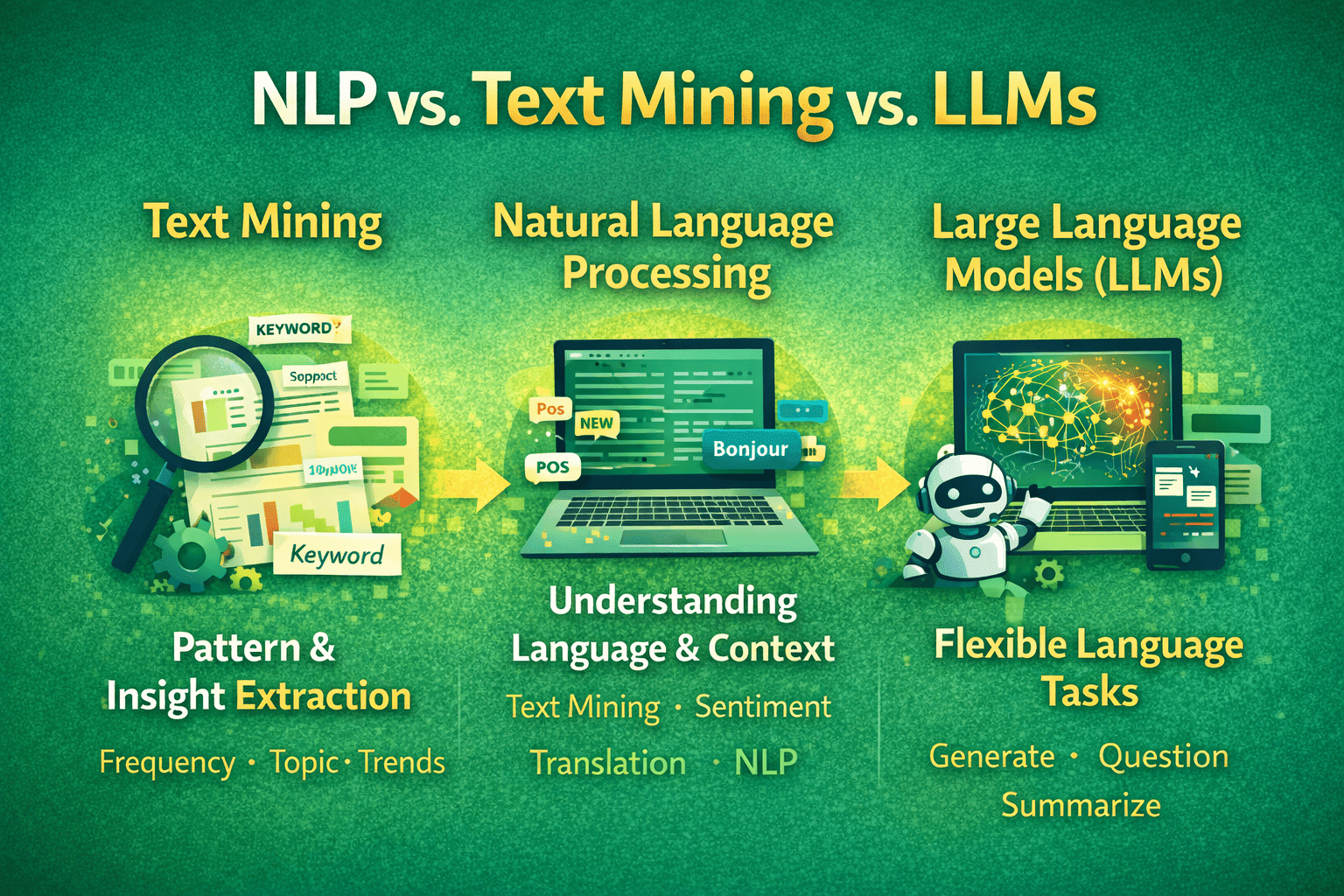
Text mining is primarily about extracting patterns and insights from large collections of text. The focus is less on language understanding and more on analysis. Tasks like finding frequent keywords, discovering topics in documents, or identifying trends in customer reviews fall under text mining. It usually relies on statistical techniques and simpler representations of text, and it answers questions like “What is being talked about the most?”
Natural Language Processing, on the other hand, goes a step further. NLP is concerned with how machines process and work with language itself. It includes text mining, but also covers tasks such as part-of-speech tagging, named entity recognition, sentiment analysis, and language translation. NLP tries to model structure, meaning, and context, not just counts and frequencies.
Large Language Models (LLMs) are a more recent development built on top of NLP and deep learning. They are trained on massive amounts of text and can perform many NLP tasks with little or no task-specific training. LLMs can generate text, answer questions, summarize documents, and even reason to some extent. However, they are not a replacement for NLP fundamentals—they depend on them.
A simple way to think about it is this: text mining helps you analyze text, NLP helps machines understand text, and LLMs help machines use language flexibly. In this roadmap, you’ll learn all three—but in the right order.
Top Tutorials

Python
Python is a popular and versatile programming language used for a wide variety of tasks, including web development, data analysis, artificial intelligence, and more.
SQL
The SQL for Beginners Tutorial is a concise and easy-to-follow guide designed for individuals new to Structured Query Language (SQL). It covers the fundamentals of SQL, a powerful programming language used for managing relational databases. The tutorial introduces key concepts such as creating, retrieving, updating, and deleting data in a database using SQL queries.

Data Science
Learn Data Science for free with our data science tutorial. Explore essential skills, tools, and techniques to master Data Science and kickstart your career

 in Bengaluru, India



All Courses (6)
Master's Degree (2)
Fellowship (2)
Certifications (2)

 What is Natural Language Processing?

 in Bengaluru, India