

Your Success, Our Mission!
6000+ Careers Transformed.
Training a powerful language model from scratch is expensive, time-consuming, and often unnecessary. This is where pre-trained models changed the NLP landscape. Instead of starting with random weights, models are first trained on massive amounts of text to learn general language patterns. Later, they are adapted to specific tasks with much smaller datasets—a process known as fine-tuning.
Pre-trained models like BERT-style encoders or GPT-style decoders already understand grammar, syntax, and a surprising amount of world knowledge. They know that “Paris” is related to “France,” that questions often start with “what” or “why,” and that certain words tend to appear together. When you fine-tune such a model, you’re not teaching it language from scratch—you’re simply nudging it to perform a specific task better.
Fine-tuning typically involves adding a small task-specific layer on top of the pre-trained model and training the entire system (or part of it) on labeled data. For example, the same base model can be fine-tuned for sentiment analysis, question answering, or named entity recognition, just by changing the training objective and data. This reuse is one of the biggest reasons modern NLP development is so fast.
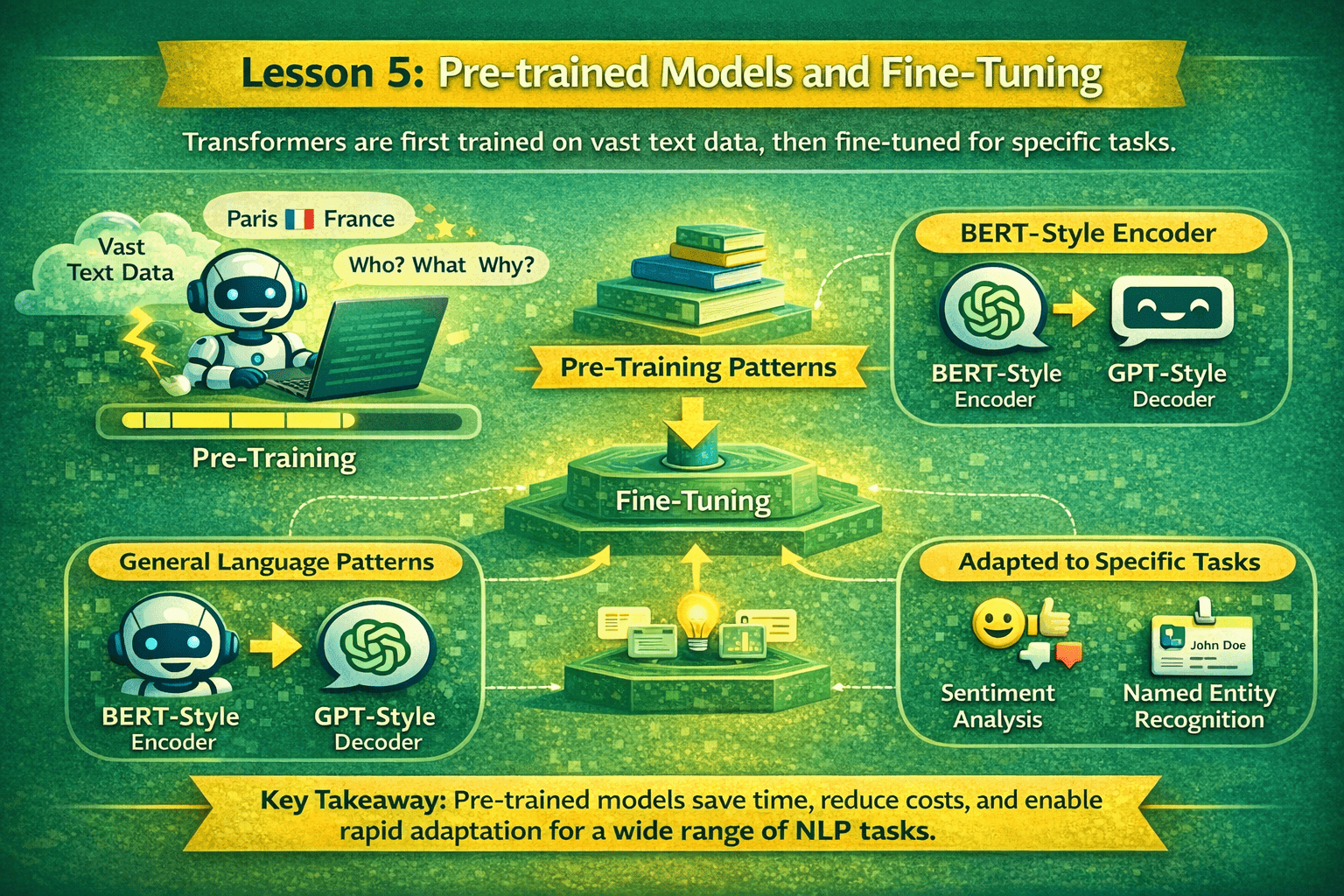
An important concept here is transfer learning. Knowledge learned from one task or dataset transfers to another. This is especially valuable in NLP, where labeled data can be scarce or expensive. With pre-trained models, even a few thousand examples can produce strong results.
However, fine-tuning is not always trivial. Models can overfit small datasets, forget useful general knowledge, or become biased toward the fine-tuning data. This is why careful evaluation and experimentation matter.
The key takeaway is this: pre-trained models turned NLP from a “build everything yourself” field into a reuse-and-adapt discipline. Once you understand this shift, modern NLP workflows start to feel far more practical and accessible.
Top Tutorials

Python
Python is a popular and versatile programming language used for a wide variety of tasks, including web development, data analysis, artificial intelligence, and more.
SQL
The SQL for Beginners Tutorial is a concise and easy-to-follow guide designed for individuals new to Structured Query Language (SQL). It covers the fundamentals of SQL, a powerful programming language used for managing relational databases. The tutorial introduces key concepts such as creating, retrieving, updating, and deleting data in a database using SQL queries.

Data Science
Learn Data Science for free with our data science tutorial. Explore essential skills, tools, and techniques to master Data Science and kickstart your career

 in Bengaluru, India



All Courses (6)
Master's Degree (2)
Fellowship (2)
Certifications (2)

 Neural Networks for NLP – A Gentle Refresher
 in Bengaluru, India