

Your Success, Our Mission!
6000+ Careers Transformed.
NLP becomes much easier to understand once you see where it actually shows up in real life. By 2026, NLP is no longer limited to research labs or big tech companies—it’s quietly embedded into everyday tools that people use without even thinking about it.
One of the most common applications is customer communication. Chatbots and virtual assistants now handle support tickets, booking requests, and FAQs across industries like banking, healthcare, and e-commerce. These systems rely on NLP to understand user intent, manage follow-up questions, and respond in a conversational way rather than through rigid scripts.
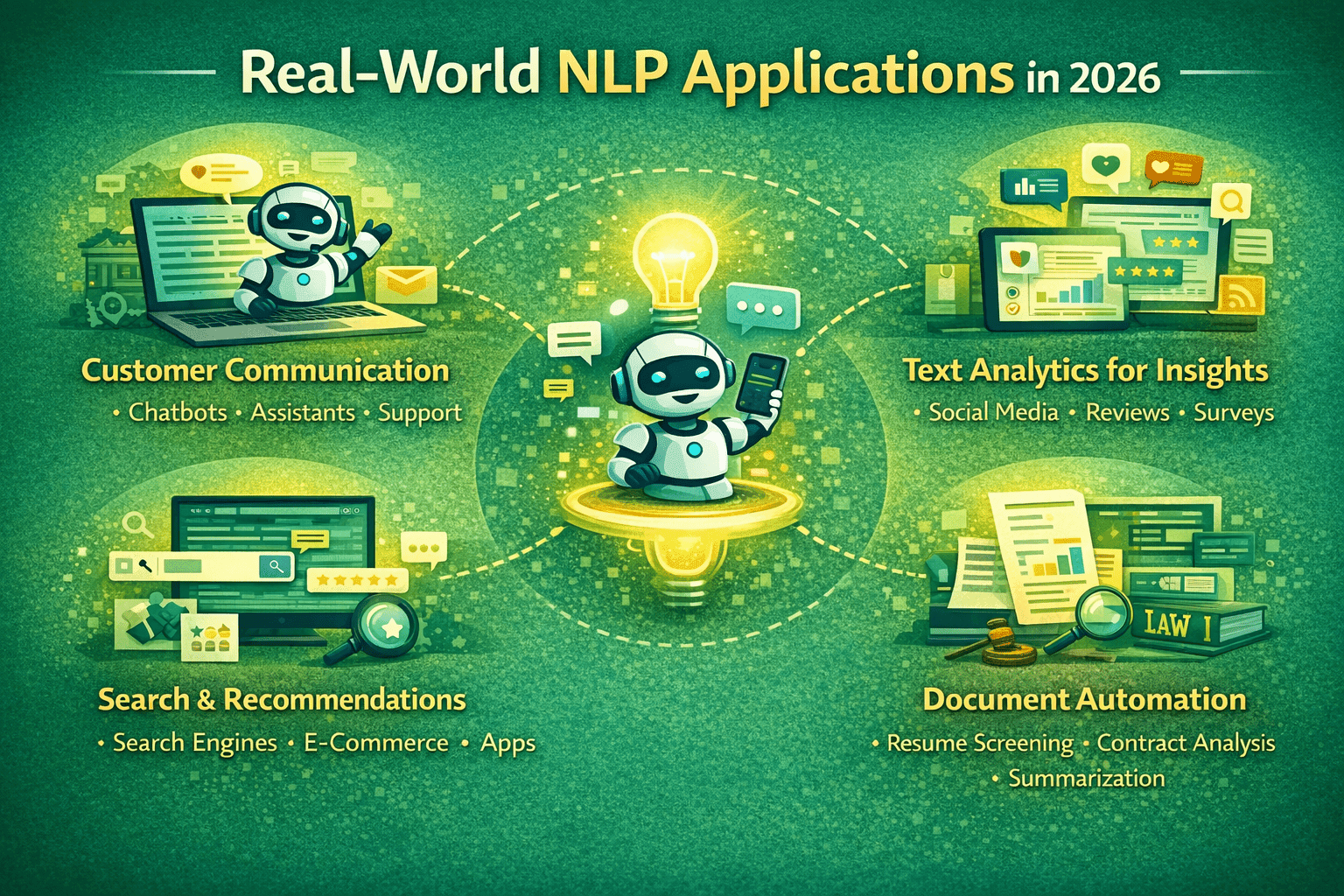
Another major area is text analytics for business insights. Companies analyze customer reviews, social media posts, and survey responses to understand sentiment, detect recurring issues, and track brand perception. Instead of manually reading thousands of comments, NLP models summarize opinions and highlight patterns that help decision-makers act faster.
NLP also plays a key role in search and recommendation systems. Modern search engines don’t just match keywords—they try to understand meaning, context, and user intent. Similarly, recommendation engines use NLP to analyze descriptions, queries, and user interactions to deliver more relevant results.
In professional settings, NLP powers document automation—from resume screening and contract analysis to summarization of long reports. In healthcare and legal domains, NLP assists experts by extracting critical information from large volumes of unstructured text.
What’s important to note is that most of these applications don’t rely on a single “magic model.” They combine preprocessing, domain knowledge, evaluation, and deployment strategies. As you move forward in this roadmap, you’ll learn how these real-world systems are actually built, step by step.
Top Tutorials

Python
Python is a popular and versatile programming language used for a wide variety of tasks, including web development, data analysis, artificial intelligence, and more.
SQL
The SQL for Beginners Tutorial is a concise and easy-to-follow guide designed for individuals new to Structured Query Language (SQL). It covers the fundamentals of SQL, a powerful programming language used for managing relational databases. The tutorial introduces key concepts such as creating, retrieving, updating, and deleting data in a database using SQL queries.

Data Science
Learn Data Science for free with our data science tutorial. Explore essential skills, tools, and techniques to master Data Science and kickstart your career

 in Bengaluru, India



All Courses (6)
Master's Degree (2)
Fellowship (2)
Certifications (2)

 What is Natural Language Processing?

 in Bengaluru, India