

Your Success, Our Mission!
6000+ Careers Transformed.
One major limitation of the models we’ve discussed so far is that they don’t naturally understand order. Language, however, is sequential by nature—the meaning of a word often depends on what came before it. This is where Recurrent Neural Networks (RNNs) were a big step forward in NLP.
An RNN processes text one word at a time, maintaining a hidden state that acts like a memory of previous words. In theory, this allows the model to understand sequences and context. In practice, basic RNNs struggle with long sentences. As sequences get longer, they suffer from the vanishing gradient problem, making it hard to retain information from earlier words.
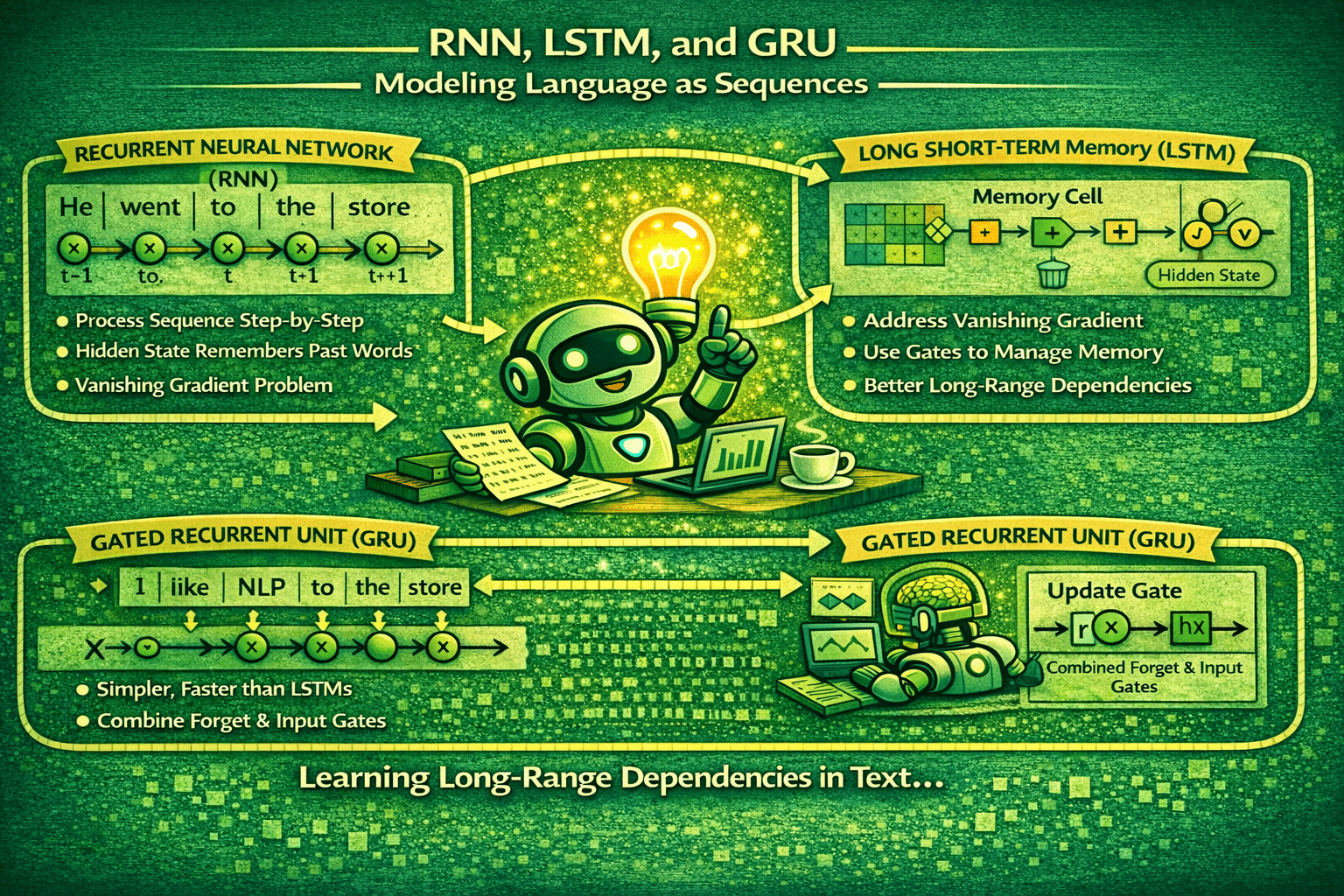
To address this, more advanced architectures were introduced. Long Short-Term Memory (LSTM) networks add gates that control what information should be remembered, forgotten, or updated. This gating mechanism allows LSTMs to capture long-range dependencies, such as linking pronouns to nouns that appeared several words earlier. For many years, LSTMs were the go-to model for tasks like machine translation, speech recognition, and text generation.
Gated Recurrent Units (GRUs) are a simpler alternative to LSTMs. They combine some of the gating mechanisms into a more compact structure, making them faster to train while still handling long-term dependencies reasonably well. In many practical cases, GRUs perform similarly to LSTMs with fewer parameters.
While RNNs, LSTMs, and GRUs were groundbreaking, they still process text sequentially, which makes training slow and limits scalability. Understanding their strengths and weaknesses is important, because these limitations directly led to the development of attention mechanisms and transformers—topics you’ll explore next.
Top Tutorials

Python
Python is a popular and versatile programming language used for a wide variety of tasks, including web development, data analysis, artificial intelligence, and more.
SQL
The SQL for Beginners Tutorial is a concise and easy-to-follow guide designed for individuals new to Structured Query Language (SQL). It covers the fundamentals of SQL, a powerful programming language used for managing relational databases. The tutorial introduces key concepts such as creating, retrieving, updating, and deleting data in a database using SQL queries.

Data Science
Learn Data Science for free with our data science tutorial. Explore essential skills, tools, and techniques to master Data Science and kickstart your career

 in Bengaluru, India



All Courses (6)
Master's Degree (2)
Fellowship (2)
Certifications (2)

 Neural Networks for NLP – A Gentle Refresher
 in Bengaluru, India