

Your Success, Our Mission!
6000+ Careers Transformed.
Once you’ve identified your text data, the very next challenge is dealing with how raw and inconsistent it usually is. Real-world text is rarely ready for modeling straight away. It comes with noise—extra spaces, random capitalization, HTML tags, emojis, URLs, spelling variations, and symbols that don’t add much meaning. Text cleaning is about reducing this noise so models can focus on what actually matters.
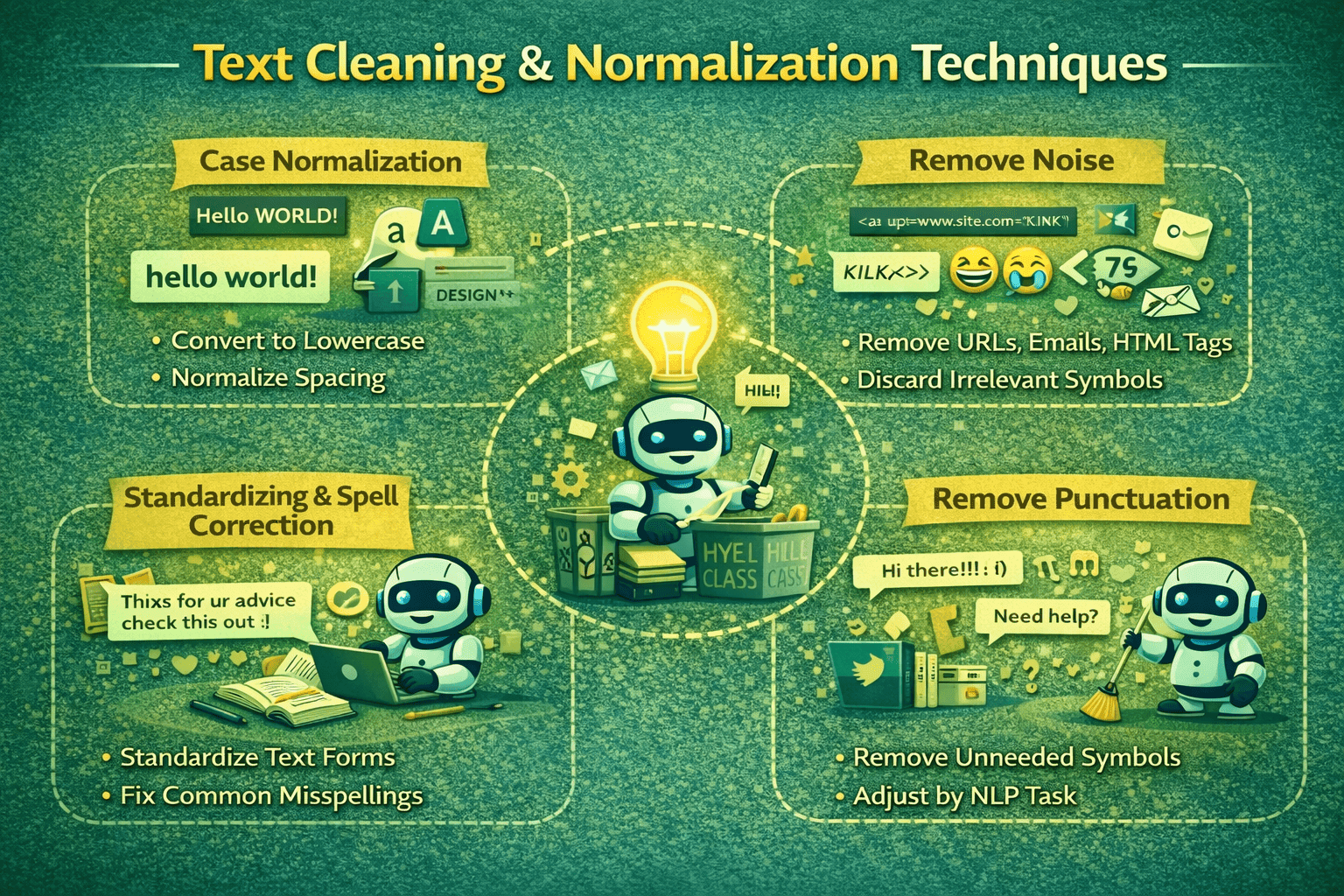
A common first step is case normalization. Converting all text to lowercase helps treat words like “Apple” and “apple” as the same token, unless capitalization itself carries meaning (as in named entities). Similarly, removing extra whitespace, line breaks, and formatting characters makes text easier to process.
Another key step is handling punctuation and special characters. In some tasks, punctuation adds no value and can be removed. In others—such as sentiment analysis—exclamation marks or question marks may carry useful signals. This is why cleaning decisions should always depend on the task, not habits.
Removing URLs, email addresses, and HTML tags is common when working with scraped web data or social media content. These elements rarely help a model understand meaning, but they can inflate vocabulary size and add noise. Numbers may also be removed or replaced with placeholders, depending on whether they matter for your use case.
Normalization also includes standardizing text forms, such as expanding contractions (“don’t” → “do not”) or correcting common spelling variations. In multilingual or informal data, normalization helps reduce unnecessary diversity in word forms.
The most important idea to remember is this: text cleaning is not about blindly deleting things. It’s about making the text consistent and meaningful for the task at hand. Done well, good preprocessing often improves model performance more than switching to a more complex algorithm.
Top Tutorials

Python
Python is a popular and versatile programming language used for a wide variety of tasks, including web development, data analysis, artificial intelligence, and more.

SQL
The SQL for Beginners Tutorial is a concise and easy-to-follow guide designed for individuals new to Structured Query Language (SQL). It covers the fundamentals of SQL, a powerful programming language used for managing relational databases. The tutorial introduces key concepts such as creating, retrieving, updating, and deleting data in a database using SQL queries.

Data Science
Learn Data Science for free with our data science tutorial. Explore essential skills, tools, and techniques to master Data Science and kickstart your career

 in Bengaluru, India



All Courses (6)
Master's Degree (2)
Fellowship (2)
Certifications (2)

 Types of Text Data and Data Sources

 in Bengaluru, India