

Your Success, Our Mission!
6000+ Careers Transformed.
Once text is cleaned and normalized, the next step is breaking it down into pieces that a machine can actually work with. This process is called tokenization, and it’s one of the most fundamental steps in NLP. Tokens are usually words, but they can also be characters, subwords, or even whole sentences, depending on the task and model.
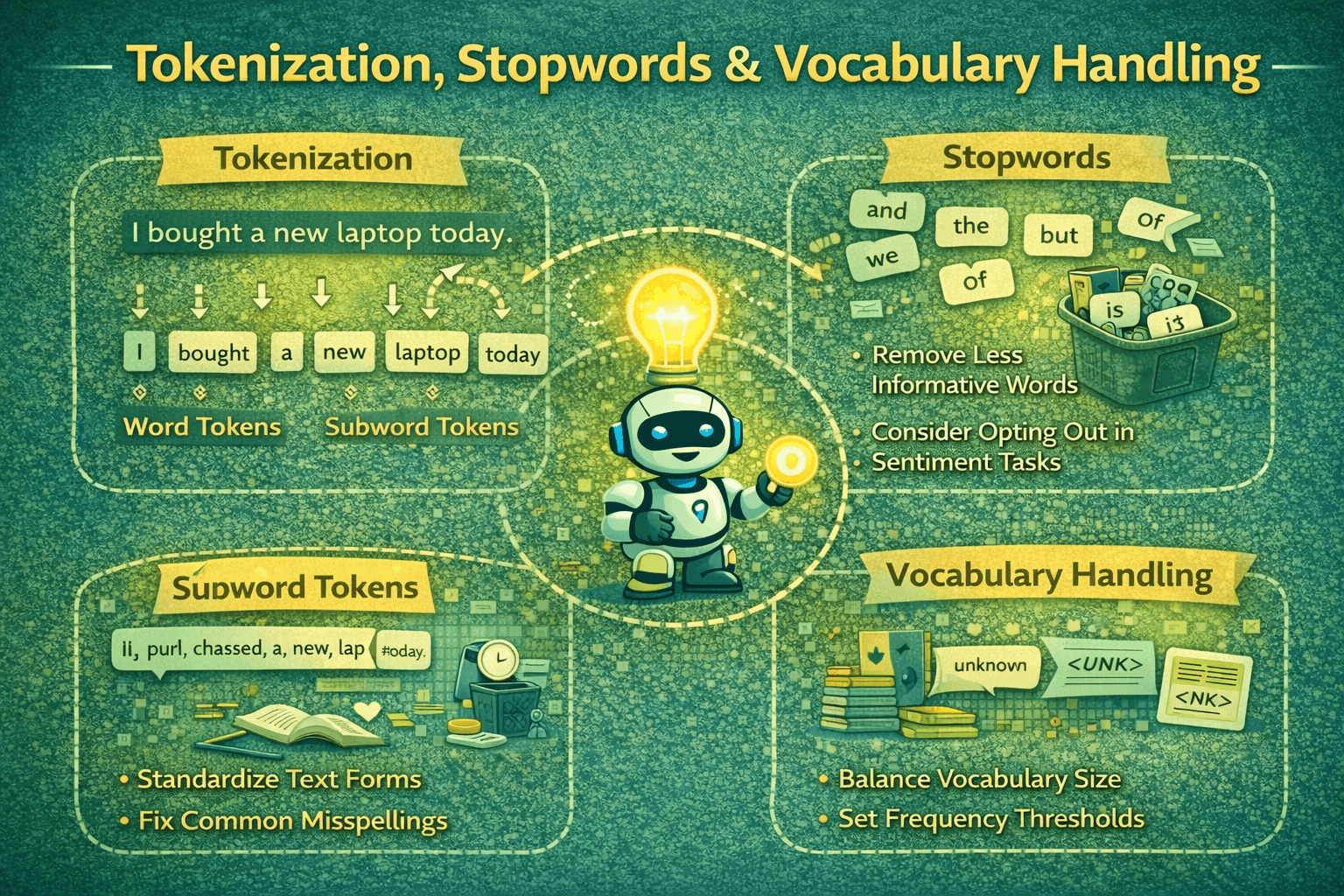
The simplest form is word-level tokenization, where a sentence is split into individual words based on spaces and punctuation. While this works well for many use cases, it has limitations—especially with languages that don’t use spaces consistently or with informal text full of abbreviations and emojis. That’s why more advanced approaches, like subword tokenization, are commonly used in modern NLP systems. These methods break words into smaller units, helping models handle rare words, spelling variations, and new vocabulary more effectively.
Another important concept is stopwords. These are very common words such as “the,” “is,” “and,” or “of” that often don’t add much meaning on their own. In tasks like topic modeling or keyword extraction, removing stopwords can help models focus on more informative terms. However, stopwords are not always useless. In tasks involving sentiment or intent, words like “not” or “never” can completely change the meaning of a sentence. This is why stopword removal should always be task-aware.
Finally, there’s vocabulary handling. The vocabulary is the set of unique tokens a model knows. If it’s too large, models become slow and memory-heavy. If it’s too small, important information may be lost. Practical NLP involves balancing this trade-off using techniques like frequency thresholds or special “unknown” tokens.
At this stage, the key idea is simple: how you break text into tokens—and which tokens you keep—directly shapes what your model can learn. Good tokenization often matters more than model complexity.
Top Tutorials

Python
Python is a popular and versatile programming language used for a wide variety of tasks, including web development, data analysis, artificial intelligence, and more.
SQL
The SQL for Beginners Tutorial is a concise and easy-to-follow guide designed for individuals new to Structured Query Language (SQL). It covers the fundamentals of SQL, a powerful programming language used for managing relational databases. The tutorial introduces key concepts such as creating, retrieving, updating, and deleting data in a database using SQL queries.

Data Science
Learn Data Science for free with our data science tutorial. Explore essential skills, tools, and techniques to master Data Science and kickstart your career

 in Bengaluru, India



All Courses (6)
Master's Degree (2)
Fellowship (2)
Certifications (2)

 Types of Text Data and Data Sources

 in Bengaluru, India