

Your Success, Our Mission!
6000+ Careers Transformed.
The attention mechanism solved a major problem in sequence models, but researchers soon asked an even bigger question: do we need recurrence at all? The answer led to one of the most important breakthroughs in NLP—the transformer architecture.
Transformers remove recurrent connections entirely and rely only on attention to model relationships between words. Instead of processing text step by step, transformers look at the entire sequence at once. This allows them to capture long-range dependencies more effectively and train much faster, especially on large datasets.
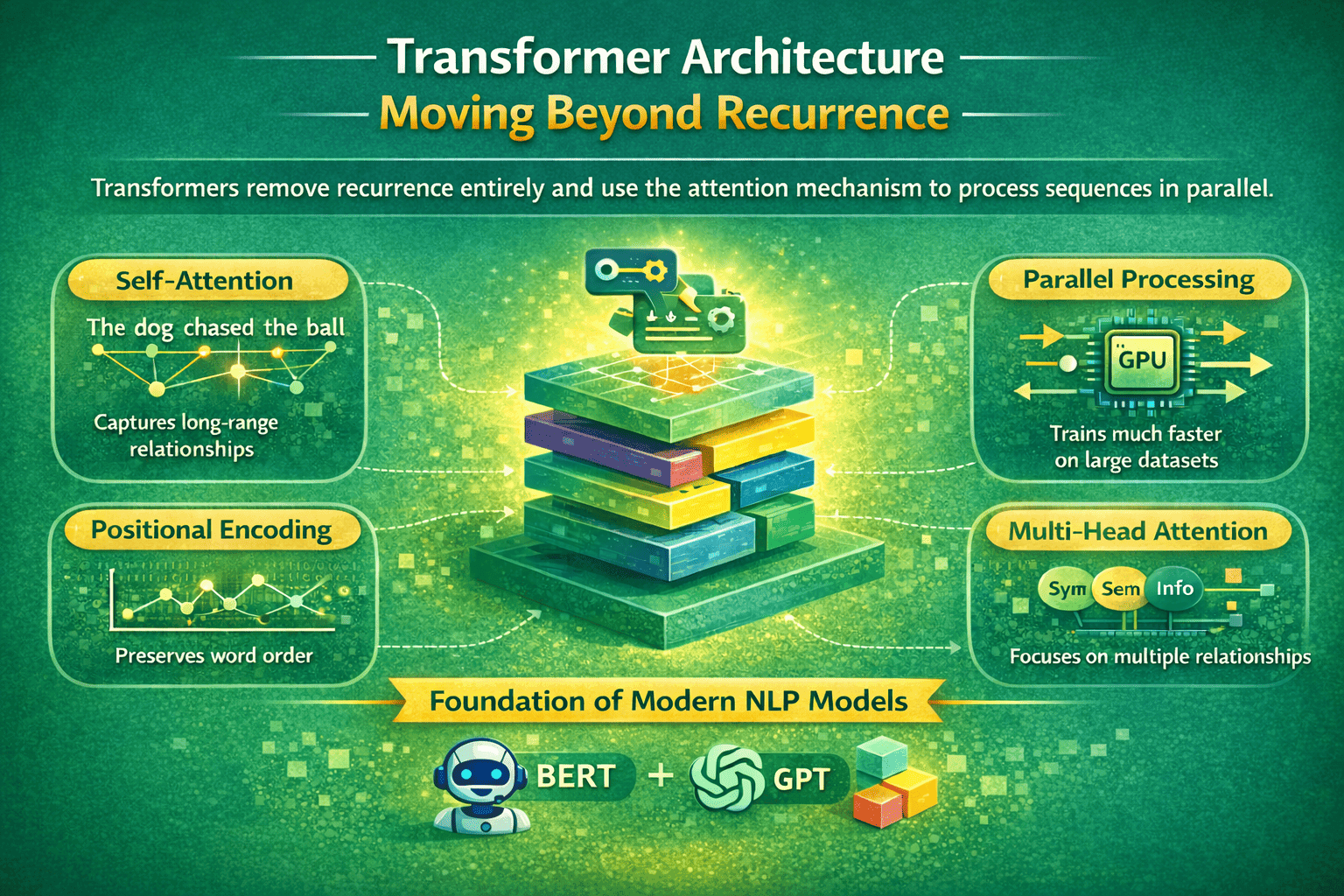
At the heart of a transformer is self-attention. Each word in a sentence looks at every other word and decides how much attention to pay to them. This makes it possible for the model to understand relationships like subject–verb agreement or references (“it,” “they”) no matter how far apart the words are. Unlike RNNs, distance in the sentence is no longer a bottleneck.
Transformers are built using stacked layers composed of multi-head attention, feedforward networks, and residual connections. Multi-head attention allows the model to focus on different types of relationships simultaneously—syntax in one head, semantics in another. Positional encoding is added to preserve word order, since the model no longer processes words sequentially.
The real impact of transformers comes from scalability. Because they process sequences in parallel, they can be trained on massive corpora using modern hardware. This scalability is what enabled the rise of models like BERT, GPT, and many others.
Understanding transformers is a turning point in NLP learning. Once you grasp this architecture, modern language models stop feeling mysterious—they become logical extensions of ideas you’ve already seen: attention, representation learning, and scale.
Top Tutorials

Python
Python is a popular and versatile programming language used for a wide variety of tasks, including web development, data analysis, artificial intelligence, and more.
SQL
The SQL for Beginners Tutorial is a concise and easy-to-follow guide designed for individuals new to Structured Query Language (SQL). It covers the fundamentals of SQL, a powerful programming language used for managing relational databases. The tutorial introduces key concepts such as creating, retrieving, updating, and deleting data in a database using SQL queries.

Data Science
Learn Data Science for free with our data science tutorial. Explore essential skills, tools, and techniques to master Data Science and kickstart your career

 in Bengaluru, India



All Courses (6)
Master's Degree (2)
Fellowship (2)
Certifications (2)

 Neural Networks for NLP – A Gentle Refresher
 in Bengaluru, India