

Your Success, Our Mission!
6000+ Careers Transformed.
Before you can clean, analyze, or model text, you need to understand what kind of text data you’re actually dealing with. Not all text is the same, and the source of the data often determines how difficult the NLP task will be.
The most common type is structured text, where the content follows a predictable format. Examples include survey responses stored in tables, customer support tickets with fixed fields, or product reviews linked to ratings. This type of data is easier to manage because it already comes with some organization, even if the text itself is messy.
Next comes semi-structured text. Think of emails, web pages, logs, or JSON documents. There is some structure—like headers, tags, or metadata—but the main content is still free-form text. A lot of real-world NLP work happens here, especially in business and enterprise applications.
The most challenging category is unstructured text. This includes social media posts, chat messages, transcripts, handwritten text converted via OCR, and raw documents like PDFs. Unstructured text often contains slang, emojis, spelling errors, mixed languages, and incomplete sentences. This is where preprocessing and domain understanding become critical.
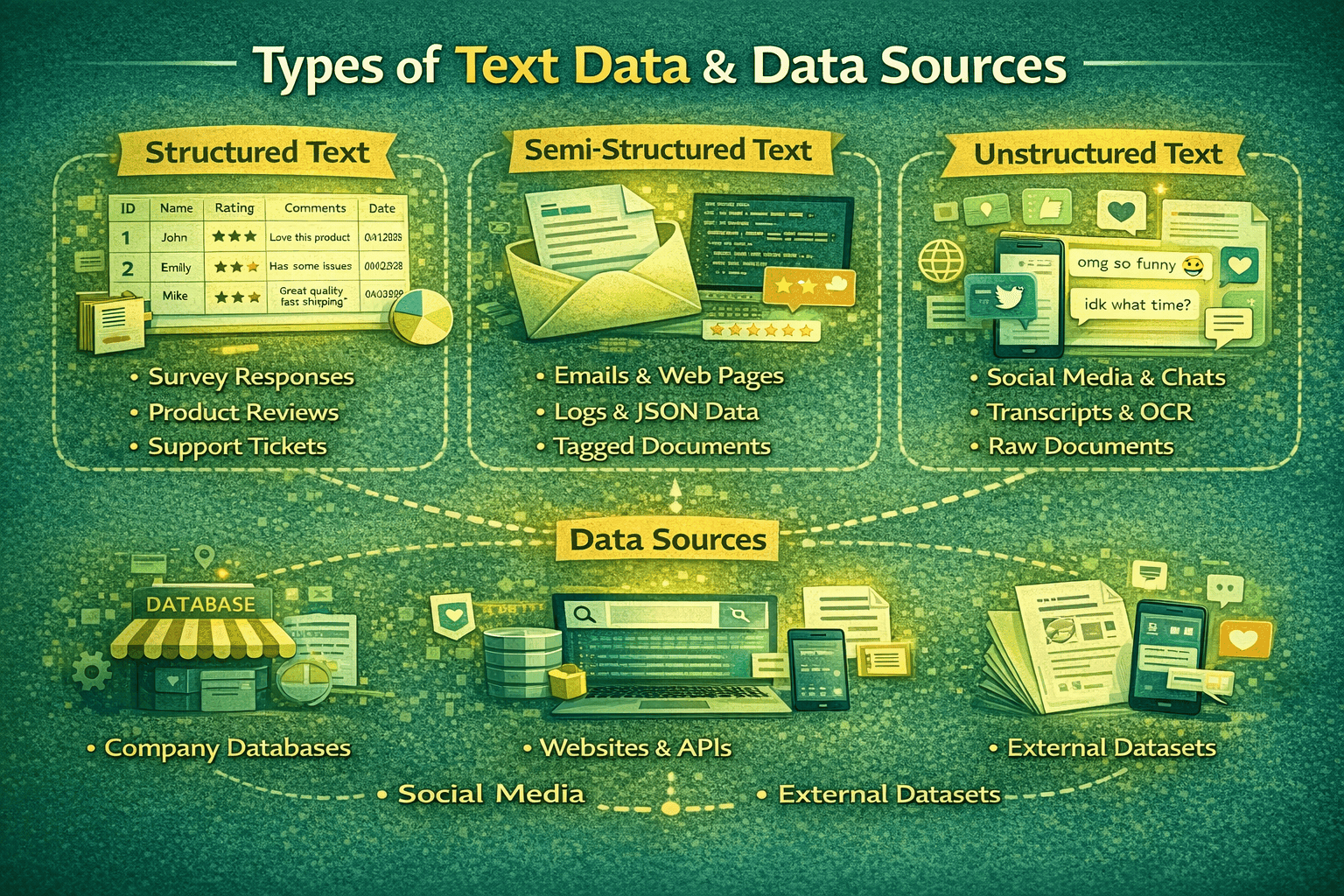
Text data can come from many sources: internal company databases, websites, APIs, social media platforms, customer feedback forms, research papers, or open datasets. Each source brings its own quirks and biases. For example, Twitter data is short and informal, while legal documents are long and highly structured in language.
Understanding the type and source of your text helps you set realistic expectations. It influences how much cleaning is needed, which techniques will work best, and how reliable your results can be. In NLP, knowing your data well is often more important than choosing a complex model.
Top Tutorials

Python
Python is a popular and versatile programming language used for a wide variety of tasks, including web development, data analysis, artificial intelligence, and more.
SQL
The SQL for Beginners Tutorial is a concise and easy-to-follow guide designed for individuals new to Structured Query Language (SQL). It covers the fundamentals of SQL, a powerful programming language used for managing relational databases. The tutorial introduces key concepts such as creating, retrieving, updating, and deleting data in a database using SQL queries.

Data Science
Learn Data Science for free with our data science tutorial. Explore essential skills, tools, and techniques to master Data Science and kickstart your career

 in Bengaluru, India



All Courses (6)
Master's Degree (2)
Fellowship (2)
Certifications (2)

 Types of Text Data and Data Sources

 in Bengaluru, India