

Your Success, Our Mission!
6000+ Careers Transformed.
So far, the text representations we’ve discussed treat words mostly as independent units. They don’t really understand that “king” and “queen” are related, or that “happy” and “joyful” are closer in meaning than “happy” and “table.” Word embeddings were a major breakthrough because they finally gave models a way to capture these relationships.
Word embeddings represent words as dense numerical vectors, where semantic similarity is reflected by distance in vector space. Words with similar meanings end up closer together. This allows models to generalize better and learn patterns that simple count-based methods miss.
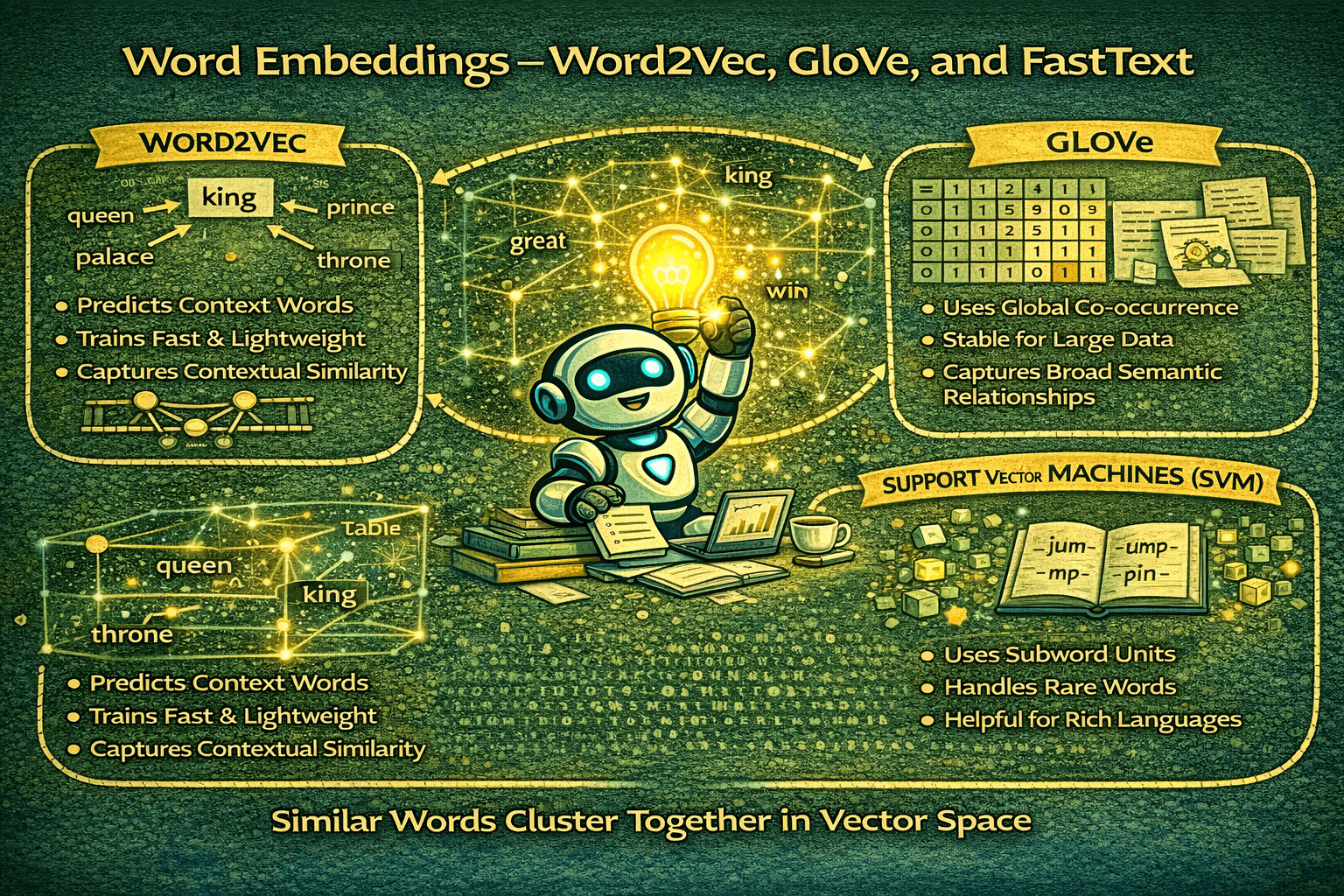
Word2Vec was one of the earliest popular embedding techniques. It learns word representations by predicting context words (or the other way around). The key idea is simple: words that appear in similar contexts tend to have similar meanings. Word2Vec embeddings are lightweight and fast to train, which made them extremely popular.
GloVe (Global Vectors) takes a slightly different approach. Instead of focusing only on local context, it uses global word co-occurrence statistics across the entire corpus. This helps GloVe capture broader semantic relationships, often producing more stable embeddings for larger datasets.
FastText improves on both by breaking words into subword units. This is especially useful for handling rare words, misspellings, and morphologically rich languages. If the model hasn’t seen a word before, it can still build a reasonable representation from its character-level components.
While embeddings have largely been replaced by contextual models in cutting-edge NLP, they are still incredibly important. They’re easier to interpret, cheaper to compute, and excellent for building intuition. Understanding them helps you appreciate why modern models work—and what problems they were designed to solve.
Top Tutorials

Python
Python is a popular and versatile programming language used for a wide variety of tasks, including web development, data analysis, artificial intelligence, and more.

SQL
The SQL for Beginners Tutorial is a concise and easy-to-follow guide designed for individuals new to Structured Query Language (SQL). It covers the fundamentals of SQL, a powerful programming language used for managing relational databases. The tutorial introduces key concepts such as creating, retrieving, updating, and deleting data in a database using SQL queries.

Data Science
Learn Data Science for free with our data science tutorial. Explore essential skills, tools, and techniques to master Data Science and kickstart your career

 in Bengaluru, India



All Courses (6)
Master's Degree (2)
Fellowship (2)
Certifications (2)

 Bag of Words and N-gram Models

 in Bengaluru, India