

Your Success, Our Mission!
6000+ Careers Transformed.
Explanation
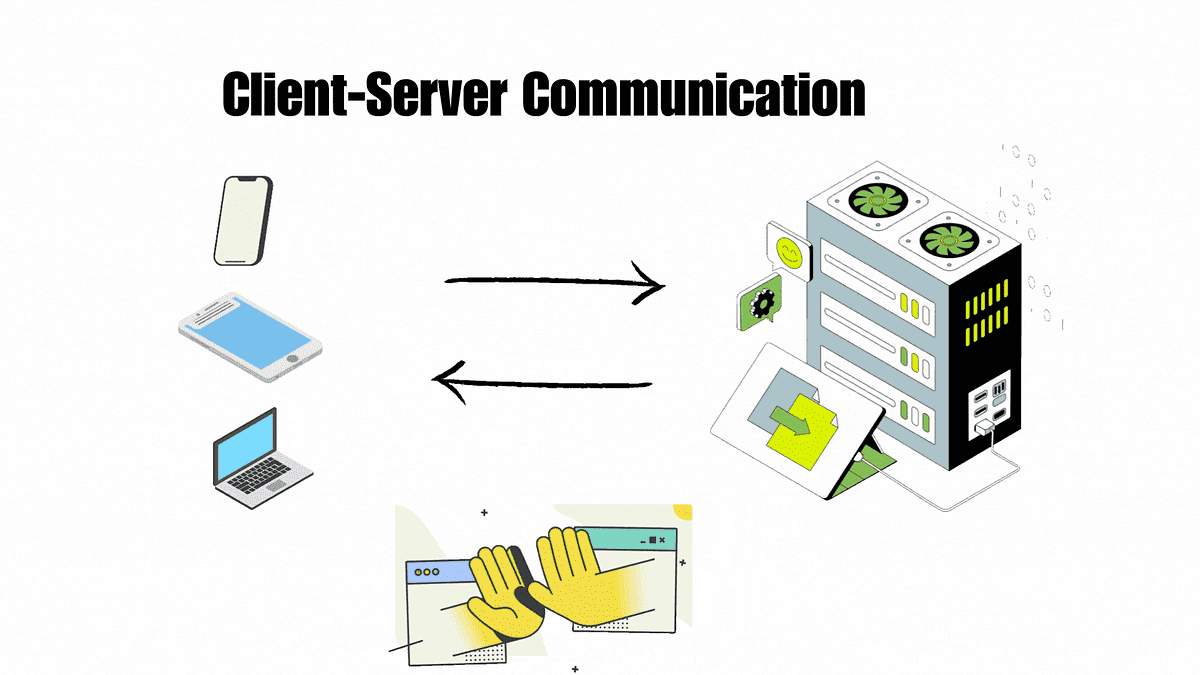
Clients are the entry point of any system and define how users or other systems interact with backend services. A client can be a web browser, mobile application, desktop application, IoT device, or even another backend service. From a system design perspective, understanding client behavior is critical because it directly impacts traffic patterns, latency expectations, security requirements, and scalability needs.
Communication models describe how clients talk to servers. Common models include synchronous request–response, asynchronous messaging, and streaming-based communication. In 2026, systems often support multiple communication models simultaneously, such as REST for standard operations, WebSockets for real-time updates, and event-driven messaging for background processing. Choosing the right communication model affects responsiveness, fault tolerance, and system complexity.
Table
Client Type | Typical Communication | Key Considerations |
| Web Browser | HTTP/HTTPS (REST) | Latency, caching, security |
| Mobile App | REST / GraphQL | Network variability, retries |
| Backend Service | gRPC / Messaging | Reliability, throughput |
| IoT Device | MQTT / HTTP | Low bandwidth, durability |
Example
A social media platform supports web and mobile clients. Web clients rely heavily on caching and CDNs for fast page loads, while mobile clients require optimized payload sizes due to limited bandwidth. Internally, backend services communicate using high-performance protocols like gRPC to handle millions of requests efficiently. Designing communication separately for external clients and internal services ensures both performance and scalability without overloading the system.
Use Cases
Designing APIs for web and mobile platforms
Supporting real-time features like chat and notifications
Optimizing backend-to-backend communication
Handling heterogeneous client environments
Explanation
Servers form the computational backbone of a system. They execute business logic, process requests, interact with databases, and coordinate with other services. In modern system design, servers are often specialized by role, such as API servers, background workers, authentication servers, or media processing servers. Separating responsibilities improves scalability, fault isolation, and maintainability.
Compute scaling determines how server capacity grows with demand. Vertical scaling increases the power of a single server, while horizontal scaling adds more servers. In 2026, horizontal scaling combined with containerization and orchestration is the dominant approach, as it provides better resilience and elasticity. System designers must also consider stateless versus stateful servers, as stateless designs simplify scaling and recovery.
Table
Server Type | Responsibility | Scaling Preference |
| API Server | Handle client requests | Horizontal |
| Worker Server | Background jobs | Horizontal |
| Auth Server | Identity validation | Horizontal |
| Media Server | File processing | Mixed |

Example
An e-commerce system uses stateless API servers behind a load balancer to handle incoming traffic. When traffic spikes during a sale, additional servers are automatically added to handle increased load. Background worker servers process tasks such as sending emails and generating invoices asynchronously. This separation ensures that heavy background tasks do not degrade the performance of user-facing requests.
Use Cases
Designing scalable backend architectures
Handling traffic spikes and seasonal demand
Improving fault isolation across services
Optimizing compute costs in cloud environments
Top Tutorials

CNN in Deep Learning 2026
A beginner-friendly guide to CNNs: understand deep learning essentials, create Python-based models, and explore advanced applications.

Breaking The Limits: Scaling Databases with MySQL Partitioning
Learn MySQL partitioning with examples. Improve query performance, scalability, and data management using RANGE, LIST, HASH, KEY, and composite techniques.

ML in Action: Hands-On Guide to Deploying and Serving Models
Learn model deployment and serving—from concepts to real-world architectures, tools, APIs, containers, and cloud workflows for production-ready ML.

 in Bengaluru, India



All Courses (6)
Master's Degree (2)
Fellowship (2)
Certifications (2)

 Clients and Communication Models


 in Bengaluru, India