

Your Success, Our Mission!
6000+ Careers Transformed.
Explanation
Scalability is the ability of a system to handle increased load without degradation in performance. The two primary scaling approaches are vertical scaling and horizontal scaling. Vertical scaling increases the resources of a single machine, such as CPU or memory, while horizontal scaling adds more machines to distribute the load.
From a system design perspective, horizontal scaling is generally preferred in modern architectures because it improves fault tolerance and supports elastic growth. However, it introduces challenges such as data partitioning, coordination, and consistency. In 2026, most scalable systems are designed to be horizontally scalable from the beginning, using stateless services and distributed data stores to simplify growth and recovery.
Table
Scaling Type | Advantage | Limitation |
| Vertical | Simple to implement | Hardware limits |
| Horizontal | High availability | Increased complexity |

Example
A startup initially runs its application on a single powerful server to minimize operational overhead. As user traffic grows, the system is redesigned to use multiple stateless servers behind a load balancer. This shift allows the application to scale dynamically during traffic spikes and remain available even if one server fails, demonstrating the long-term benefits of horizontal scaling.
Use Cases
Supporting rapid user growth
Handling unpredictable traffic patterns
Designing fault-tolerant systems
Building cloud-native applications
Explanation
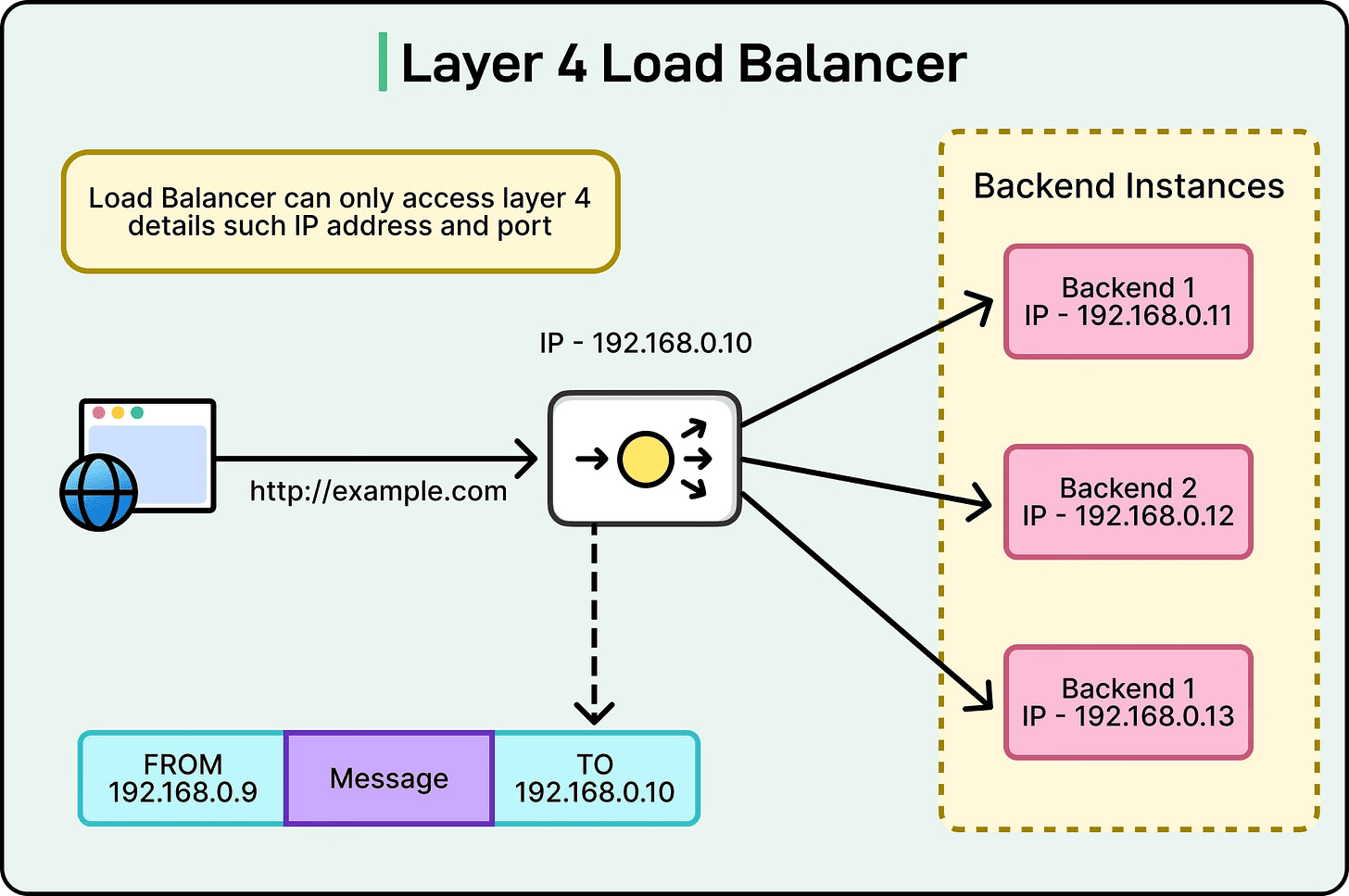
Load balancing distributes incoming traffic across multiple servers to prevent overload and improve availability. It acts as a control point that ensures no single server becomes a bottleneck. System designers must choose load balancing strategies based on traffic patterns, server capabilities, and application requirements.
Common algorithms include round-robin, least connections, and hash-based routing. In 2026, intelligent load balancers also incorporate health checks, auto-scaling signals, and geographic routing. Proper load balancing is critical for maintaining low latency and high reliability in distributed systems.
Table
Algorithm | How It Works | Best Use Case |
| Round Robin | Even distribution | Uniform servers |
| Least Connections | Routes to least busy | Variable workloads |
| Hash-Based | Routes by key | Session affinity |
Example
An online ticketing platform uses a load balancer with health checks to route traffic only to healthy servers. During peak booking times, new server instances are added automatically, and the load balancer begins routing traffic to them immediately. If a server fails, traffic is rerouted without user impact, maintaining system availability under heavy load.
Use Cases
High-availability web services
Traffic management during peak events
Supporting auto-scaling infrastructure
Reducing system bottlenecks
Top Tutorials

CNN in Deep Learning 2026
A beginner-friendly guide to CNNs: understand deep learning essentials, create Python-based models, and explore advanced applications.

Breaking The Limits: Scaling Databases with MySQL Partitioning
Learn MySQL partitioning with examples. Improve query performance, scalability, and data management using RANGE, LIST, HASH, KEY, and composite techniques.

ML in Action: Hands-On Guide to Deploying and Serving Models
Learn model deployment and serving—from concepts to real-world architectures, tools, APIs, containers, and cloud workflows for production-ready ML.

 in Bengaluru, India



All Courses (6)
Master's Degree (2)
Fellowship (2)
Certifications (2)

 Vertical and Horizontal Scaling


 in Bengaluru, India