

Your Success, Our Mission!
6000+ Careers Transformed.
PayPal operates as a global payment processor with customers spread across multiple time zones, currencies, and device types. Payment initiation events are highly burst-driven due to international sales campaigns, regional festivals, and flash deals. The concurrency patterns exhibit sharp spikes where millions of payment requests arrive within seconds. Each request initiates a multi-step workflow consisting of fraud checks, user authentication, currency conversions, merchant routing, and settlement operations.
These workflows are predominantly I/O-bound, involving multiple external services such as card networks, banks, anti-fraud engines, regulatory systems, and internal logging pipelines. Traditional synchronous architectures introduce latency at every stage due to blocking operations. A scalable payments platform must support parallel execution of these steps without requiring resource-heavy thread creation.
Node.js provided an event-driven architecture capable of processing thousands of simultaneous I/O operations without blocking, making it suitable for PayPal’s high-concurrency environment.
async function processPayment(req, res) {
const user = await getUser(req.body.userId);
const fraudScore = await runFraudCheck(user);
const settlement = await initiateSettlement(fraudScore);
res.json({ status: "success", settlement });
Workload Component | Nature of Operation | Node.js Advantage |
| Fraud Checks | External API | Non-blocking async call |
| Currency Conversion | Internal DB | Efficient parallel queries |
| Bank Settlement | Network I/O | Event-driven handling |
| Merchant Routing | Multi-step API | Minimal overhead |
| Logging | Stream I/O | Fast async file/stream writes |

During major global sale events, PayPal recorded traffic surges up to 7× the baseline load. Under Java-based systems, this required provisioning additional machines to avoid thread exhaustion. Node.js enabled the platform to withstand similar surges with significantly fewer resources due to the event loop model.
Legacy PayPal systems depended on Java’s multi-threaded model where each incoming request spawned or occupied a thread in a thread pool. While effective for CPU-intensive workloads, it performs poorly for I/O-bound processes that require frequent waiting. When numerous requests block simultaneously, thread pools saturate, causing cascading delays and timeouts.
Scaling such systems requires vertical hardware scaling—adding more CPU and RAM—which increases operational cost and complexity. Node.js avoids this pitfall by using a single-threaded event loop where operations yield control instead of blocking, allowing thousands of concurrent requests without thread creation overhead.
This model significantly reduces memory consumption, eliminates thread contention, and improves overall predictability under load.
const events = require('events');
const emitter = new events.EventEmitter();
emitter.on('paymentInitiated', async (data) => {
const result = await handlePayment(data);
console.log(result);
emitter.emit('paymentInitiated', { id: 1001 });
Feature | Java Thread Model | Node.js Event Loop Model |
| Thread Count | High | Minimal |
| Memory Usage | Large per thread | Low per process |
| Blocking Behavior | Common | Non-blocking |
| Scaling Method | Vertical | Horizontal |
| Throughput | Limited by thread pool | High concurrency |

Under Java, reaching 2,000 concurrent requests per node resulted in thread contention and rising response latency. Equivalent Node.js services sustained 10,000+ concurrent connections with stable performance due to non-blocking operations.
Traditional monolithic architectures execute processes in sequential steps. When each step requires waiting for an external service, the delay compounds through the entire workflow. In payment processing, where one transaction may require 5–10 external I/O operations, latency accumulation can significantly degrade the user experience.
Node.js enables parallel asynchronous processing, allowing multiple steps to execute simultaneously. This reduces total execution time and ensures that checkout flows remain responsive even during heavy load.
const [risk, balance] = await Promise.all([
checkRisk(user),
getBalance(user)
Operation | Sequential Time | Parallel Async Time |
| Risk Check + Balance Check | ~300ms | ~150ms |
| Identity Verification + Limit Validation | ~250ms | ~120ms |

Parallelizing fraud scoring and account limit calculations reduced PayPal’s average checkout time by 25–40%, depending on region.
Legacy systems stored user session data and stateful information inside in-memory containers, creating tight coupling. Scaling such systems requires duplicating entire monoliths, increasing memory consumption and operational burden. Stateful nodes also complicate failover and load balancing because user sessions cannot easily move between nodes.
Node.js microservices allowed PayPal to adopt stateless architectures, where sessions, tokens, and user metadata are stored in distributed systems like Redis. Stateless components scale horizontally with minimal overhead, improving reliability and enabling multi-region redundancy.
app.get('/session', (req, res) => {
const data = verifyToken(req.headers.authorization);
res.json(data);
Architecture Type | Scaling Method | Reliability | Cost |
| Stateful Monolith | Node duplication | Moderate | High |
| Stateless Microservices | Horizontal containers | High | Low |
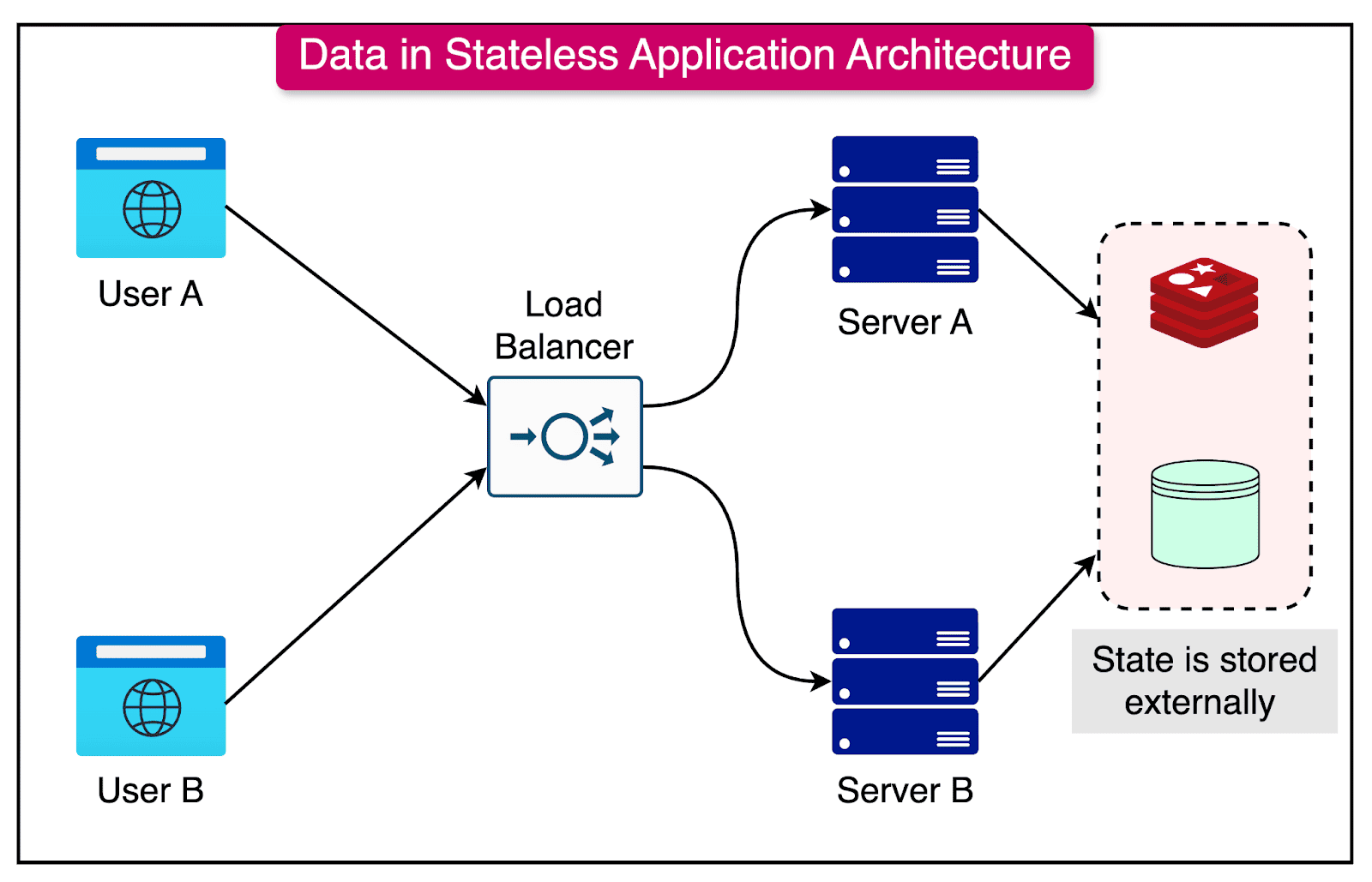
A Java-based session service required 50 servers for global operations. After being redesigned as a stateless Node.js microservice backed by Redis, it required 12 containers with better performance.
Top Tutorials

Technologies to Learn in 2026: Building the Future of Innovation
Explore the top technologies to learn in 2026 including Generative AI, Cloud, Cybersecurity, Web3, Data Science, AR/VR, Quantum, RPA, and Green Tech.

aws
This tutorial presents a structured, beginner-focused yet industry-aligned guide to Amazon Web Services, designed specifically for 2026 learning and career requirements
aws
This tutorial presents a structured, beginner-focused yet industry-aligned guide to Amazon Web Services, designed specifically for 2026 learning and career requirements

 in Bengaluru, India



All Courses (6)
Master's Degree (2)
Fellowship (2)
Certifications (2)

 PayPal’s Global Traffic and Concurrency Challenges


 in Bengaluru, India