

Your Success, Our Mission!
6000+ Careers Transformed.
Imagine This...
You’re taking a test on paper and writing digits quickly
Now imagine your phone camera scanning your sheet and instantly identifying every number you wrote correctly!
Sounds like sci-fi? Nope, that's Handwritten Digit Recognition, one of the most iconic projects in Machine Learning.
It’s the same tech behind:
Let’s uncover how it works behind the scenes.
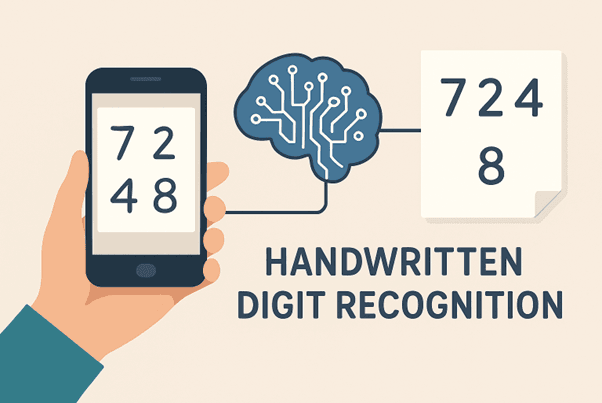
This project uses Image Classification teaching a model to recognize digits (0–9) from images of handwritten numbers.
The most famous dataset used is MNIST (Modified National Institute of Standards and Technology) which contains 70,000 grayscale images of handwritten digits, each 28x28 pixels.
Think of it like showing a child thousands of examples of numbers until they can identify any digit even in messy handwriting!
We use the MNIST dataset, preloaded in most ML libraries.
Each image is a small grid of pixels, with intensity values representing how dark the stroke is.
We normalize the pixel values (from 0–255 to 0–1) so the model can process them efficiently. Then we reshape the images to feed them into a neural network.
We use a Convolutional Neural Network (CNN) , a model that mimics how our brain processes visual patterns.
The CNN learns:
Each image passes through multiple layers, and the network adjusts itself until it accurately identifies the correct digit.
Finally, we test it with new, unseen digits to check if it predicts correctly and voilà! The machine reads handwriting flawlessly.
Code Example (Simplified)
import tensorflow as tf
from tensorflow.keras.datasets import mnist
from tensorflow.keras.models import Sequential
from tensorflow.keras.layers import Dense, Flatten, Conv2D, MaxPooling2D
from tensorflow.keras.utils import to_categorical
# Load Data
(x_train, y_train), (x_test, y_test) = mnist.load_data()

# Preprocessing
x_train = x_train.reshape(-1, 28, 28, 1) / 255.0
x_test = x_test.reshape(-1, 28, 28, 1) / 255.0
y_train = to_categorical(y_train)
y_test = to_categorical(y_test)

# Build Model
model = Sequential([
    Conv2D(32, (3,3), activation='relu', input_shape=(28,28,1)),
    MaxPooling2D(2,2),
    Flatten(),
    Dense(128, activation='relu'),
    Dense(10, activation='softmax')
])

# Compile and Train
model.compile(optimizer='adam', loss='categorical_crossentropy', metrics=['accuracy'])
model.fit(x_train, y_train, epochs=5, validation_data=(x_test, y_test))
This simple CNN can achieve ~99% accuracy on handwritten digit recognition!
Try building this project with your own handwriting images to see how well your model performs outside the MNIST dataset. That's where real learning happens!
Top Tutorials

Data Science
Learn Data Science for free with our data science tutorial. Explore essential skills, tools, and techniques to master Data Science and kickstart your career

MLOps
Dive into the fundamentals with our MLOPs tutorial. Learn MLOps best practices and streamline your ML operations for enhanced productivity and reliability.

ChatGPT
In this ChatGPT tutorial, learn how to use ChatGPT effectively. Master the art of conversational AI with our step-by-step lessons. Start to learn ChatGPT today!

 in Bengaluru, India



All Courses (6)
Master's Degree (2)
Professional Certifications (4)
Ideal for working professionals and graduates
Outcomes: 5-40 LPA Job + Masters Degree

 Iris Flower Classification


 in Bengaluru, India