

Your Success, Our Mission!
6000+ Careers Transformed.
Imagine this:
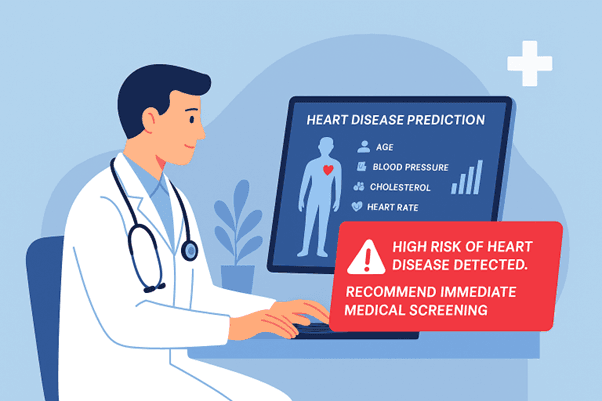
A doctor opens a dashboard, enters a patient’s health data age, blood pressure, cholesterol level and within seconds, an alert pops up:
“ High risk of heart disease detected. Recommend immediate medical screening.”
That’s not just technology that’s Machine Learning potentially saving a life.
Heart Disease Prediction is one of the most impactful ML projects in healthcare combining medical data and intelligent algorithms to predict risks before it’s too late.
This project teaches a machine how to recognize patterns in medical data that might signal heart issues.
Instead of waiting for symptoms, the model analyzes key health indicators like:
and predicts whether someone is at risk empowering doctors and patients to take preventive steps.
Data Collection
The dataset (like the Cleveland Heart Disease Dataset) includes thousands of patient records with labeled outcomes “1” for heart disease, “0” for healthy.
Data Preprocessing
Feature Selection
Identify which medical parameters matter most (e.g., chest pain type, resting ECG results, maximum heart rate achieved).
Using correlation heatmaps helps visualize which features strongly impact heart disease.
Model Training
Train ML algorithms like:
* Logistic Regression (for binary classification)
* Decision Tree or Random Forest (for complex decision paths)
* Support Vector Machine (SVM)
* Neural Networks (for deeper learning)
Model Evaluation
Measure performance using:
* Accuracy → Correct predictions
* Precision & Recall → Catching true patients without false alarms
* ROC Curve → Balancing sensitivity and specificity
Prediction
Input a new patient’s data → The model predicts:
“Low / Moderate / High risk of heart disease.”
A tool that helps doctors prioritize care and save precious time.
Technical Example (Python Code Snippet)
import pandas as pd
from sklearn.model_selection import train_test_split
from sklearn.preprocessing import StandardScaler
from sklearn.ensemble import RandomForestClassifier
from sklearn.metrics import classification_report, accuracy_score
# Load data
df = pd.read_csv('heart.csv')

# Split features and labels
X = df.drop('target', axis=1)
y = df['target']

# Train-test split
X_train, X_test, y_train, y_test = train_test_split(X, y, test_size=0.2, random_state=42)

# Scale data
scaler = StandardScaler()
X_train = scaler.fit_transform(X_train)
X_test = scaler.transform(X_test)

# Model
model = RandomForestClassifier(n_estimators=100, random_state=42)
model.fit(X_train, y_train)
preds = model.predict(X_test)

# Evaluation
print("Accuracy:", accuracy_score(y_test, preds))
print(classification_report(y_test, preds))
“Data can’t replace doctors but it can give them superpowers.”
Heart Disease Prediction is a perfect example of AI for Good using data science not just for efficiency, but for empathy.
Top Tutorials

Data Science
Learn Data Science for free with our data science tutorial. Explore essential skills, tools, and techniques to master Data Science and kickstart your career

MLOps
Dive into the fundamentals with our MLOPs tutorial. Learn MLOps best practices and streamline your ML operations for enhanced productivity and reliability.

ChatGPT
In this ChatGPT tutorial, learn how to use ChatGPT effectively. Master the art of conversational AI with our step-by-step lessons. Start to learn ChatGPT today!

 in Bengaluru, India



All Courses (6)
Master's Degree (2)
Professional Certifications (4)
Ideal for working professionals and graduates
Outcomes: 5-40 LPA Job + Masters Degree

 Iris Flower Classification


 in Bengaluru, India