

Your Success, Our Mission!
6000+ Careers Transformed.
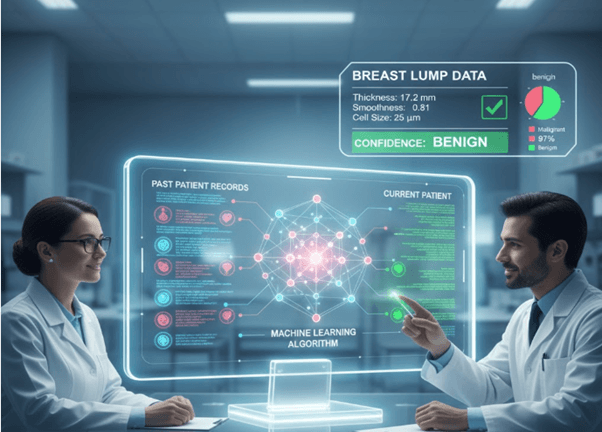
Imagine you’re working in a hospital lab. Doctors send you data about a breast lump:
things like its thickness, smoothness, and cell size.
You need to quickly decide:
“Is this tumor benign (non-cancerous) or malignant (cancerous)?”
Instead of relying only on manual analysis, we can build a Machine Learning model that has learned from hundreds of past patient records and can help doctors make faster, more accurate decisions.
from sklearn.datasets import load_breast_cancer
from sklearn.model_selection import train_test_split
from sklearn.linear_model import LogisticRegression
Step 2: Load the Breast Cancer dataset
data = load_breast_cancer()
X = data.data        # Features (measurements)
y = data.target      # Labels: 0 = malignant, 1 = benign
Step 3: Split data into training and testing sets
X_train, X_test, y_train, y_test = train_test_split(
    X, y, test_size=0.3, random_state=42, stratify=y
)
Step 4: Train the Logistic Regression model
model = LogisticRegression(max_iter=500)
model.fit(X_train, y_train)
Step 5: Evaluate the model
accuracy = model.score(X_test, y_test)
print("Model Accuracy:", round(accuracy * 100, 2), "%")
You’ll usually see an accuracy around 95–98% for this dataset.
| Step | What Happens | Why It’s Important |
|---|---|---|
| Data Loading | Loads tumor measurements and labels (benign/malignant) | Gives the model real medical data to learn |
| Train–Test Split | Splits data into training (learn) and testing (check) sets | Prevents overfitting and ensures fair evaluation |
| Model Training | Learns patterns in tumor measurements | B |
Machine Learning models can analyze:
These models learn patterns that humans might miss, such as tiny abnormalities or subtle changes in cells.
What it helps with:
Example:
AI tools like Google’s LYNA can detect breast cancer cells with very high accuracy, helping doctors catch early signs even in complex cases.
Machine Learning can analyze a patient’s lifestyle and medical data to predict their risk of developing diseases like:
ML models use factors such as:
Example:
Hospitals use ML-based “Heart Risk Scores” to identify which patients need urgent monitoring.
Screening is the process of quickly checking patients to see if they need further tests.
Machine Learning models are used to:
These tools act as a first filter before the doctor reviews the patient.
Example:
In many hospitals, AI systems automatically scan chest X-rays to flag possible pneumonia or lung cancer.
By doing this project, you will:
Learn to train, test, and evaluate a real-world model
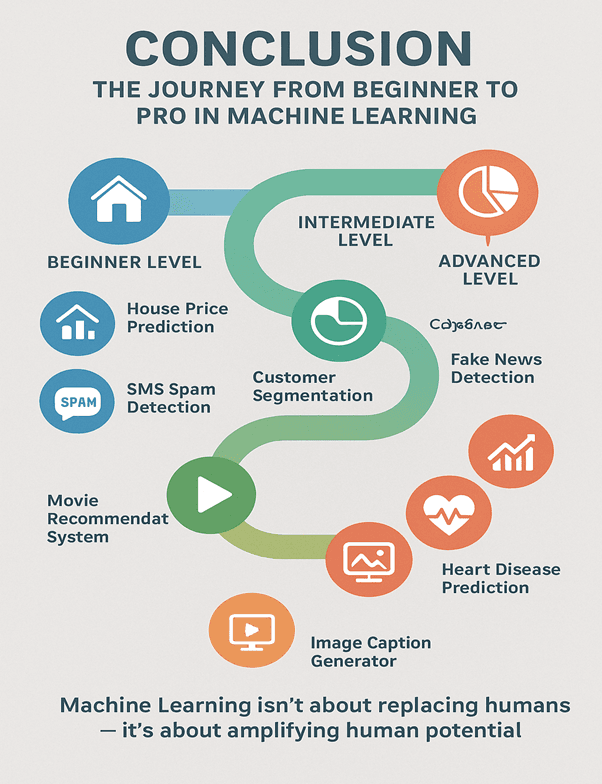
And there you have it a complete journey through Top 10 Machine Learning Projects, from predicting house prices to generating image captions!
Throughout this tutorial, you’ve witnessed how Machine Learning isn’t just about coding it’s about teaching machines to think, see, and decide. Each project took you one step closer to mastering how data transforms into intelligence.
Let’s quickly recap your adventure:
The Big Picture:
Machine Learning isn’t about replacing humans, it's about amplifying human potential. Whether it’s improving healthcare, enhancing shopping experiences, or making daily life smarter, ML is shaping a future where data drives decisions with precision and empathy.
Your Next Step:
Keep experimenting! Try combining these projects, tweak the models, and visualize the results in your own creative way.
Because in ML, every model you build is a story you teach your machine to tell.
Your learning journey doesn’t stop here!
Machine Learning is a vast universe and every project you’ve explored opens a doorway to something deeper.
To help you sharpen your skills, gain fresh insights, and stay ahead of the curve, here are some handpicked AlmaBetter resources that perfectly complement this tutorial.
From mastering ML algorithms and understanding real-world applications to exploring new project ideas these readings will transform your curiosity into expertise.
Top Tutorials

Data Science
Learn Data Science for free with our data science tutorial. Explore essential skills, tools, and techniques to master Data Science and kickstart your career

MLOps
Dive into the fundamentals with our MLOPs tutorial. Learn MLOps best practices and streamline your ML operations for enhanced productivity and reliability.

ChatGPT
In this ChatGPT tutorial, learn how to use ChatGPT effectively. Master the art of conversational AI with our step-by-step lessons. Start to learn ChatGPT today!

 in Bengaluru, India



All Courses (6)
Master's Degree (2)
Professional Certifications (4)
Ideal for working professionals and graduates
Outcomes: 5-40 LPA Job + Masters Degree

 Movie Recommendation System

 in Bengaluru, India