
Your Success, Our Mission!
6000+ Careers Transformed.
Imagine this:
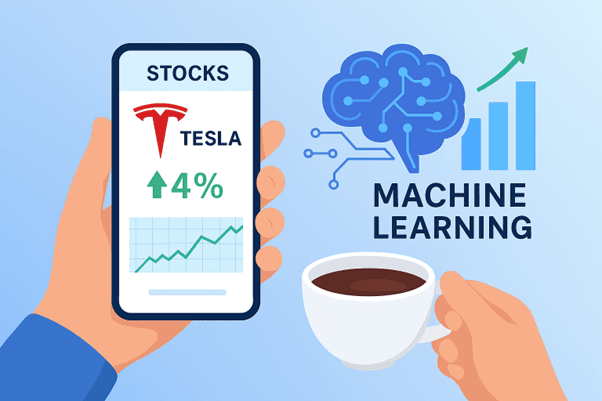
You open your trading app, sip your coffee, and your phone flashes:
“Tesla stock might rise by 4% tomorrow!”
Sounds like magic? Nope, that's Machine Learning at work again!
Stock Price Prediction is where data meets destiny using algorithms to peek into the financial future.
The stock market seems chaotic prices jump up and down based on countless factors:
But what if we could train a machine to find hidden patterns in this chaos?
That’s exactly what Stock Price Prediction does. It uses historical data, like past prices and trading volume, to forecast future trends. Think of it as teaching your computer to be a mini Warren Buffet minus the suit and tie!
Technical Example (Python + LSTM Neural Network)
import numpy as np
import pandas as pd
from tensorflow.keras.models import Sequential
from tensorflow.keras.layers import LSTM, Dense
from sklearn.preprocessing import MinMaxScaler
import matplotlib.pyplot as plt

# Load data
df = pd.read_csv('AAPL.csv')
data = df['Close'].values.reshape(-1, 1)

# Normalize
scaler = MinMaxScaler()
data_scaled = scaler.fit_transform(data)

# Create sequences
X, y = [], []
for i in range(60, len(data_scaled)):
    X.append(data_scaled[i-60:i, 0])
    y.append(data_scaled[i, 0])
X, y = np.array(X), np.array(y)

# Model
model = Sequential([
    LSTM(50, return_sequences=True, input_shape=(X.shape[1], 1)),
    LSTM(50),
    Dense(1)
])
model.compile(optimizer='adam', loss='mse')
model.fit(X, y, epochs=20, batch_size=32)

# Predict
predicted = model.predict(X)
plt.plot(y, label="Actual")
plt.plot(predicted, label="Predicted")
plt.legend()
plt.show()
Stock Price Prediction is like giving computers a telescope to see into the future of finance. While no model can guarantee profits, it empowers investors to make smarter, data-driven decisions instead of relying on gut feelings.
"In the world of trading, data is the new gold and Machine Learning is your treasure map."
Top Tutorials
Data Science
Learn Data Science for free with our data science tutorial. Explore essential skills, tools, and techniques to master Data Science and kickstart your career

MLOps
Dive into the fundamentals with our MLOPs tutorial. Learn MLOps best practices and streamline your ML operations for enhanced productivity and reliability.

ChatGPT
In this ChatGPT tutorial, learn how to use ChatGPT effectively. Master the art of conversational AI with our step-by-step lessons. Start to learn ChatGPT today!

 in Bengaluru, India



All Courses (6)
Master's Degree (2)
Professional Certifications (4)
Ideal for working professionals and graduates
Outcomes: 5-40 LPA Job + Masters Degree

 Stock Price Prediction -The Crystal Ball of Wall Street

 in Bengaluru, India