

Your Success, Our Mission!
6000+ Careers Transformed.
Algorithms are step-by-step procedures or instructions to solve problems efficiently. In Python, implementing algorithms is much easier due to its simple syntax and powerful libraries. Algorithms can be broadly categorized into searching, sorting, and optimization techniques, among others.
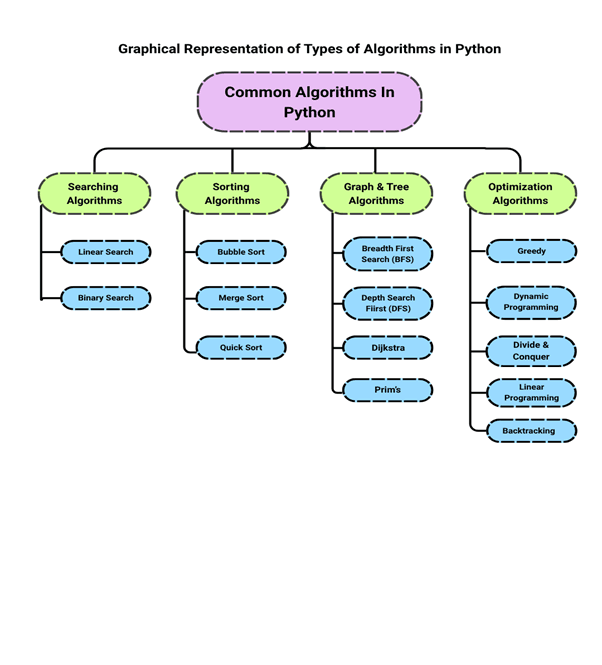
Searching Algorithms are techniques used to find the position or existence of a specific element within a collection of data such as an array, list, or database. They help in efficiently locating data without checking every element manually. Common searching algorithms include Linear Search and Binary Search, each with different performance and use cases.
Linear Search is the simplest searching technique where each element in a dataset is checked one by one until the target element is found. It works well on unsorted data, but can be inefficient for large datasets because it may need to examine every element. Its time complexity is O(n), where n is the number of elements.
In Python, linear search can be implemented using loops. The main operations performed in linear search are:
Linear search is widely used in small datasets, unsorted collections, or when simplicity is preferred over efficiency.
arr = [10, 25, 30, 45, 50]
x = 30

for i in range(len(arr)):
    if arr[i] == x:
        print("Element found at index:", i)
        break
Element found at index: 2
Binary Search is a more efficient searching technique that works on sorted arrays. It repeatedly divides the search space in half, comparing the target value with the middle element to determine whether to search the left or right half. This reduces the time complexity to O(log n), making it much faster than linear search for large datasets.
In Python, binary search can be implemented using loops or recursion. The main operations performed in binary search are:
Binary search is widely used in database lookups, dictionary searches, search engines, and any application involving large sorted datasets.
arr = [10, 20, 30, 40, 50]
x = 30
low, high = 0, len(arr) - 1

while low <= high:
    mid = (low + high) // 2
    if arr[mid] == x:
        print("Element found at index:", mid)
        break
    elif arr[mid] < x:
        low = mid + 1
    else:
        high = mid - 1
Element found at index: 2
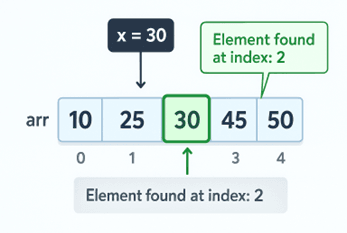
Binary Search is a more efficient searching technique that works on sorted arrays. It repeatedly divides the search space in half, comparing the target value with the middle element to determine whether to search the left or right half. This reduces the time complexity to O(log n), making it much faster than linear search for large datasets.
In Python, binary search can be implemented using loops or recursion. The main operations performed in binary search are:
Binary search is widely used in database lookups, dictionary searches, search engines, and any application involving large sorted datasets.
arr = [10, 20, 30, 40, 50]
x = 30
low, high = 0, len(arr) - 1

while low <= high:
    mid = (low + high) // 2
    if arr[mid] == x:
        print("Element found at index:", mid)
        break
    elif arr[mid] < x:
        low = mid + 1
    else:
        high = mid - 1
Element found at index: 2
Top Tutorials

Python
Python is a popular and versatile programming language used for a wide variety of tasks, including web development, data analysis, artificial intelligence, and more.

SQL
The SQL for Beginners Tutorial is a concise and easy-to-follow guide designed for individuals new to Structured Query Language (SQL). It covers the fundamentals of SQL, a powerful programming language used for managing relational databases. The tutorial introduces key concepts such as creating, retrieving, updating, and deleting data in a database using SQL queries.

Data Science
Learn Data Science for free with our data science tutorial. Explore essential skills, tools, and techniques to master Data Science and kickstart your career

 in Bengaluru, India



All Courses (6)
Master's Degree (2)
Professional Certifications (4)
Ideal for working professionals and graduates
Outcomes: 5-40 LPA Job + Masters Degree

 Searching Algorithms


 in Bengaluru, India